

- Due upon receipt means the full amount is owed on the day the client receives the invoice, with no grace period.
- Xero data shows US small businesses waited an average of 29.3 days to be paid in the June 2026 quarter, so the term sets expectations but not the real payment date.
- Write the exact due date next to the term, keep proof of when you sent the invoice, and agree any late fee in writing first.
"Due upon receipt" means the client owes the full amount the moment the invoice reaches them, with no grace period. The due upon receipt meaning is about timing, not about a late fee or a deadline in days. This guide shows what the term requires, how it differs from Net 30, and the exact wording to put on your invoice.
What does due upon receipt mean on an invoice?
Due upon receipt means the payment date is the day the client receives the invoice. Payment due upon receipt gives the client no extra days. If you email the invoice on October 14, 2026, the full amount is owed on October 14, 2026, regardless of when the client opens the message or reviews the attachment.
Due on receipt means the same thing as due upon receipt. Both phrases are payment terms. Payment terms are the part of an invoice that says when and how the client should pay. Suppliers also write them as "Due on Receipt" in a terms box or as a line near the total.
To define upon receipt in one sentence: the clock starts when the client gets the document, not when you finish the work. That makes the term different from "due immediately", which says nothing about delivery. It is also different from a fixed date, such as "due October 31, 2026".
The term is a contractual arrangement rather than a statutory requirement, because no US statute sets a standard meaning of "receipt" for private invoices. The words only work if your invoice, quote or contract states them clearly and consistently.
How is due on receipt different from Net 30?
Net 30 is a payment term that gives the client 30 days from the invoice date, while due on receipt gives zero days. The two terms sit at opposite ends of the range most invoices use. Net 15 and Net 60 fall between and beyond them.
Here is how the common terms compare on one invoice sent on October 14, 2026:
| Term | Payment due date | Days allowed |
|---|---|---|
| Due on receipt | October 14, 2026 | 0 |
| Net 7 | October 21, 2026 | 7 |
| Net 15 | October 29, 2026 | 15 |
| Net 30 | November 13, 2026 | 30 |
| Net 60 | December 13, 2026 | 60 |
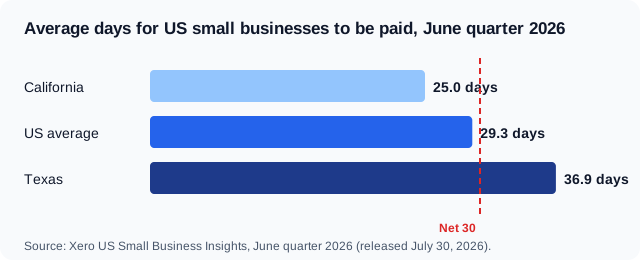
In practice, due on receipt rarely means that cash arrives on the same day, even when the client intends to pay promptly. Xero's small business data for the June quarter of 2026 shows US businesses waited an average of 29.3 days to be paid, according to the Xero US Small Business Insights release of July 30, 2026. Invoices arrived 8.5 days late on average in the same period.
The same release shows how much the state matters. California businesses were paid in 25 days, while Texas businesses waited 36.9 days. A term of due on receipt establishes your expectation, but your client's accounting habits and approval process determine the real payment date.
When should you use due upon receipt?
Use due upon receipt when the work is finished, the amount is known and the client has no approval process. That covers most one-off jobs for individuals and very small businesses. It suits a plumber's repair call, a photographer's final delivery or a freelancer's single deliverable.
Avoid the term in four situations, because each of them makes immediate payment unrealistic or hard to prove:
- The client is a larger company with an accounts-payable cycle. Their system will pay on its own schedule, whatever your invoice says.
- The contract already names a term. A master services agreement usually overrides the invoice.
- The invoice needs approval from a third party, such as an insurer or a general contractor.
- You send the invoice by post. You cannot prove when it was received.
If you want fast payment from a business client, a short, specific term often works better than an immediate one. Net 7 or Net 10 sounds firm without being impossible to meet. The term should match how the client really pays.
What counts as "receipt" when you email an invoice?
For an emailed invoice, receipt is the moment the message is delivered to the client's inbox. Keep the sent email and its delivery timestamp. The late fee calculator shows what a fee adds over time. That timestamp is your proof of the due date if a payment is disputed.
Three habits protect you:
- Put the invoice date and the due date on the invoice itself, even when the term is due on receipt.
- Email the PDF the same day you date it. A gap between the invoice date and the send date creates arguments.
- Ask the client to confirm receipt on a first invoice, especially for amounts above a few hundred dollars.
Writing the exact date next to the term removes the ambiguity. "Due upon receipt (October 14, 2026)" cannot be misread. The post titled How to write an invoice: what it looks like, with Excel steps shows where each field goes.
Worked example: a $1,850 invoice under due on receipt
A $1,850 invoice with due on receipt terms is owed in full on its issue date, and a monthly late fee of 1.5 percent adds $27.75 per month. The example below uses a freelance web designer. All figures are illustrative.
| Line | Amount |
|---|---|
| Homepage design, 10 hours at $125 | $1,250.00 |
| Mobile layout, 4 hours at $125 | $500.00 |
| Stock images | $100.00 |
| Total due upon receipt | $1,850.00 |
The invoice number is 2026-0147, dated October 14, 2026, with the note "Payment due upon receipt." If the client has not paid by November 13, 2026, one month of a 1.5 percent fee equals $27.75 (0.015 × $1,850).
State rules limit late fees and interest. Some states cap the rate a business can charge, and a fee must usually be stated before the work starts. Put the fee in your quote or contract, and state it on the invoice. Do not add a fee that the client never agreed to.
The example shows why the wording matters. Under Net 30 the same invoice would not be late until November 14, 2026. Under due on receipt, it is late the day after it is issued. Many clients treat it as a polite suggestion, so a reminder is still part of the process.
How do you write due on receipt on an invoice?
Write the term in the payment terms box, next to the total, in plain words. A clear invoice has the term in three places: the header, the total and the footer note. Use a single version of the phrase throughout.
Here is a short wording set you can copy:
- Standard: "Payment due upon receipt."
- With the date: "Due upon receipt, October 14, 2026."
- With a late fee: "Due upon receipt. A 1.5 percent monthly fee applies to balances unpaid after 30 days."
- With payment methods: "Due upon receipt by ACH, card or check."
Pair the term with an invoice number so the client can quote it. The post What is an invoice number? How to number invoices covers numbering schemes that stop duplicates. A clean number and a clear term together cut the questions you get after sending.
What does the law say about late payment in the US and UK?
The US generally has no federal law that sets interest on late private invoices, so the contract and state law decide. Your invoice terms are the evidence. A term that says due on receipt, plus an agreed late fee, is the strongest position you can take.
The UK works differently. Statutory interest on late business debts is 8% plus the Bank of England base rate, according to GOV.UK guidance on charging interest on commercial debt. On a £2,000 invoice, the 8% part alone comes to about 44p per day before the base-rate portion.
The UK is also tightening payment terms. In its response of March 24, 2026, the government said it would cap business-to-business payment terms at 60 days. Some 66% of consultation respondents supported the cap and 27% disagreed, according to the Mayer Brown summary of the late payment consultation response. The cap would take effect no earlier than 2027.
The proposed cap has exemptions. It would not apply where both parties are large companies, where the smaller business is the buyer, or for imports and exports. A term of due on receipt sits far inside the proposed limit, so the change does not affect it.
Does due on receipt help you get paid faster?
Due on receipt helps most with small clients and one-off jobs, and helps least with companies that pay on a cycle. The term does not change the client's process. It changes their expectation and your right to chase.
Three practices matter considerably more than the phrase itself, and each one is within your control:
- Send the invoice the day the work ends. Delay moves your payment date by the same number of days.
- Offer a payment link. A client who can pay in one click does not wait for a check run.
- Chase on day one after the due date. A short, polite reminder works better than silence for a week.
Treat the term as a starting point for the conversation rather than a guarantee of fast payment. Combine it with a deposit on larger jobs, and you reduce the amount left at risk. Invoqk builds the invoice, the payment terms and the PDF from a plain description of the job. Start with the invoice generator and the wording stays consistent from one invoice to the next.
Key points to remember
Due upon receipt means the full amount is owed on the day the client receives the invoice. It is a contract term with no statutory definition in the US. Averages from Xero show most US small businesses are still paid in about 29 days, so the real date depends on your client.
Write the exact date next to the term. Questions or corrections are welcome on the contact page, and the about page explains who writes these guides. Keep proof of when you sent the invoice. State any late fee in writing before the work begins, and check your state's limits on fees and interest.
Frequently asked questions
What does due upon receipt mean?
Due upon receipt means the client must pay the full invoice amount as soon as they receive it. There is no grace period or net days. If you email an invoice on October 14, 2026, the amount is owed that same day under the agreed terms.
Is due on receipt the same as due immediately?
Due on receipt and due immediately both ask for fast payment, but receipt ties the date to delivery of the invoice. Immediately gives no anchor point. Writing the exact date next to either phrase removes doubt about when the payment is late.
How is due upon receipt different from Net 30?
Net 30 gives the client 30 days from the invoice date to pay. Due upon receipt gives none. An invoice dated October 14, 2026 is owed on October 14 under due upon receipt and on November 13, 2026 under Net 30.
Can I charge a late fee on an invoice that is due upon receipt?
Yes, if the client agreed to the fee in a quote or contract before the work and your state allows it. Put the fee rate on the invoice as well. A fee the client never saw is hard to collect and may be limited by state law.
What is statutory interest on late invoices in the UK?
UK statutory interest on late business debts is 8% plus the Bank of England base rate, according to GOV.UK. A contract can set a different rate in some cases. Interest cannot be lower for public authority customers.
Comments
0No comments yet
Be the first to share your thoughts on this article.
Leave a comment
Your email is never published. Comments appear after approval.