
- Send four collection emails on day 1, 7, 14 and 21 after the due date, moving from a friendly nudge to a final notice.
- Every email names the invoice number, amount, due date and days overdue, attaches the invoice and asks for one specific payment date.
- UK suppliers can add statutory interest and a fixed sum of 40, 70 or 100 pounds, German suppliers a 40 euro flat fee, and US charges depend on the contract.
A collect payment email is a written message that asks a customer to pay an overdue invoice. It names the invoice, the amount and the date it was due, and it tells the customer what to do next. Sent at the right time and in the right tone, it recovers most unpaid invoices without a lawyer, an agency or a phone call.
In short: send four emails over three weeks, on day 1, day 7, day 14 and day 21 after the due date. Move from a friendly nudge to a firm notice to a final notice, and put the invoice number in every subject line.
This guide gives you the subject line, the send day and the full wording for each email. It also covers what each country allows you to add for late payment, and the mistakes that make a customer ignore you.
What should a payment collection email contain?
A payment collection email should contain the invoice number, the amount, the original due date, how many days late it is and one clear request. The request is what separates a collection email from a complaint. "Please pay $3,200 by Friday" can be answered. "I am disappointed" cannot.
Every email in the sequence carries the same six facts:
- The invoice number and issue date.
- The amount owed, in the invoice currency.
- The due date and the number of days overdue.
- How to pay: bank details, a reference or a payment link.
- The invoice attached again as a PDF.
- A date by which you expect payment.
Keep each email under 120 words. A short email gets read, and a long one gets filed.
When should you send each collection email?
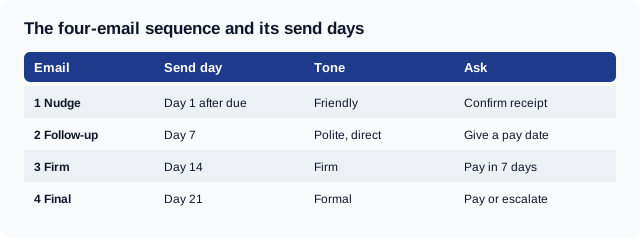
Send the first collection email the day after the due date, then follow the schedule below. The spacing gives the customer time to act while keeping the debt fresh in their mind.
| Send day | Tone | The ask | |
|---|---|---|---|
| 1. Nudge | Day 1 after due date | Friendly | Confirm they received the invoice |
| 2. Follow-up | Day 7 | Polite and direct | Give a payment date |
| 3. Firm notice | Day 14 | Firm | Pay within 7 days; late charges mentioned |
| 4. Final notice | Day 21 | Formal | Pay by a stated date or you escalate |
An optional reminder on the due date, or three days before it, costs nothing and prevents many late payments. Invoqk's payment reminder email generator writes that pre-due message.
For example, an invoice for $3,200 is due on October 15, 2026. The four emails go out on October 16, October 22, October 29 and November 5. Count the days from the due date, not from the invoice date, because the customer is only late after the due date.
Email 1: the friendly nudge (day 1)
The first email assumes the customer forgot, not that they refuse to pay. Most late payments start as an oversight, so a warm tone keeps the relationship intact and still gets paid.
Subject lines to choose from:
- "Invoice 1042: quick check that you received it"
- "Friendly reminder: invoice 1042 was due October 15"
- "Did invoice 1042 reach you?"
Wording:
Hi Sam,
A quick note: invoice 1042 for $3,200.00 was due on October 15, 2026, and I can't see the payment yet. The invoice is attached again for convenience.
If it has already been sent, thank you, and please ignore this message. If not, you can pay by bank transfer using reference 1042.
Thanks, Dana
This email asks one thing: confirm receipt or pay. It does not accuse anyone. If the customer replies that they never got the invoice, the problem is yours to fix, and you now know it on day 1 instead of day 30.
Email 2: the follow-up that asks for a date (day 7)
The second email asks for a specific payment date. Specific dates turn a vague promise into a commitment you can check.
Subject lines to choose from:
- "Invoice 1042, $3,200.00: when can we expect payment?"
- "Following up on invoice 1042 (7 days overdue)"
- "Re: invoice 1042: payment date?"
Wording:
Hi Sam,
I'm following up on invoice 1042 for $3,200.00, which was due on October 15, 2026 and is now 7 days overdue. I haven't heard back since my last note.
Could you let me know the date you expect to pay? If something is holding up the payment, such as a missing purchase order number or an approval, tell me and I'll sort it out today.
Thanks, Dana
The sentence about a missing purchase order matters. Many business invoices stall in an approval queue because a reference is missing, and offering to fix it gives the customer an easy way to move forward. Reply to your own earlier thread so the history stays visible.
Email 3: the firm notice (day 14)
The third email changes tone. It states the consequence of further delay and sets a deadline of seven days.
Subject lines to choose from:
- "Overdue: invoice 1042, $3,200.00, payment needed by October 29"
- "Second notice: invoice 1042 is 14 days overdue"
- "Action needed: invoice 1042"
Wording:
Hi Sam,
Invoice 1042 for $3,200.00 was due on October 15, 2026 and is now 14 days overdue. I have not received payment or a reply to my two earlier emails.
Please pay in full by October 29, 2026. Under the terms on the invoice, a late fee of 1.5% per month applies from the due date, and I will add it to the balance if payment is not received by that date.
If there is a dispute about the work, tell me by return and I will respond within two business days.
Regards, Dana Ruiz
Mention a late fee only if your contract or invoice terms already allow it. A fee you invented after the fact is hard to enforce and damages trust. The late fee calculator shows what a stated rate adds on a given invoice.
This email also invites a dispute. That is deliberate, because a customer who disputes the work is telling you why they have not paid, and you can then deal with the real issue.
Email 4: the final notice (day 21)
The fourth email is formal. It states the next step, and it gives a last date.
Subject lines to choose from:
- "Final notice: invoice 1042, $3,200.00"
- "Final reminder before further action: invoice 1042"
- "Invoice 1042: payment required by November 12"
Wording:
Dear Sam,
This is a final notice for invoice 1042 for $3,200.00, due on October 15, 2026 and now 21 days overdue. I have written to you on October 16, October 22 and October 29.
Please pay in full by November 12, 2026. If I do not receive payment by then, I will pass the matter to a collection service or begin a small claims action, and I will add the costs allowed by our agreement.
The invoice and a copy of our signed agreement are attached.
Sincerely, Dana Ruiz Ruiz Design
Only say you will escalate if you are prepared to do it. An empty threat teaches the customer that your deadlines are soft. Follow the final notice with a phone call on the same day, because some customers respond to a voice when they ignore an inbox.
What do the subject lines need to do?
A collection email subject line needs to identify the invoice, signal the urgency and avoid triggering a spam filter. The invoice number lets the customer's accounts team search for it, and the amount shows it is not a mass mailing.
| Do | Don't |
|---|---|
| Put the invoice number first | Write "URGENT!!!" in capitals |
| Include the amount | Use "Final demand" in the first email |
| State the days overdue | Leave the subject blank or vague |
| Use "Re:" on follow-ups in the same thread | Start a new thread each time |
Keep subject lines under 60 characters where you can, since mobile mail apps cut off long ones. Use plain text. Heavy formatting and attachments with unusual file types raise the chance of the email landing in spam.
What can you charge for a late payment in the USA, the UK and Germany?
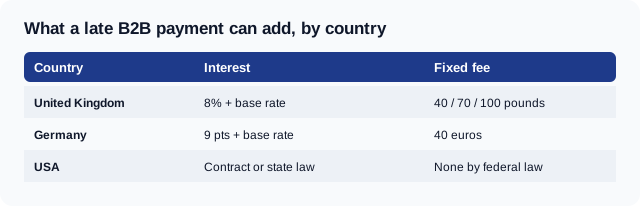
What you can add depends on the country and on your written terms. The table summarises the position for business-to-business invoices.
| Country | Interest | Fixed fee |
|---|---|---|
| United Kingdom | 8% plus the Bank of England base rate | £40, £70 or £100 by debt size |
| Germany | 9 percentage points above the base rate | €40 flat fee |
| USA | Set by contract or state law | None under federal law |
Late payment charges in the UK
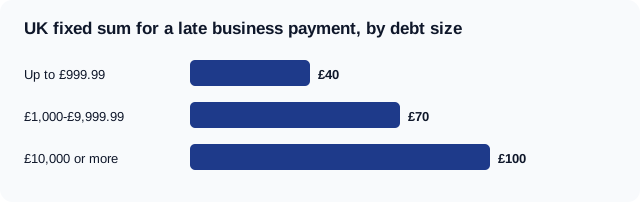
In the UK, statutory interest on a late payment between businesses is 8% plus the Bank of England base rate, according to GOV.UK guidance on charging interest. You can also charge a fixed sum: £40 for a debt up to £999.99, £70 for £1,000 to £9,999.99, and £100 for £10,000 or more, according to the GOV.UK page on debt recovery costs. You can only charge it once for each payment. You cannot claim statutory interest if the contract sets a different rate of interest.
Late payment charges in Germany
In Germany, a debtor on a business claim pays interest at 9 percentage points above the base rate, and the creditor can claim a flat fee of €40 when the debtor is in default, according to BGB section 288. Default occurs at the latest 30 days after the claim is due and the invoice is received, according to BGB section 286. A written reminder (a Mahnung) can start default earlier, so Email 2 or Email 3 doubles as that reminder when it states the due date and asks for payment.
Late payment charges in the USA
The USA has no federal statute that adds interest or a fee to a late business invoice. Your contract, quote or invoice terms decide, and state law may cap the rate. Write the late fee into the agreement before the work starts.
The federal Fair Debt Collection Practices Act (FDCPA) covers consumer debts, which it defines as obligations arising from transactions primarily for personal, family or household purposes, according to 15 U.S.C. section 1692a. A business invoice sent to another business is outside that definition. If your customer is a private individual, state rules may apply, so read them before you escalate.
This is general information, not legal advice. A dispute over a large amount deserves a lawyer's review.
What mistakes make a collection email fail?
Most collection emails fail for avoidable reasons, such as a missing invoice or an angry tone. Check the list before you press send.
| Mistake | Why it fails | Fix |
|---|---|---|
| No invoice attached | The customer has nothing to forward to accounts | Attach the PDF every time |
| Emotional language | It invites a defensive reply | State facts and dates only |
| No payment date requested | The customer has no deadline | Name the date |
| Threatening what you won't do | Credibility is lost | Only state real next steps |
| Writing to the wrong person | The invoice sits with someone who cannot pay | Send to accounts payable and your contact |
| Sending too late | The debt goes cold | Start on day 1 |
| Mixing disputes with collection | The real issue stays unresolved | Ask whether there is a dispute |
Consider the contact point as well. A project manager may love your work and still have no control over payment. Ask for the name and email of the person in accounts payable when you start the job, and copy them in from the first reminder.
How do you stop needing collection emails?
You need fewer collection emails when you make payment easier and the deadline obvious. These habits cut the number of late invoices.
- Send the invoice the day the work is finished.
- Put the actual due date on it, not just "Net 30".
- Add bank details, a reference and a payment link.
- Ask for a deposit on larger jobs.
- Send a reminder before the due date.
- Keep a record of every reminder you send, with the date.
Invoqk's invoice generator puts the due date, the payment details and the late-payment terms on the invoice, so the later emails have something specific to point to.
Key points
Send four emails on day 1, 7, 14 and 21 after the due date. Put the invoice number in every subject line, attach the invoice every time and ask for one specific thing. State only the charges your terms and your country allow, and only threaten what you will do.
Frequently asked questions
What should I write in a collect payment email?
Write the invoice number, amount, original due date and days overdue, then ask for payment by a stated date. Attach the invoice again and include payment details. Keep it under 120 words, stay factual, and say what happens next if the date passes.
How many collection emails should I send before escalating?
Send four over three weeks: day 1, day 7, day 14 and day 21 after the due date. The fourth is a final notice with a deadline. Call the customer on the day you send the fourth one, and keep a note of what was said.
When is the first collection email appropriate?
The day after the due date. Most late payments are oversights, so a friendly first message is usually enough. An optional reminder before the due date prevents many late payments altogether, and costs nothing to send.
Can I charge interest in a collection email?
Only if your contract or invoice terms allow it, or the law provides it. In the UK and Germany, statutory interest and a fixed fee exist for business debts. In the USA, your contract decides, so state the rate in your terms before the work starts.
Is a collection email legally binding?
An email is a written notice, not a court order. It can start default in some countries, such as Germany, and it creates a record you can show later. Keep every email with its date and the invoice attached, because that record supports any later claim.
Comments
0No comments yet
Be the first to share your thoughts on this article.
Leave a comment
Your email is never published. Comments appear after approval.