

- A Net 60 due date is the invoice date plus 60 calendar days, so an invoice dated November 4, 2026 is due January 3, 2027.
- EOM terms count from the end of the invoice month, so Net 30 EOM on that invoice is due December 30, 2026.
- At an 8% cost of money, waiting 60 days costs about $131.51 per $10,000 invoice, which is $65.76 more than Net 30.
Net 60 is a payment term that gives the customer 60 days from the invoice date to pay the full amount. Net 30 gives 30 days and Net 45 gives 45. The number after "Net" is the count of calendar days, and the clock starts on the date the term names.
In short: add the number of days to the invoice date to get the due date. Add them to the end of the month instead if the term says EOM. A longer term is a free loan to your customer, and the cost of that loan lands on your cash flow.
This guide works through due dates for one real invoice, explains the EOM and early-payment-discount variants, shows what each term costs you, and gives the legal default in the USA, the UK and Germany.
What do Net 30, Net 45 and Net 60 mean?
In commercial practice these abbreviations originate from trade credit conventions, under which the supplier extends unsecured financing to the purchaser for a predetermined interval. Understanding that arrangement as a form of lending, rather than as a mere administrative deadline, explains why suppliers negotiate payment periods so carefully.
A net term is a payment term that states how many days a customer has to pay an invoice in full. "Net" means the full amount with no discount. "30", "45" or "60" is the number of calendar days counted from the invoice date.
Net terms are written in one of several ways on an invoice:
- "Net 30" or "Net 30 days".
- "Payment due within 60 days of invoice date".
- A fixed due date, such as "Due December 4, 2026".
Weekends and public holidays count. If day 30 falls on a Sunday, the invoice is still due on that Sunday unless the contract says otherwise. In practice, most customers pay on the next working day.
How do you calculate a due date with a Net 60 calculator?
You calculate a due date by adding the term's days to the invoice date, counting every calendar day. The invoice date itself is day zero, so a Net 30 invoice dated November 4 is due on December 4.
Follow these steps:
- Write down the invoice date. Use the issue date, not the date work finished.
- Add the number of days from the term.
- Roll the date across month ends using the real month lengths.
- Write the result as a date, not as "30 days", on the invoice.
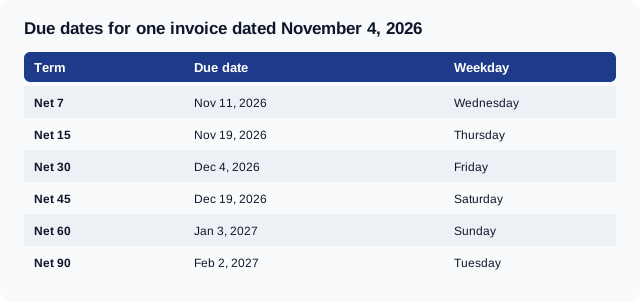
Invoqk's invoice due date calculator does this arithmetic for any term. The table below shows the answer for one invoice dated Wednesday, November 4, 2026.
| Term | Days added | Due date | Weekday |
|---|---|---|---|
| Net 7 | 7 | November 11, 2026 | Wednesday |
| Net 15 | 15 | November 19, 2026 | Thursday |
| Net 30 | 30 | December 4, 2026 | Friday |
| Net 45 | 45 | December 19, 2026 | Saturday |
| Net 60 | 60 | January 3, 2027 | Sunday |
| Net 90 | 90 | February 2, 2027 | Tuesday |
Notice that Net 45 and Net 60 both land on a weekend here. Writing the actual date on the invoice removes any argument about when the day count starts.
What does EOM mean in Net 30 EOM?
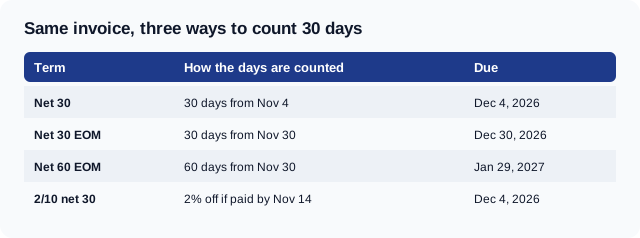
EOM means end of month. A Net 30 EOM term counts its 30 days from the last day of the invoice month, not from the invoice date. The customer therefore gets the rest of the month plus 30 days.
Using the same invoice dated November 4, 2026:
| Term | Count starts | Due date |
|---|---|---|
| Net 30 | November 4 | December 4, 2026 |
| Net 30 EOM | November 30 | December 30, 2026 |
| Net 60 EOM | November 30 | January 29, 2027 |
The extra time depends on when in the month you invoice. An invoice dated November 1 gets 29 extra days under EOM. An invoice dated November 30 gets none. If you bill at the start of the month, EOM terms are much more generous to the customer than they look.
What is a 2/10 net 30 early-payment discount?
A 2/10 net 30 term is a payment term that gives a 2% discount if the customer pays within 10 days, and otherwise requires full payment within 30 days. The first number is the discount percentage and the second is the discount window in days.
On a $10,000 invoice dated November 4, 2026:
- Paid by November 14: the customer pays $9,800.
- Paid after November 14 and by December 4: the customer pays $10,000.
The discount looks small but is expensive for you. Giving 2% to be paid 20 days sooner works out to an annualised cost of about 37%. The calculation is (2 ÷ 98) × (365 ÷ 20) = 0.372. Offer a discount only if your own cost of waiting is higher than that.
What does each payment term cost you?
Economically, trade credit represents an involuntary investment in the customer's working capital, and the opportunity cost grows proportionally with both the invoice amount and the length of the permitted payment period. Quantifying that opportunity cost before accepting a contract is considerably more reliable than estimating it afterwards.
Each extra day of credit costs you the interest on the money you are owed. Suppose your cost of money is 8% a year, whether that is an overdraft rate or what the cash could earn. The 8% rate is an assumption for this example, so replace it with your own.
The cost on a $10,000 invoice is $10,000 × 8% ÷ 365 × days:
| Term | Days | Cost of waiting |
|---|---|---|
| Net 15 | 15 | $32.88 |
| Net 30 | 30 | $65.75 |
| Net 45 | 45 | $98.63 |
| Net 60 | 60 | $131.51 |
| Net 90 | 90 | $197.26 |
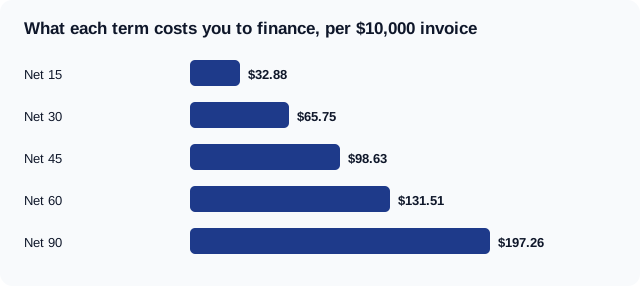
Net 60 costs $65.76 more than Net 30 on the same invoice. Multiply by the number of invoices to see the yearly cost. A business that bills $500,000 a year on Net 60 instead of Net 30 carries about $41,000 more in unpaid invoices at any moment ($500,000 ÷ 365 × 30).
The cost is not only interest, because a longer term also raises the probability that the customer disputes the invoice, forgets it during a busy quarter, or becomes insolvent before the money reaches your account. A supplier who depends on a handful of large customers should therefore treat an extended term as a credit decision, not as a clerical detail of the invoice.
Which payment term should you choose?
Choose the shortest term your customer will accept without losing the work. Use this decision rule.
- Individual consumers and small jobs: due on receipt or Net 7.
- Freelancers and small businesses as customers: Net 14 or Net 30.
- Mid-size business customers with an accounts payable process: Net 30 is standard; expect them to ask for Net 45 or Net 60.
- Large corporate or public buyers: they often impose Net 60 or longer in their purchase terms.
If a large customer demands Net 60, consider a deposit, a milestone invoice or a small price uplift to cover the cost of waiting. Compare the cost table above with the price increase that would be needed to recover the financing expense, and decide whether the contract is still worth taking at the longer term. Many suppliers find that a deposit of 25% to 30% at the start of the job removes most of the exposure while leaving the customer's preferred term on the balance.
Due on receipt is the shortest option. The pros and cons of that term are a separate topic from the net terms here.
What does the law say about payment terms?
Statutory provisions regulating commercial payment periods differ substantially between jurisdictions, and contractual arrangements generally override the statutory default wherever the legislature permits such flexibility. Consequently, the explicit written agreement remains the principal protection available to a supplier.
The legal default applies only when you and the customer have not agreed a date. Each country sets its own default and its own limits.
Payment terms in the USA
The United States has no federal law that sets a default payment term between businesses. The invoice or contract terms govern, and late interest applies only if the contract or a state law provides for it. Because nothing in federal law fills the gap, the safest approach for a US supplier is to put the term and any late fee in writing before the work starts, ideally in a signed quote or contract that the invoice then refers to.
Payment terms in the UK
If you do not agree a payment date in the UK, the law says payment is late 30 days after the customer receives the invoice or after you deliver the goods or services, whichever is later, according to GOV.UK guidance on when a payment becomes late. The same page says an agreed date for business transactions must usually be within 60 days. A longer period is allowed if it is fair to both businesses.
Statutory interest on a late commercial debt is 8% plus the Bank of England base rate, according to the GOV.UK page on charging interest on a commercial debt.
Payment terms in Germany
In Germany, a debtor of a monetary claim falls into default at the latest 30 days after the claim falls due and the invoice is received, according to BGB section 286(3). For a consumer, that rule applies only if the invoice specifically pointed out this consequence. Interest between businesses is 9 percentage points above the base rate and a €40 flat fee applies, according to BGB section 288.
The reminder you send after a missed date is a separate step. The late fee calculator shows what a missed Net 30 or Net 60 date can add to the bill.
How do you write payment terms on an invoice?
Write the term as both a rule and a date, so nobody has to count. A clear line leaves no room for disagreement.
Copy-paste wording:
- "Payment terms: Net 30. Due December 4, 2026."
- "Payment terms: Net 60 EOM. Due January 29, 2027."
- "Payment terms: 2/10 net 30. Pay by November 14, 2026 to deduct 2%. Full amount due December 4, 2026."
- "Late payments incur interest at [rate] per year from the due date."
Add the due date, the bank details and a payment reference on the same invoice. The sample invoice formats show where each line goes, and the invoice generator at Invoqk fills in the due date from the term you pick.
Common mistakes with net terms
Most disputes about net terms come from unclear counting rather than bad faith. Avoid these.
| Mistake | What happens | Fix |
|---|---|---|
| Writing only "Net 30" | Dispute over where the 30 days start | Add the actual due date |
| Counting from delivery when the invoice is later | Customer says it is not due yet | State "from invoice date" |
| Forgetting EOM adds time | Cash arrives weeks later than planned | Calculate the real date |
| Agreeing Net 60 and no late terms | No consequence for being late | Write the interest and fee |
| Sending the invoice late | The clock starts late | Invoice on the day of delivery |
| Offering 2/10 net 30 by habit | Costs about 37% a year | Only offer if you need the cash |
Key points
Add the term's days to the invoice date, or to the month end for EOM. Write the real due date on the invoice. Longer terms cost real money, so price them in. Know the default in your country if nothing is agreed.
Frequently asked questions
How do you calculate a Net 60 due date?
Add 60 calendar days to the invoice date. An invoice dated November 4, 2026 is due January 3, 2027. Weekends and holidays count, so write the actual date on the invoice to avoid a dispute. The count starts on the invoice date, which is day zero.
What does Net 30 EOM mean?
Net 30 EOM means 30 days counted from the end of the invoice month. An invoice dated November 4, 2026 is due December 30, 2026. The customer gets the rest of the month plus 30 days, so an invoice sent at the start of a month gives much more time than one sent at the end.
Is Net 60 a good payment term?
Net 60 is good for the customer and costly for you. At an 8% cost of money, it costs about $131.51 per $10,000 invoice to wait 60 days. Accept it only if the customer is worth the delay, or price the cost of waiting into the quote, or ask for a deposit to offset it.
What is the default payment term if none is agreed?
In the UK, payment is late 30 days after the invoice or delivery, whichever is later. In Germany, default arises at the latest 30 days after the due date and invoice receipt. The USA has no federal default, so write the term into the contract or invoice.
What does 2/10 net 30 mean?
It means a 2% discount if the invoice is paid within 10 days, and the full amount due within 30 days. The discount costs you an annualised rate of about 37%, so offer it sparingly and only when you need the cash sooner than the full term would bring it.
Comments
0No comments yet
Be the first to share your thoughts on this article.
Leave a comment
Your email is never published. Comments appear after approval.