

- Accounts receivable turnover equals net credit sales divided by average accounts receivable, where the average is opening plus closing receivables divided by two.
- Dividing 365 by the ratio gives days to collect, so a turnover of 8 means about 45.6 days.
- Using closing receivables or counting cash sales changes the answer, so use credit sales only and state the method.
The accounts receivable turnover ratio is the number of times a business collects its average receivables during a period. A ratio of 8 means the company turned its customer balances into cash eight times in the year. A higher ratio means customers pay faster.
In short: divide net credit sales by average accounts receivable. Average receivables is the opening balance plus the closing balance, divided by two. Then divide 365 by the ratio to turn it into days.
This guide shows the formula, the average-receivables step that many guides skip, a worked example in US dollars, the three mistakes that change the answer, and what a good ratio looks like for your own payment terms.
What is the accounts receivable turnover ratio?
The accounts receivable turnover ratio measures how efficiently a business collects the money customers owe it. Accounts receivable are the unpaid invoices a business has issued to customers on credit terms. The ratio compares the credit sales of a period with the typical size of that balance.
A high ratio suggests prompt payment, careful credit decisions or tight collection routines. A low ratio suggests slow payers, loose credit terms or invoices that were sent late. The ratio says nothing on its own about why, so use it as a prompt to look at the ageing report.
Receivables turnover is the inverse of the average collection period. The collection period expresses the same fact in days, and the two are converted by dividing 365 by the ratio.
How do you calculate accounts receivable turnover?
You calculate accounts receivable turnover by dividing net credit sales by average accounts receivable for the same period. The formula is:
Accounts receivable turnover = net credit sales ÷ average accounts receivable
Net credit sales are the sales made on credit terms, minus returns, allowances and discounts. Average accounts receivable is (opening receivables + closing receivables) ÷ 2.
Follow these steps:
- Choose the period. Use a year, a quarter or a month, and keep it the same on both sides of the fraction.
- Find the opening and closing receivables. Take them from the balance sheet or the accounts receivable ageing report.
- Calculate the average. Add the two balances and divide by two.
- Find net credit sales. Use credit sales only, because a cash sale never creates a receivable.
- Divide. Net credit sales ÷ average receivables is the turnover ratio.
- Convert to days. Divide 365 by the ratio, or the number of days in a shorter period.
Invoqk's DSO calculator does the conversion to days for you once you have the two inputs.
What does a worked example look like?
A worked example uses one small company over one year. All figures are in US dollars.
| Input | Amount |
|---|---|
| Receivables on January 1 (opening) | $280,000 |
| Receivables on December 31 (closing) | $320,000 |
| Net credit sales for the year | $2,400,000 |
| Cash sales for the year | $600,000 |
The calculation runs in four steps:
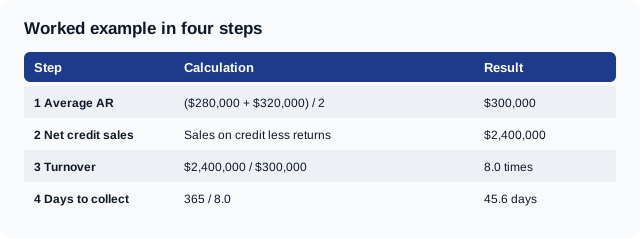
- Average receivables = ($280,000 + $320,000) ÷ 2 = $300,000.
- Net credit sales = $2,400,000. The cash sales are left out.
- Turnover = $2,400,000 ÷ $300,000 = 8.0 times.
- Days to collect = 365 ÷ 8.0 = 45.6 days.
Consider what that means in cash: with $300,000 permanently tied up in unpaid invoices, every day of faster collection releases about $6,575 ($2,400,000 ÷ 365). This company collects its average receivables eight times a year. A typical customer takes about 46 days to pay, so a company that offers Net 30 terms has customers paying roughly 16 days late on average.
Why do most guides skip the average-receivables step?
Many guides divide by the closing balance because it is quicker, but that figure can mislead whenever receivables change during the year. The closing balance shows one day, while the average shows the typical level across the period.
The comparison below uses the same company.
| Method | Calculation | Ratio | Days |
|---|---|---|---|
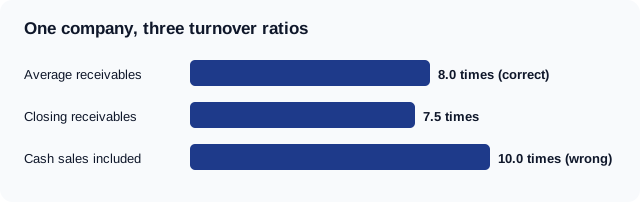
| Average receivables (correct) | $2,400,000 ÷ $300,000 | 8.0 | 45.6 |
| Closing receivables | $2,400,000 ÷ $320,000 | 7.5 | 48.7 |
| Cash sales included (wrong) | $3,000,000 ÷ $300,000 | 10.0 | 36.5 |
Closing receivables understate the ratio here because the balance grew during the year. If receivables had fallen, closing would have overstated it. Average receivables avoid both distortions. The third row is an error: counting cash sales inflates the ratio to 10.0 and makes the business look faster than it is.
When a business is seasonal, even the two-point average can mislead. A year-end balance taken after the busy season may be far from the typical level. In that case average twelve month-end balances instead of two.
How do you convert turnover into days?
You convert turnover into days by dividing the number of days in the period by the ratio. For a year, divide 365 by the turnover ratio. The lower the days, the faster customers pay.
| Turnover ratio | Days to collect (365 ÷ ratio) |
|---|---|
| 4 | 91.3 |
| 6 | 60.8 |
| 8 | 45.6 |
| 10 | 36.5 |
| 12 | 30.4 |
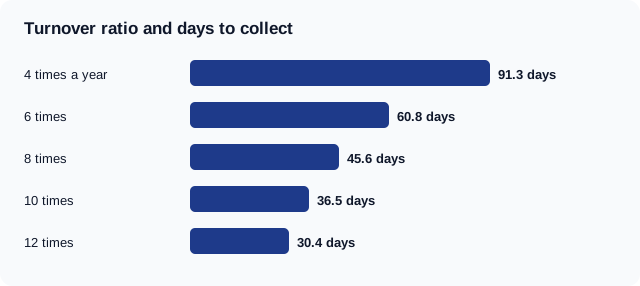
Days are easier to compare with your payment terms. If you invoice on Net 30, a result near 30 days is excellent and a result of 46 days is a signal to chase earlier. The same figure from a different angle appears in our guide to the average debtors collection period formula.
Why can one blended ratio hide a problem?
A blended ratio averages every customer together, so a single slow group can sit behind a healthy-looking number. Consider the same company split into two customer groups, as in the table.
| Group | Net credit sales | Average receivables | Turnover | Days |
|---|---|---|---|---|
| Retail accounts | $1,500,000 | $100,000 | 15.0 | 24.3 |
| Corporate accounts | $900,000 | $200,000 | 4.5 | 81.1 |
| Blended | $2,400,000 | $300,000 | 8.0 | 45.6 |
The blended 45.6 days looks tolerable. The corporate group takes 81 days, though, and holds two-thirds of the receivables. Splitting the ratio by customer group shows where the cash is stuck, and it tells you which customers to chase or put on shorter terms.
What is a good accounts receivable turnover ratio?
A good ratio is one that implies a collection time close to your own payment terms. There is no single correct number for every business. Terms of Net 30 make a turnover of about 12 normal. Terms of Net 60 make a turnover of about 6 normal.
For instance, a freelancer on Net 14 terms should expect turnover near 26, while a wholesaler on Net 60 terms should expect turnover near 6. Use this simple rule for reading your result:
| Your terms | Expected turnover | Reading |
|---|---|---|
| Net 30 | About 12 (30.4 days) | On target |
| Net 30 | 8 (45.6 days) | Customers about 15 days late |
| Net 30 | 6 (60.8 days) | A collections problem |
| Net 60 | About 6 (60.8 days) | On target |
These bands are a rule of thumb for interpreting your own numbers. They are not an official benchmark, and sector norms differ, so compare with your own history and your own terms first.
A falling ratio over several quarters is a stronger warning than one weak quarter. If turnover moves from 10 to 9 to 8 over three quarters, customers are paying later each time.
What does the ratio mean if you use cash-basis accounting?
If you use the cash method, you record income only when you receive payment, so your books have no receivables and the ratio does not apply. The IRS explains that under the cash method you generally report income in the tax year you receive it, while under the accrual method you report it in the year you earn it, according to IRS Publication 538.
Many freelancers and small businesses use the cash method for tax. You can still track your unpaid invoices outside the books. List every open invoice and its amount, and treat that total as your receivables for management purposes. The ratio then works as a cash-flow check even though your tax return does not use it.
What does the ratio look like for a UK or German business?
The calculation is identical in the UK and Germany, but the currency and the tax treatment change the inputs. For example, a UK consultancy has opening debtors of £90,000 and closing debtors of £110,000, both including 20% VAT. Its net credit sales are £700,000, which is £840,000 with VAT.
Match the two sides before dividing. Average debtors are £100,000, and VAT-inclusive sales are £840,000, so turnover is 8.4 times and the collection time is 43.5 days. Dividing by the net figure of £700,000 would give 7.0 times and 52.1 days, which makes the business look nine days slower than it is. Under HMRC rules, the standard VAT rate is 20%, according to GOV.UK.
Consider a German agency with the same pattern. Its receivables include 19% Umsatzsteuer, so it should compare gross receivables with gross credit sales. Such a business can also use the ratio to decide whether a customer who regularly pays after 30 days is already in default under BGB section 286, where the reminder step matters.
How can you improve accounts receivable turnover?
You improve turnover by collecting faster, not by selling less on credit. The steps below are listed from cheapest to most demanding.
- Invoice immediately. An invoice sent a week late adds a week to every customer's collection time.
- Shorten the terms. Moving from Net 45 to Net 30 can remove about two weeks if customers follow the term.
- Ask for a deposit. Cash received up front never becomes a receivable.
- Remind before the due date. A friendly message a few days early is cheaper than a chase later. The payment reminder email generator writes it.
- Make payment easy. Put bank details, a reference and a payment link on the invoice.
- Charge late fees where the law and contract allow. Use the late fee calculator to see the amount before you add it to the terms.
- Review credit before you extend it. A new customer with a poor payment history should start on shorter terms.
Late payment also has a legal remedy in some countries. In the UK, statutory interest on a late commercial debt is 8% plus the Bank of England base rate, according to GOV.UK guidance on charging interest. In Germany, business-to-business interest is 9 percentage points above the base rate, plus a €40 flat fee, according to BGB section 288.
What are the limits of the ratio?
The ratio is a summary, and a summary hides detail. Check these limits before you act on one number.
| Limit | Why it matters | What to do |
|---|---|---|
| One large slow customer | Hides behind a healthy average | Read the ageing report |
| Seasonal sales | A year-end balance is unrepresentative | Average twelve month-ends |
| Tax in receivables only | Overstates days | Match tax on both sides |
| Write-offs | Removing bad debts improves the ratio | Report bad debts separately |
| Different terms by customer | One ratio mixes them | Calculate by customer group |
The tax mismatch is common in the UK and Germany, where receivables include VAT but sales are recorded net. Divide VAT-inclusive receivables by VAT-inclusive sales, or remove the tax from both.
Key points
Accounts receivable turnover is net credit sales divided by average receivables. Use credit sales only, average the opening and closing balances, convert to days with 365 divided by the ratio, and compare the days with your payment terms.
Frequently asked questions
What is the formula for accounts receivable turnover?
Accounts receivable turnover equals net credit sales divided by average accounts receivable. Average receivables is the opening balance plus the closing balance, divided by two. Use credit sales only and the same period for both, and match the tax treatment of receivables and sales.
How do you calculate average accounts receivable?
Add the receivables at the start of the period to the receivables at the end, then divide by two. For a seasonal business, average the month-end balances for all twelve months instead, which smooths out the busy and quiet periods.
Which turnover ratio counts as good?
A good ratio implies a collection time close to your payment terms. A turnover of about 12 suits Net 30 terms, and about 6 suits Net 60. Compare it with your own history first, and with the gap between the result and your terms.
How do you convert turnover to days?
Divide 365 by the turnover ratio. A ratio of 8 gives 365 ÷ 8 = 45.6 days. Use the number of days in the period when you calculate for a month or a quarter, such as 30 or 91.
Should cash sales be included in the calculation?
No. Cash sales never create a receivable, so including them raises the ratio and hides slow-paying credit customers. Use net credit sales only, because cash sales never create a receivable and would hide slow-paying credit customers.
Comments
0No comments yet
Be the first to share your thoughts on this article.
Leave a comment
Your email is never published. Comments appear after approval.