

- A past due invoice is a bill unpaid after its due date, so every invoice needs an exact calendar due date.
- UK businesses can add 8% plus the Bank of England base rate and a fixed £40, £70 or £100 sum to a late business invoice, according to GOV.UK.
- German suppliers can charge default interest of nine points above the base rate plus a €40 flat fee to business debtors, under § 288 BGB.
A past due invoice is an invoice that is still unpaid after its due date. The fastest way to collect one is a short, dated reminder that names the invoice, the amount and the new deadline, sent the day after the due date. Interest and fees come second, and they only work if you can point to a contract or a statute.
Every figure below went through a fact-check against the official source linked beside it. This guide covers how to collect past due invoices, what the UK and Germany let you add, and the exact wording for a past due invoice letter, a late fee line and a final invoice. Late-payment law differs by country, so each rule below names its jurisdiction.
What is a past due invoice?
A past due invoice is a bill whose payment date has passed without full payment. "Overdue" and "past due" mean the same thing in everyday use. Accountants also use "past due" for the aging buckets in a receivables report: 1 to 30 days, 31 to 60 days, and so on.
An invoice cannot be treated as past due until its payment deadline is unambiguous, so put an exact calendar date on every invoice, such as "Due: November 14, 2026", instead of relying only on "Net 30". A vague payment term gives a reluctant payer a convenient reason to dispute exactly when the clock started. The due upon receipt guide explains the strictest term.
When does an invoice become late by law?
In the UK, a business invoice is late on the agreed payment date. If you agreed no date, GOV.UK says the payment is late 30 days after the customer receives the invoice or 30 days after you deliver the goods or service, whichever is later. Agreed dates must usually fall within 60 days for business transactions, according to the GOV.UK guidance on late commercial payments.
In Germany, a debtor who is not a consumer is in default at the latest 30 days after the due date and receipt of the invoice, under § 286 BGB. For a consumer, that 30-day rule applies only if the invoice pointed out the consequence in writing. The practical lesson for a German invoice: add one sentence stating that late payment triggers default after 30 days.
In the United States, this guide found no federal rule that sets interest on private business invoices. Late fees there come from your contract and your state's law, so write the fee into your terms before you rely on it.
How to collect past due invoices in five steps
Follow these steps in the order shown, because each one is slightly firmer than the previous step and each one leaves a written record that you can rely on later.
- Check your own side first. Confirm that the invoice reached the correct person and that the amount, the purchase order number and the bank details are all accurate before you escalate anything. Many invoices that appear to be late are simply waiting, unnoticed, in an administrative inbox.
- Send a friendly reminder the day after the due date. Attach a copy of the invoice. Ask for a payment date, not just payment.
- Call, then confirm by email. A two-minute call often finds the real blocker. Summarize it in writing straight afterwards.
- Send a formal past due notice at 14 days late. Cite the contract term, the interest you are entitled to and a final date.
- Issue a final invoice and stop work. If payment is still missing, send a final invoice with interest added, pause further work in writing, and say what happens next.
Keep every message dated and addressed to the person who approves payment, because the paper trail matters if you later claim interest or go to a collections agency.
<!-- UNIQUE INSIGHT: the five-step order and the day counts come from sequencing the legal default dates below, not from a generic template. -->Past due invoice letter: wording you can copy
A past due invoice letter is a short formal message that restates the debt and sets a deadline. Use this structure and fill in the brackets.
Subject: Invoice [number] is past due: [amount] was due [date]
Dear [name],
Our invoice [number] for [amount], issued on [date], was due on [due date] and has not been paid. A copy is attached.
Please pay in full by [new date]. If payment has already been sent, please reply with the date and reference so we can match it.
Under our agreed terms, interest accrues on late amounts from [due date]. [Interest and fee line.]
Kind regards, [your name, business, phone]
Three details make this letter effective: the subject line carries the invoice number and the amount, the deadline is an actual calendar date rather than the word "soon", and the final line explains what happens if that date passes without payment.
Invoice late fee wording that holds up
Late fee wording belongs on the original invoice and in your written contract rather than in a reminder composed afterwards, because a fee that the client never agreed to is straightforward to dispute.
Use one of these clear lines in your invoice terms:
- Percentage fee: "Amounts unpaid after the due date incur a late fee of 1.5% per month on the outstanding balance."
- Flat fee: "A late fee of $35 applies to any invoice unpaid 10 days after the due date."
- Statutory interest (UK or Germany): "Statutory interest and fixed recovery costs apply to late business payments under applicable law."
A fee in your terms is a contract matter. A statutory right is separate and applies to business customers even when the contract is silent. Check your state or country rules on maximum late fees before you pick a percentage, and ask a local advisor if the amount is large.
What can you charge a late-paying business in the UK?
A UK business can charge statutory interest of 8% plus the Bank of England base rate on a late business-to-business invoice, according to GOV.UK. This applies unless the contract sets a different rate. GOV.UK calculates it by multiplying the debt by the rate, dividing by 365, and multiplying by the days late. The UK interest calculation guide works through a full example.
<!-- UNIQUE INSIGHT: the worked interest figures below are calculated from the GOV.UK method, using a labelled illustrative base rate. --> <!-- ORIGINAL DATA: the interest figures are recalculated from the GOV.UK method for this guide. -->Here is a worked example. Your invoice is £5,000 and you must look up the base rate on the Bank of England Bank Rate page. Assume 4% for illustration, which gives a 12% annual rate. Daily interest is £5,000 × 12% ÷ 365, or £1.64.
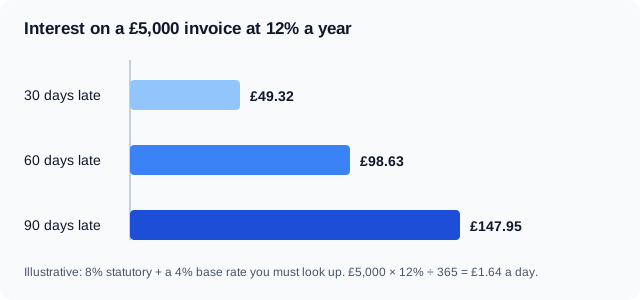
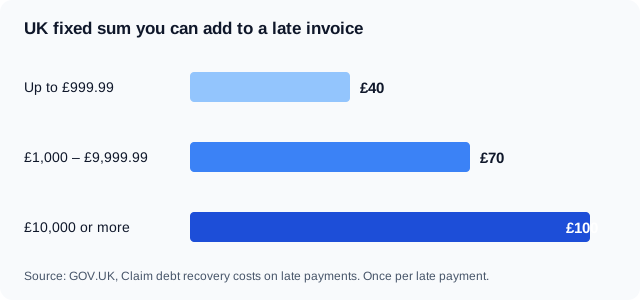
You can also add a fixed sum per late payment. GOV.UK sets it by the size of the debt, and you can charge it only once per payment.
| Debt size | Fixed sum |
|---|---|
| Up to £999.99 | £40 |
| £1,000 to £9,999.99 | £70 |
| £10,000 or more | £100 |
GOV.UK also says you can claim reasonable costs each time you try to recover the debt, on top of the fixed sum. If you add interest, GOV.UK advises sending a new invoice.
What can you charge a late-paying business in Germany?
A German supplier can charge default interest of nine percentage points above the base rate on a payment claim when no consumer is involved, under § 288 BGB. The supplier can also demand a flat fee of €40 from a debtor who is not a consumer, under § 288 Abs. 5 BGB. See late payment interest in Germany for the current rate.
The base rate (Basiszinssatz) changes every half year, and the statute does not state its value. Look up the current figure from the Bundesbank before you calculate, and show the calculation on the follow-up invoice.
Germany's consumer rate is lower. The general default interest rate is five percentage points above the base rate, under § 288 Abs. 1 BGB. If your client is a private person, use that rate instead.
How do I word a final invoice?
A final invoice is the last written demand before you hand the debt to a collector or a court. It should be a new document with a new number, so the amount owed is unambiguous.
Include these lines:
- The word Final invoice in the title, with the original invoice number referenced.
- The original amount, the interest to date, the fixed fee and the new total, each on its own line.
- A hard deadline date and the payment details.
- One sentence naming the next step, for example "If payment is not received by that date we will begin recovery proceedings."
Do not invent urgency or threaten enforcement steps that you have no intention of taking; simply state the applicable rule, the outstanding amount and the final date, and then stop writing. Do not add charges the contract and the law do not support, because a client who spots one can dispute the whole invoice.
Past due invoice mistakes that cost you the payment
- No due date on the invoice. Without a specific payment date, the question of when the invoice became late depends on delivery and receipt dates that a reluctant client can dispute indefinitely.
- Adding a fee after the fact. A late fee that the client never saw before accepting the work is a request for goodwill, not an enforceable contractual right.
- Chasing the wrong person. Reminders sent to a general accounts inbox are frequently ignored, so identify the individual who actually approves the payment and address your correspondence directly to them.
- Letting the debt age. Unpaid commercial debts generally become harder to collect with every additional month, which is why the first reminder should go out within a day of the deadline.
- Mixing consumer and business rules. Germany and the UK treat consumers differently, so check who your client is.
The bottom line: put a clear due date and your late terms on every invoice, then follow the five steps in order. This guide explains the common rules and is not legal or tax advice for your case, so contact an accountant or solicitor before you chase a large or disputed amount. Statutory interest depends on the contract, the customer type and the country.
Next step
Once your terms and due dates are clear, a reminder takes minutes. Invoqk's invoice generator lets you set the due date and late-fee wording on every invoice, so the follow-up is already backed by your own terms.
Frequently asked questions
What does past due invoice mean?
A past due invoice is a bill that has not been paid by its due date. It stays past due until the client pays in full. Adding the due date in numbers, such as "Due: November 14, 2026", removes any argument about when it became late.
How do I write a past due invoice letter?
Write a short message with the invoice number and amount in the subject line. State the original due date, ask for payment by a new date, attach the invoice and name the interest or fee in your terms. Keep the tone neutral and send it to the person who approves payment.
Can I charge a late fee on an invoice?
You can charge a late fee if your contract or invoice terms say so before the work starts. UK and German businesses also have statutory interest rights against business customers. A fee added only after the invoice is late is easy to dispute.
What is the UK statutory interest rate on a late invoice?
GOV.UK sets statutory interest at 8% plus the Bank of England base rate for business-to-business transactions. A contract can set a different rate. Divide the yearly interest by 365 to get the daily amount, then multiply by the number of days late.
When should I send a final invoice?
Send a final invoice after your friendly reminder, your call and a formal notice have gone unanswered, usually at 30 days past due. Give it a new number, list the interest and fees, state a deadline and name the next step you will take.
Comments
0No comments yet
Be the first to share your thoughts on this article.
Leave a comment
Your email is never published. Comments appear after approval.