

- Statutory interest on a late UK business invoice is 8% plus the Bank of England base rate, which is 11.75% a year with Bank Rate at 3.75%.
- You can add a fixed recovery sum of £40, £70 or £100 once for each payment, plus reasonable recovery costs.
- A £4,500 invoice paid 45 days late adds £65.19 interest and £70 fixed sum, so the client owes £4,635.19.
A client has missed the due date and you want to know exactly what additional amounts the law allows you to claim, so this guide gives you the formula, a worked example in pounds, a lookup table for common invoice sizes and the wording to send. It covers late payments between UK businesses, as set out in official government guidance.
How do you calculate interest on a late UK business invoice?
Multiply the unpaid amount by the annual rate, divide the result by 365, and then multiply by the number of days the payment is late, where the annual rate is 8% plus the Bank of England base rate and is known as statutory interest.
The government's guidance on charging interest on commercial debt describes the rule in these terms. You can charge 8% plus the Bank of England base rate when another business pays late. Its worked example uses £1,000 owed and a 0.5% base rate, which the gov.uk team chose for illustration (see the gov.uk worked example). The annual interest is £85, the daily interest is 23p, and after 50 days the interest is £11.50.
The steps are short.
- Find the annual rate: 8% plus the current Bank Rate.
- Multiply the unpaid invoice amount by that rate to get the interest for a full year.
- Divide by 365 to get the interest for one day.
- Multiply by the number of days the payment is late.
- Add the fixed recovery sum for your invoice size.
What is statutory interest?
Statutory interest is the interest rate that the law lets you charge on a late business payment when your contract sets no other rate. It is 8% plus the Bank of England base rate, and it runs from the day the payment becomes late until the day it is paid.
Bank Rate is the Bank of England's official interest rate. The Bank shows a current rate of 3.75% on its Bank Rate page. It held the rate at 3.75% at its June, July and September 2026 meetings, and its next decision is due on November 5, 2026.
That gives a statutory interest rate of 11.75% a year (8% margin plus Bank Rate, Bank of England, 2026) for the calculations below. The base rate changes over time. Check the Bank's page for the current figure, and check the gov.uk guidance for which base rate applies to your invoice, before you send a claim.
When does an invoice count as late?
An invoice is late when the agreed payment date has passed, and if you agreed no date, the law treats the payment as late 30 days after the customer receives the invoice or after you deliver the goods or services, whichever comes later.
The gov.uk late payment guide explains the timing rules. An agreed date must usually fall within 60 days for business transactions. You can agree a longer period, but it must be fair to both businesses.
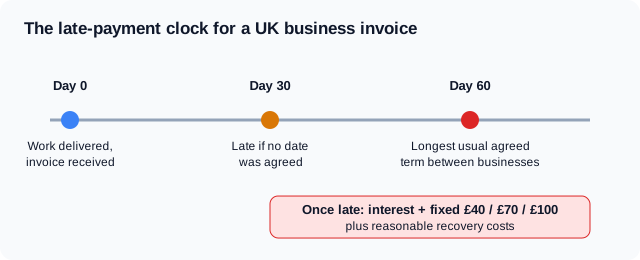
Here is how this looks for three common setups.
| Your payment terms | When the invoice becomes late |
|---|---|
| No date agreed, invoice received May 1 | 30 days later, on May 31 |
| 14 days agreed, invoice dated May 1 | After the 14th day, on May 15 |
| 60 days agreed, invoice dated May 1 | After the 60th day, on June 30 |
Count from the day the customer receives the invoice, and if you email the invoice on that same day, the date is easy to prove, so keep the sent message as documentary evidence.
What is the fixed recovery sum?
The fixed recovery sum is a flat amount you can add to a late business invoice to cover your cost of chasing it. It depends on the size of the unpaid invoice.
The gov.uk page on claiming debt recovery costs lists the amounts. You can charge them on top of interest, and only once for each payment.
| Unpaid invoice amount | Fixed recovery sum |
|---|---|
| Up to £999.99 | £40 |
| £1,000 to £9,999.99 | £70 |
| £10,000 or more | £100 |
The same page adds that a supplier can also claim reasonable costs each time they try to recover the debt, so keep receipts and a record of each recovery step, such as postage, a payment service fee or a letter from a solicitor.
What does a worked example look like?
Here is a full calculation for one invoice. A freelance designer in Manchester invoices a business client £4,500 on September 1, with payment due in 30 days. The client pays 45 days after the due date.
The calculation follows the steps above, using the 11.75% rate from the Bank Rate figure of 3.75%.
| Step | Calculation | Result |
|---|---|---|
| Annual interest | £4,500 × 11.75% | £528.75 |
| Daily interest | £528.75 ÷ 365 | £1.4486 |
| Interest for 45 days | £1.4486 × 45 | £65.19 |
| Fixed recovery sum | Invoice of £1,000 to £9,999.99 | £70.00 |
| Total added | £65.19 + £70.00 | £135.19 |
The client therefore owes £4,635.19: the original £4,500 plus £135.19. The gov.uk worked example rounds the daily interest to the nearest penny before multiplying. If you do that here, £1.45 × 45 gives £65.25, which is six pence more. Either method is fine if you show your working.
How much interest builds up on common invoice sizes?
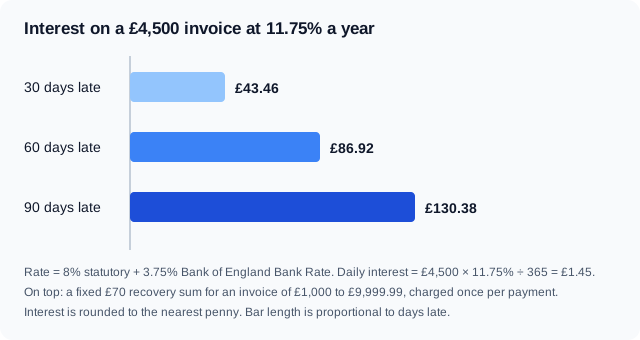
The table below gives the interest at 11.75% a year for four invoice sizes and three delays. Use it as a quick estimate before you run the exact calculation.
| Invoice amount | Daily interest | 30 days late | 60 days late | 90 days late |
|---|---|---|---|---|
| £800 | £0.26 | £7.73 | £15.45 | £23.18 |
| £2,500 | £0.80 | £24.14 | £48.29 | £72.43 |
| £4,500 | £1.45 | £43.46 | £86.92 | £130.38 |
| £12,000 | £3.86 | £115.89 | £231.78 | £347.67 |
The figures use the 3.75% Bank Rate (Bank of England, 2026) plus the 8% statutory margin. If Bank Rate moves, recalculate. The method stays the same.
When does interest overtake the fixed sum?
On a small invoice the fixed sum is worth far more than the accumulated interest for several months, whereas on a large invoice interest passes the fixed sum within a few weeks, and the break-even point is the number of days after which daily interest has added up to the fixed sum.
This is a useful planning number, because it tells you where the money is. The calculation divides the fixed sum by the daily interest.
| Invoice amount | Fixed sum | Daily interest | Days until interest exceeds the fixed sum |
|---|---|---|---|
| £800 | £40 | £0.26 | About 155 days |
| £2,500 | £70 | £0.80 | About 87 days |
| £4,500 | £70 | £1.45 | About 48 days |
| £12,000 | £100 | £3.86 | About 26 days |
On an £800 invoice, the £40 fixed sum is five times the interest after 30 days. Do not skip it. On a £12,000 invoice, interest of £115.89 after 30 days already exceeds the £100 fixed sum. Claim both, and keep the interest running until payment arrives.
Can a contract change the interest rate?
Yes, because if your contract sets a different interest rate for late payment, the gov.uk guidance says you cannot claim statutory interest on top of it, and the contract rate applies instead. The guidance also says that you cannot use a lower rate if your customer is a public authority.
Write the late payment term into your contract or your quote before the work starts, because a clear term avoids a dispute later, and a simple clause names the rate, the day it starts and the fixed recovery sum.
Here is a short clause you can adapt.
Payment is due within 30 days of the invoice date. If payment is late, interest is charged at 8% above the Bank of England base rate from the due date until payment, together with the fixed recovery sum allowed by law.
Have a solicitor review any clause in a contract worth a large sum. A clause that sets a lower rate than the law gives you may reduce what you can claim.
How do you claim the interest and the fixed sum?
Send the client a new invoice that adds the interest and the fixed recovery sum, because the gov.uk guidance says to send a new invoice if you decide to add interest to the money you are owed, and a separate invoice keeps the original invoice number and amount unchanged.
Follow this order.
- Check that the original invoice is past its due date and that the client is a business.
- Calculate the interest to a stated date, and write that date on the new invoice.
- Add the fixed recovery sum for the size of the original invoice.
- Give the new invoice its own number and refer to the original invoice number.
- Send it by email and keep the sent message.
- Set a short payment date, such as 7 days, for the new invoice.
State clearly that interest continues to accumulate until the original invoice is paid in full, and send an updated figure if the payment is delayed any further.
What should the reminder email say?
Keep the email short, factual and polite, and make sure it names the invoice, the due date, the unpaid amount and the additional charges you are making, because a calm tone often gets a faster reply than a threat.
Hello, invoice 2026-087 for £4,500.00 was due on October 1, 2026 and is now 45 days overdue. Under UK late payment law I am adding interest of £65.19 to November 15, 2026 and the fixed recovery sum of £70.00. A new invoice for £135.19 is attached. Please pay the original invoice and the new invoice within 7 days.
Replace the dates and amounts with your own figures and attach both invoices, and if the client raises a query, answer it in writing and keep the whole conversation in one thread.
What evidence should you keep before you claim interest?
Keep documentary evidence that proves the amount owed, the agreed payment date and the date on which the customer received the invoice, because a customer who disputes the claim will usually challenge one of those three facts first. Organised records also make any later court claim considerably simpler and cheaper to prepare.
Gather these items in one folder.
- The signed quote, contract or written acceptance that confirms the agreed price and payment terms.
- The original invoice, together with the sent email and any delivery or read confirmation.
- Proof that the work was delivered, such as a completed handover message, a delivery note or an approval from the client.
- Every reminder you sent, with the date and the reply, if any.
- Your interest calculation, showing the rate, the number of days and the Bank Rate you used.
- Receipts for any recovery costs you intend to claim in addition to the fixed sum.
Store copies in a place you can reach even if your invoicing account is closed later.
Which mistakes weaken a late payment claim?
Most weak claims come from a few avoidable errors. The table lists each one and how to fix it.
| Mistake | Why it hurts | Fix |
|---|---|---|
| No payment date on the original invoice | The late date is harder to prove | Always state a due date |
| Using 8% alone | The base rate is left out, so the claim is too low | Use 8% plus the current Bank Rate |
| Ignoring the contract rate | A different contract rate replaces statutory interest | Check the contract first |
| Claiming the fixed sum twice | The guidance allows it once for each payment | Charge it once |
| No working shown | The client disputes the figure | Show the formula and dates |
| Charging a private customer | The guidance covers payments between businesses | Check the customer type first |
Run through this table before you send anything. It takes a minute and removes the most common arguments.
Should you actually charge interest?
Charging interest is your choice, and it is usually worthwhile on large or repeated late payments, although for a good client who is one week late a friendly reminder may protect the relationship better, while for a client who is always late a consistent policy of adding interest changes behaviour.
A balanced approach works for many freelancers: send a reminder at the due date, a second note a week later, and the interest invoice after that, while stating your late payment terms on every quote so that the policy never comes as a surprise.
If you want to estimate the amount before you decide, the Invoqk late fee calculator lets you test different rates and delays. When you are ready to issue the document, Invoqk's invoice generator creates the invoice and can send it by email with a PDF.
What to do next
Gather four numbers before you act: the unpaid amount, the due date, today's date and the current Bank Rate. Work through the steps once on paper, then send the new invoice with the interest and the fixed sum. If the client still does not pay, the gov.uk pages on late commercial payments and on making a court claim for money explain the next stage.
This guide describes the general rules. Your own facts can change the answer, for example a contract term, a dispute about the work or a client who is not a business. Ask a solicitor or an adviser if the amount is large. For more on the basics, see "Past due invoice: what it is and what you can charge" and "Due upon receipt meaning: what it requires and when to use it". For the message itself, see "Invoice email template: how to email an invoice".
Frequently asked questions
How do I calculate interest on a late invoice in the UK?
Multiply the unpaid amount by the annual rate of 8% plus the Bank of England base rate, divide by 365, then multiply by the days late. Add a fixed recovery sum of £40, £70 or £100 depending on the invoice size.
How much can I charge for a late business invoice in the UK?
You can charge statutory interest at 8% plus the base rate, plus a fixed sum of £40 for up to £999.99, £70 for £1,000 to £9,999.99, or £100 for £10,000 or more. The fixed sum is charged once for each payment.
When is a UK business invoice legally late?
When the agreed payment date has passed. If no date was agreed, the payment is late 30 days after the customer gets the invoice, or after delivery of the goods or services if that is later.
Can I charge statutory interest if my contract has its own late payment rate?
No. The gov.uk guidance says you cannot claim statutory interest if a contract sets a different interest rate. The contract rate applies instead, so check your terms before you calculate a claim.
Do I send a new invoice to claim late payment interest?
Yes. The gov.uk guidance says to send a new invoice if you add interest to the money you are owed. Give it its own number, refer to the original invoice, show your working and state the date the interest runs to.
Comments
0No comments yet
Be the first to share your thoughts on this article.
Leave a comment
Your email is never published. Comments appear after approval.