

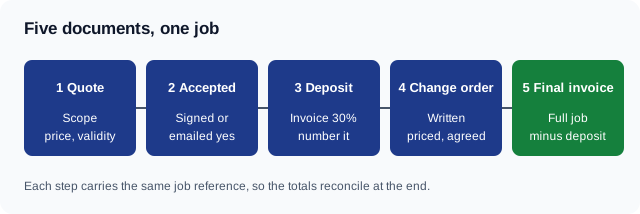
- An accepted quote becomes an invoice by copying its line items, adding an invoice number and date, and subtracting any deposit already paid.
- Every change order must be written, priced and agreed before the work starts, then added as its own line on the final invoice.
- In the UK and Germany the deposit invoice carries its own VAT, and the final invoice must deduct both the deposit and the tax already billed on it.
Quote to invoice: how to convert an accepted quote without retyping
A quote is a written offer to do defined work for a stated price, which becomes a contract once the client accepts it. An invoice is the bill that asks for payment once that work, or an agreed part of it, is done. Turning a quote to invoice should take a minute, because every line the client approved already exists. What takes time is everything that happens in between: a deposit, a change of scope, a price that moved.
In brief: copy the accepted quote line by line into the invoice, give it a new number and date, credit any deposit, add every signed change order as its own line, and check that the final total equals quote plus changes minus payments.
This guide follows one job from the first quote to the last invoice. It shows the arithmetic in US dollars, then in pounds and euros for the UK and Germany, where the VAT rules change what the final invoice must show.
How do you turn a quote into an invoice?
You turn a quote into an invoice by copying its accepted line items into a new document, adding an invoice number, an issue date and payment terms, and then subtracting anything the client has already paid. The quote's description, quantities and unit prices stay exactly as the client approved them.
Follow these steps in order:
- Confirm the quote was accepted. Keep the signed copy, the reply email or the signed-off message. An invoice for a quote nobody accepted starts an argument, not a payment.
- Copy every line unchanged. Keep the description, quantity, unit and price. Do not round, merge or reword lines, because the client will compare the two documents side by side.
- Assign a new invoice number. A quote number such as Q-0412 is not an invoice number. Use the next number in your invoice sequence and keep the quote number as a reference.
- Add the invoice date, due date and payment terms. The quote's validity date is irrelevant now. The terms are what the client agreed on the quote, so repeat them.
- Add change orders as separate lines. Each one gets its own description and the date it was agreed.
- Subtract the deposit and any earlier invoice. Show the credit as its own line so the client sees where the money went.
- Check the reconciliation. Revised total minus payments received must equal the amount due. If it does not, stop and find the difference before sending.
Invoqk's quote generator makes the quote and its invoice generator makes the matching invoice, so the lines can be pasted across instead of retyped.
What stays the same and what must change between quote and invoice
The scope, prices and terms stay the same, while the document type, number, dates and balance change. The table shows each field.
| Field | On the quote | On the invoice |
|---|---|---|
| Document title | Quote or Estimate | Invoice |
| Number | Quote number (Q-0412) | New invoice number (INV-1087) |
| Date | Issue date plus a validity period | Issue date plus a due date |
| Line items | Proposed work and prices | Same lines, plus any change orders |
| Payments | None | Deposit and earlier invoices credited |
| Reference | Client's request | Quote number and purchase order number |
| Status | Valid until a date | Due on a date |
A quote that says "valid for 30 days" has done its job once the client accepts. The invoice replaces the validity date with a due date, such as 14 days after issue.
Quote invoice or estimate: which document are you converting?
A quote is a fixed price, while an estimate is an approximate price that can move. If you sent an estimate, converting it to an invoice means the final figure may legitimately differ, and you should explain why on the invoice.
For example, a plumber who estimated $900 to $1,100 and finished at $1,040 invoices $1,040 and lists the parts that set the number. A plumber who quoted $1,000 invoices $1,000 unless the client signed a change.
This difference matters when the client disputes the bill. A quote is a price you committed to. An estimate is a forecast. Whichever you send, say on the document which one it is. The same logic applies to the related terms people search for, such as quotation invoice, invoice and quotation, or quote and invoice: all describe the same two-step flow of an offer followed by a bill.
How does a deposit change the quote-to-invoice process?
A deposit adds an extra invoice in the middle, and it changes the last one. You bill the deposit first, as a percentage of the accepted quote, and the final invoice then shows the full job with the deposit credited.
A deposit invoice is a bill for an advance payment that the client makes before the work starts, and that you later deduct from the final invoice. A 30% deposit is common for small jobs, but the percentage is whatever the client accepted on the quote.
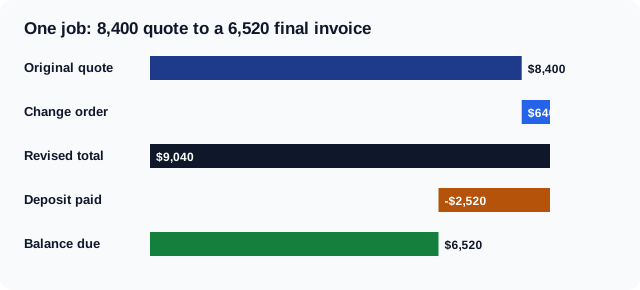
Here is the dollar sequence for a kitchen refresh priced at $8,400:
| Document | What it shows | Amount |
|---|---|---|
| Quote Q-0412 | Cabinet refacing, countertop, backsplash, labor | $8,400 |
| Deposit invoice INV-1086 | 30% of the quote, due before work starts | $2,520 |
| Change order CO-1 | Under-cabinet lighting, agreed in writing | $640 |
| Final invoice INV-1087 | $8,400 + $640 - $2,520 deposit | $6,520 due |
Three details stop disputes. First, say on the deposit invoice what it is for, for example "30% deposit on quote Q-0412". Second, state whether the deposit is refundable if the client cancels, because that decides whether you keep it. Third, give the deposit invoice its own number in your normal sequence.
The final invoice then lists the full scope. It does not say "balance due" and leave the client guessing. It shows the $8,400 job, the $640 change, the revised $9,040 total, the $2,520 credit and the $6,520 due.
Invoqk has a longer walk-through in its post on the deposit invoice template, which covers percentages and refund wording.
How do you handle a change order between quote and final invoice?
You handle a change order by writing it down, pricing it and getting the client's agreement before the extra work starts. Then you add it to the final invoice as its own line, with its own description and date.
A change order is a written agreement that adds to, removes from or alters the work in an accepted quote, together with the price effect. A change order can also be negative. If the client drops the backsplash, the credit belongs on the same line structure.
A usable change order has five parts:
- The quote or job it changes, by number.
- A one-sentence description of the change.
- The price effect, positive or negative, with quantity and unit.
- Any effect on the completion date.
- The client's approval, which can be a signature, a reply email saying "approved" or a text the client sent.
Here is wording you can copy:
Change order CO-1 to quote Q-0412. Add under-cabinet LED lighting, 12 linear feet, installed and wired, $640. Completion date moves from March 14 to March 17. Please reply "approved" to confirm.
The mistake that costs most is doing the work first and pricing it later. A client who never agreed to $640 will argue about it at the final invoice, and you will have no written trail. Verbal approval is worth little when the client forgets it.
If the change is small, you may decide to absorb it. Do that deliberately and say so on the invoice with a line at zero, for example "Extra outlet, no charge". That records the goodwill instead of leaving the client to forget it.
What does the final invoice need to show so the totals reconcile?
The final invoice must show the original quote lines, each change order, the revised total, every payment received and the balance due. The balance is always the revised total minus payments.
Use this layout:
| Line | Amount |
|---|---|
| Quote Q-0412, kitchen refresh (as accepted) | $8,400 |
| Change order CO-1, under-cabinet lighting | $640 |
| Revised total | $9,040 |
| Less deposit, invoice INV-1086, paid February 3 | -$2,520 |
| Balance due by March 31 | $6,520 |
The check is simple arithmetic: 8,400 + 640 = 9,040, and 9,040 - 2,520 = 6,520. Do it every time. If you billed a progress payment halfway, subtract that too. The rule stays the same however many invoices come before: revised total minus all payments equals the balance.
For US clients there is no single federal invoice format, so the layout above is a convention, not a rule. Sales tax on the job depends on the state and on whether the work is a taxable service or a sale of goods, so check your state's tax agency before you add a tax line. This post does not cover state sales tax.
How does VAT change the quote-to-invoice process in the UK?
In the UK, a deposit usually creates a VAT tax point, so the deposit invoice must carry VAT and the final invoice must deduct it. HMRC's VAT Notice 700, paragraph 14.2.2, says that if you issue a VAT invoice or receive a payment before the basic tax point, the tax point for that amount is whichever of those happens first.
A tax point is the date a supply is treated as taking place for VAT, which decides which VAT period the tax belongs to. For services, HMRC's paragraph 14.2.1 normally takes it as the date all the work except invoicing is completed. A deposit invoice or payment pulls part of the tax point earlier.
HMRC also says you normally issue a VAT invoice within 30 days of the tax point arising, according to paragraph 16 of the same notice. So a deposit received on a Monday should be invoiced promptly, not left until the job ends.
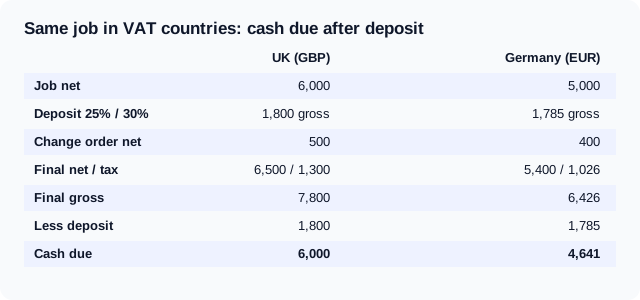
Here is the UK job in pounds. The quote is £6,000 net plus 20% VAT. The deposit is 25% of the gross price.
- Quote: £6,000 net, £1,200 VAT, £7,200 gross.
- Deposit invoice: £1,800 gross, which is £1,500 net plus £300 VAT.
- Change order: £500 net, £100 VAT, £600 gross.
- Final invoice: net £6,500, VAT £1,300, gross £7,800.
- Less the deposit of £1,800 (net £1,500 plus VAT £300), cash due is £6,000.
On the final invoice, show the full job and then the credit. The VAT that remains payable on it is £1,300 less the £300 already invoiced, which is £1,000. The client's cash due is £6,000, and the numbers add up: £7,800 - £1,800 = £6,000.
This applies to VAT-registered suppliers charging standard-rate VAT. A business under the registration threshold charges no VAT, and the dollar-style layout applies unchanged. Whether a particular deposit is a payment for the supply or a refundable security deposit can change the answer, so check the notice or ask HMRC if yours is unusual.
How does Umsatzsteuer change the quote-to-invoice process in Germany?
In Germany, the final invoice must deduct the deposits already received and the tax that fell on them. Section 14(5) of the Umsatzsteuergesetz (UStG) says that when a final invoice is issued, partial payments received before the supply and the tax amounts on them must be deducted, if invoices were issued for those partial payments.
The deposit invoice is called an Anzahlungsrechnung and the final one a Schlussrechnung or Endrechnung. A Schlussrechnung is the final invoice for a job, showing the full price and crediting every advance payment already invoiced with its tax.
The same section of the UStG lists what each invoice must contain, in section 14(4) UStG, including the full names and addresses of both parties, a tax number or VAT ID, an issue date, a sequential invoice number, a description of the work, the date of supply, the net amount by tax rate, and the rate and tax amount. For deposits, the law lets the date of receiving the payment stand in for the date of supply.
Here is the German job in euros with 19% Umsatzsteuer:
| Item | Net | Umsatzsteuer 19% | Gross |
|---|---|---|---|
| Quote, as accepted | 5,000 | 950 | 5,950 |
| Anzahlungsrechnung, 30% | 1,500 | 285 | 1,785 |
| Change order | 400 | 76 | 476 |
| Schlussrechnung, full job | 5,400 | 1,026 | 6,426 |
| Less deposit | -1,500 | -285 | -1,785 |
| Remaining to pay | 3,900 | 741 | 4,641 |
The check works in both columns. Net: 5,400 - 1,500 = 3,900. Tax: 1,026 - 285 = 741. Gross: 6,426 - 1,785 = 4,641, and 3,900 + 741 = 4,641.
This is general information about how the rule reads. If your supply is exempt, reverse-charged or falls under the small-business rule, the layout changes, and your tax adviser should confirm it.
Quote invoice software: what should it do for you?
Software should copy the accepted quote into an invoice in one click, keep both documents tied to one job, and calculate the balance for you. If it makes you retype lines, it saves nothing.
Look for these features:
- One-click conversion. The invoice starts with the quote's lines, terms and client details.
- Linked numbering. The invoice shows the quote reference, and the quote shows its status.
- Deposit and progress credits. The balance is calculated, not typed.
- Change orders as lines. You can add or remove lines without breaking the link to the quote.
- Correct tax per document. Deposit invoices and final invoices carry the right VAT or Umsatzsteuer.
- A record. The client's acceptance is stored with the quote.
A spreadsheet can do all of this if you build it carefully, but it will not stop you typing a new number into a copied line. That is the usual source of mismatches, and the check in the next section catches it.
For example, a roofer who copies a quote into a spreadsheet and edits one unit price by accident invoices $200 less than agreed and finds out three months later. A one-click conversion removes the chance.
A pre-send checklist for a quote invoice template
Run this list before you send any invoice that comes from a quote.
- The invoice lines match the accepted quote word for word.
- The invoice number is new and the quote number appears as a reference.
- Every change order has a written approval and its own line.
- Each payment already received is credited, with the date.
- Revised total minus payments equals the balance due.
- The due date and payment terms match the quote.
- In the UK and Germany, the VAT or Umsatzsteuer on the deposit is deducted along with the deposit.
If you use an invoice quote template, add the quote reference and a "payments received" block to the invoice layout once, and every future conversion has them.
Which mistakes make a converted quote get disputed?
Most disputes come from three habits: changing a line quietly, forgetting to credit a payment, and billing work nobody approved. Each has a cheap fix.
| Mistake | What happens | Fix |
|---|---|---|
| Rewording a quote line | Client says "that is not what I agreed" | Copy lines unchanged, add notes below |
| Forgetting the deposit | Client is billed twice, trust is lost | Show the deposit as a negative line |
| Unapproved extras | Client refuses to pay the extra | Get written approval first |
| Using the quote number as the invoice number | Gaps and duplicates in your sequence | Issue a fresh invoice number |
| Sending after the quote expired | Prices are challenged | Invoice against the accepted date, not the validity date |
| Mixing net and gross on a deposit | VAT is under- or over-stated | State net, tax and gross on every deposit invoice |
A mistake that is already on a sent invoice is fixed with a credit note and a corrected invoice, not by overwriting the first one. The wording for that is a separate topic.
Frequently asked questions
Can I turn a quote into an invoice automatically?
Yes. Most invoicing tools copy the accepted quote lines, terms and client details into a new invoice with a new number. You still add the issue date, credit any deposit and attach signed change orders before sending.
Is a quote the same as an invoice?
No. A quote is an offer of work at a price before the job starts. An invoice is a bill issued after work is done or a payment is due. A quote can be declined, while an invoice asks for money.
Do I need a new number when I convert a quote to an invoice?
Yes. The invoice needs the next number in your invoice sequence, and the quote number should appear only as a reference. Reusing the quote number breaks the sequence and can cause problems in the UK and Germany, where invoice numbers must be sequential.
How do I invoice a change order after the quote was accepted?
Get the change in writing with its price and a reply of approval, then add it to the final invoice as its own line. Show the revised total, subtract the deposit and show the balance due.
Does the deposit carry VAT?
In the UK and Germany it usually does. HMRC treats a payment or invoice before the basic tax point as a tax point for that amount, and the German UStG requires the final invoice to deduct deposits and their tax. Sales tax on US deposits depends on the state.
What goes on the final invoice after a deposit?
The final invoice shows the full job at the accepted quote prices, every change order, the revised total, the deposit as a credit with its date and invoice number, and the balance due. Revised total minus payments must equal the balance.
Comments
0No comments yet
Be the first to share your thoughts on this article.
Leave a comment
Your email is never published. Comments appear after approval.