

- A quote for services should state the scope, a price for each deliverable, the payment milestones, the assumptions it relies on and what is out of scope.
- A website quote that splits a $6,200 price into 30, 30, 30 and 10 percent milestones gets cash in before the work is finished and ties each payment to something the client can check.
- An out-of-scope clause with a priced change order stops scope creep, because extra requests become a written add-on instead of free work.
Most quote templates are built for goods: a list of items, a quantity and a unit price. A service is different. You are selling work that does not exist yet, so the quote has to say what will be delivered, in what order, when you are paid and what happens when the client asks for more. This guide gives you a template for quote for services, filled in as a website project, because web work shows every problem a service quote has to solve: vague scope, endless revisions, late content and unpaid final invoices. The same structure works for design, consulting, marketing, photography and any other project priced as a whole.
In brief: write the scope as a list of deliverables, price each one, split the total into milestone payments, list your assumptions, state what is out of scope with a rate for extras, and add a validity date.
What is a quote for services?
A quote for services is a written fixed price for defined work, valid until a stated date, which becomes a binding offer once the client accepts it. It differs from an estimate, which is an approximate price that can move. The quote is the document both sides point to when a disagreement starts, so it has to be specific.
Search results use many names for the same thing: a web quotation, a website quote, a services quote template and a project quotation template. They all describe the same document. The only real difference is how much detail the work needs. A one-day job needs a few lines. A website needs the structure below.
What a services quote needs that a product quote does not
A product quote answers "what will it cost?" A service quote must also answer "what exactly am I getting, and what happens if that changes?" Five sections do that job.
| Section | What it holds | The question it answers |
|---|---|---|
| Scope | Deliverables, quantities, revision rounds | What am I buying? |
| Price | A price per deliverable and a total | What does it cost? |
| Milestones | Payment amounts tied to events | When do I pay? |
| Assumptions | What must be true for the price to hold | What are you relying on from me? |
| Exclusions and changes | What is not included, and the rate for extras | What if I want more? |
Skipping the last two is the usual mistake. Without assumptions and exclusions, the price covers whatever the client later decides it covers.
Template for a quote for services
Copy this layout and replace the bracketed parts. It fits a website and, with different deliverables, any other project.
- Header: your business name and address, the client's name, the quote number, the issue date and a valid-until date.
- Project summary: two sentences on the goal, such as "A six-page website for a dental practice, with online contact form and a CMS the staff can edit."
- Deliverables: a numbered list, each with a quantity and a fixed price.
- Payment milestones: each payment as a percentage, an amount and the event that triggers it.
- Assumptions: the client supplies copy and images by a date, gives feedback within a set number of days, and names one person who approves work.
- Out of scope: everything you are not doing, plus a rate for extra work.
- Timeline: start date, review points and target launch, conditional on the assumptions.
- Acceptance: a line for the client's name, signature and date, or a reply that says "Accepted".
The quote template on Invoqk follows this order, so you can start from it and add the milestone and exclusion sections for service work.
Worked example: a six-page website quote
The example below is a small business website quoted in US dollars. A freelance developer quotes a local dental practice for a responsive six-page site with a contact form and an editable CMS. The client supplies the written copy and photos.
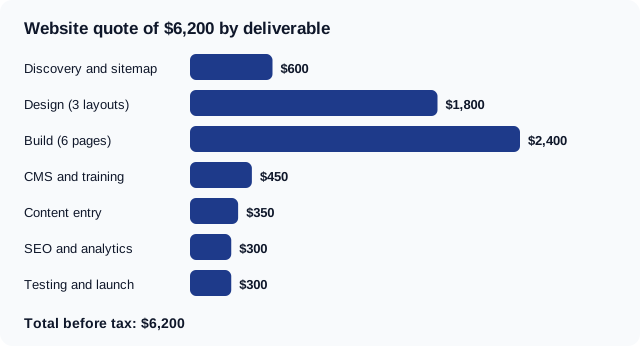
The deliverables and prices
| # | Deliverable | Price |
|---|---|---|
| 1 | Discovery call and sitemap | $600.00 |
| 2 | Design: home page plus two page templates, two revision rounds | $1,800.00 |
| 3 | Build: six responsive pages and a contact form | $2,400.00 |
| 4 | CMS setup and a one-hour training session | $450.00 |
| 5 | Content entry from client-supplied copy, up to six pages | $350.00 |
| 6 | SEO basics and analytics setup | $300.00 |
| 7 | Testing and launch | $300.00 |
| Total before tax | $6,200.00 |
Each line is a fixed price for a named result, not an hourly estimate. The client can compare it with another bid line by line, and you can point to a line when a request falls outside it.
The milestone payments
A milestone payment is a part of the total price that falls due when a defined event happens, rather than on a calendar date. For a project of this size, four payments work well.
| Milestone | Share | Amount | Trigger |
|---|---|---|---|
| Deposit | 30% | $1,860.00 | Client accepts the quote |
| Design | 30% | $1,860.00 | Client approves the design |
| Build | 30% | $1,860.00 | Pages are built on a staging site |
| Launch | 10% | $620.00 | Site goes live |
The four amounts add up to $6,200.00. The developer has been paid 90 percent of the price before the site goes live, so the last invoice is small and rarely disputed. The client pays only after seeing a result, which makes the structure fair to both sides.
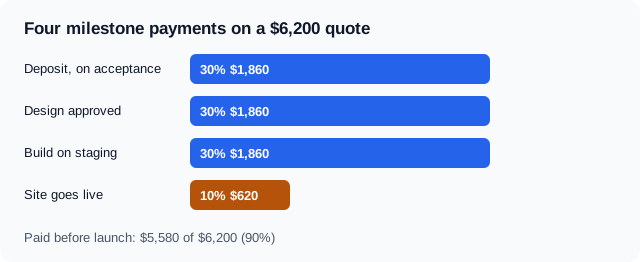
For example, if the client pauses the project after approving the design, the developer has already received $3,720.00, which is 60 percent of the price, for roughly the first half of the work. Tying payments to events, not dates, also means a slow client delays your payment only by delaying the project.
Which milestone split should you use?
Use the split that matches how much work you front-load. A small project can run on 50 percent up front and 50 percent on delivery. A larger project benefits from four or five payments. A common rule is that no single unpaid milestone should exceed what you can afford to lose.
| Project size | Common split | Why |
|---|---|---|
| Under $1,500 | 50% / 50% | Few moving parts |
| $1,500 to $10,000 | 30% / 30% / 30% / 10% | Cash arrives with each result |
| Over $10,000 | 20% to 25% per stage, 5 or 6 stages | Limits exposure on long projects |
These ranges are a working convention, not a legal standard. Choose them to suit the risk of the job and the client.
Write the assumptions your price depends on
An assumption is a condition you state in the quote that must hold for the price and timeline to stay valid. Assumptions are where a website quote is won or lost, because the typical overrun is not the build. It is waiting for content, feedback and approvals.
For the dental website, the assumptions read as follows:
- The client supplies all page copy and photos within 10 working days of the deposit.
- The client names one person who approves design and content, and gives feedback within 5 working days.
- Hosting, the domain name and any stock photography are bought by the client.
- The site uses the existing logo and brand colors.
- All work happens on the developer's staging site until the final payment.
Each assumption is a trigger for a conversation, not a trap. If copy arrives six weeks late, the quote says the timeline moves, and the developer does not absorb the delay.
Write the out-of-scope clause
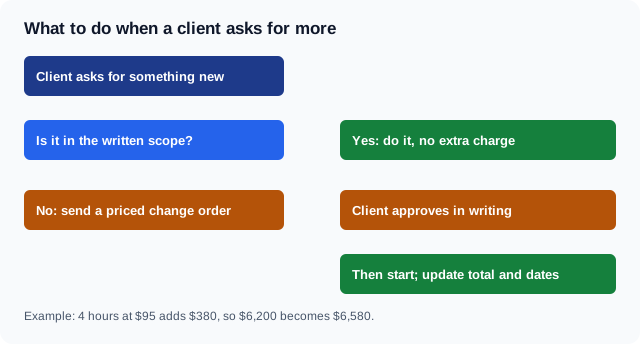
An out-of-scope clause is a statement of work the quote does not include, paired with a price or rate for adding it. It is the single most useful paragraph in a services quote, because it turns "can you just add..." into a written decision.
For the dental website, the clause reads:
The following are not included: additional pages beyond six, more than two design revision rounds, copywriting, photography, logo design, online booking or payment features, content in languages other than English, and ongoing hosting or maintenance. Extra work is quoted before it starts, at $95.00 per hour or a fixed price agreed in writing. Additional pages are $350.00 each.
The clause names the things clients most often ask for later. It does not insult the client. It says what the price buys and that more is possible at a stated cost.
A change order in practice
A change order is a short written agreement that adds or removes work and changes the price. Suppose the client approves the design and then asks for an online booking page. The developer estimates four hours.
| Item | Amount |
|---|---|
| Original quote | $6,200.00 |
| Booking page, 4 hours at $95.00 | $380.00 |
| New total | $6,580.00 |
The developer sends one email with the added work, the added price and any change to the timeline. The client replies "approved", and the milestone amounts are updated. Without that email, the four hours become unpaid work.
Add the tax and payment terms for your country
A services quote must show tax correctly, and the rules differ by country. This guide covers the USA, the UK and Germany. It states the rules as the authorities publish them and does not give advice for an individual situation.
USA
In the USA, whether web design is subject to sales tax depends on the state, and some states tax it while others do not. Check your state revenue department before you quote, and show any tax as a separate line. Add your payment terms, such as "milestone invoices due within 14 days", and state any late fee in the quote itself so the client agrees to it in advance.
United Kingdom
In the UK, you must register for VAT if your taxable turnover over the last 12 months goes above £90,000, according to GOV.UK guidance on when to register for VAT. The standard rate is 20 percent, according to GOV.UK VAT rates. A registered business quotes net, VAT and gross figures. A business below the threshold quotes a single price and shows no VAT.
Germany
In Germany, the standard VAT rate is 19 percent of the tax base, according to section 12 of the Umsatzsteuergesetz. A small business is exempt from charging VAT if its total turnover was no more than 25,000 euros in the previous calendar year and stays at or below 100,000 euros in the current year, according to section 19 of the Umsatzsteuergesetz. A business using that exemption (Kleinunternehmer) quotes one price with no VAT.
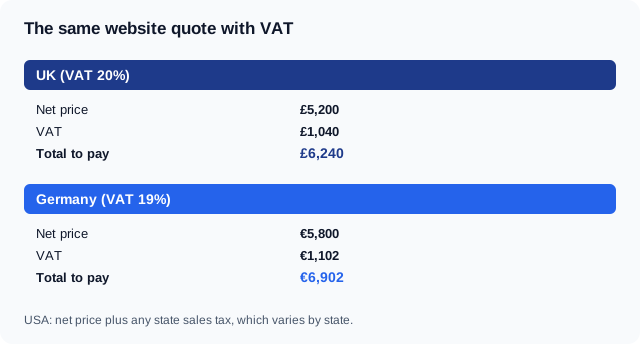
The same website quote in each country looks like this:
| USA | UK (VAT-registered) | Germany (regular VAT) | |
|---|---|---|---|
| Net price | $6,200.00 | £5,200.00 | €5,800.00 |
| Tax | State rules vary | VAT 20%: £1,040.00 | VAT 19%: €1,102.00 |
| Total | Net plus any state tax | £6,240.00 | €6,902.00 |
These figures are illustrative prices for one project. They are not a recommended rate for web work in any market.
Quote or estimate: what German law says about a cost estimate
If you are not sure whether to give a binding quote or a non-binding estimate, German contract law treats the two differently. A Kostenanschlag is a cost estimate on which a contract for work is based. Under section 649 of the Bürgerliches Gesetzbuch (BGB), if the contractor has not guaranteed the estimate and the work cannot be done without a substantial overrun, the client who cancels for that reason owes only the payment set out in section 645(1). The contractor must also tell the client without delay when an overrun is expected.
Two other BGB rules matter for service quotes. Section 632(3) states that a Kostenanschlag is, in case of doubt, not to be paid for, according to the text of section 632 BGB. So a German client expects a free quote. And section 632a lets a contractor demand a part payment equal to the value of the work already delivered, according to the text of section 632a BGB. The contractor must support it with a statement that allows a quick and reliable check.
In practice, a quote with milestones fits this rule well, because each milestone invoice comes with a visible result. Whether a particular website contract falls under these provisions depends on how it is classified, so confirm with a lawyer if the amount at stake is large.
Mistakes that make a services quote fail
Most quote problems come from the same few gaps. Check yours against this list before you send it.
- Hourly estimates without a cap. "About 40 hours" invites a fight when the job takes 55. Fix a price, or state a not-to-exceed figure.
- No revision limit. "Revisions included" means unlimited. Write "two rounds" and define a round.
- Content with no deadline. Late copy is the top cause of late launches. Put a date or a number of days on it.
- Final payment tied to the client's satisfaction. Tie it to launch, an event you can both see.
- No validity date. Prices change. A quote valid for 30 days protects you from a project that sat for six months.
- Hosting and domain left unsaid. State who buys them and who owns the account.
Send the quote and turn it into an invoice
Send the quote as a PDF with a short email that names the one decision you need: acceptance and the deposit. When the client accepts, issue the deposit invoice at once and reference the quote number on it. Each later milestone gets its own invoice with the same reference. The quote then acts as the contract and the invoices as the payment record, so nothing is retyped. The quote to invoice guide shows the conversion step by step.
If you build quotes often, the quote generator on Invoqk turns a plain description of the project into a formatted quote. It saves time on the layout, though the scope, assumptions and exclusions still have to come from you.
Frequently asked questions
What should a quote for services include?
A quote for services should include your details, the client's details, a quote number, a valid-until date, a list of deliverables with prices, payment milestones, assumptions, an out-of-scope list with a rate for extras, and a place for the client to accept. These items keep both sides clear on the price and the work.
How do I write a website quote?
Start with a short project summary, then list each deliverable with a fixed price: design, build, content entry, training and launch. Add milestone payments, the assumptions you rely on, and what is excluded. Finish with a validity date and an acceptance line. The worked example above shows each part filled in.
How should I split payments on a website project?
Tie payments to events the client can see. A split of 30 percent on acceptance, 30 percent at design approval, 30 percent when the site is built and 10 percent at launch suits a mid-sized project. Smaller jobs often use 50 percent up front and 50 percent on delivery.
What is an out-of-scope clause?
An out-of-scope clause lists the work a quote does not cover and states the price or hourly rate for adding it. It prevents scope creep by turning each extra request into a written change order that the client approves before the work starts.
Is a quote for services legally binding?
A quote becomes a binding offer when the client accepts it, but the exact effect depends on the country and the wording. Use clear terms, a validity date and a written acceptance. For a large project or a dispute, ask a lawyer to review the contract rather than relying on a template.
Do I charge VAT on a website quote?
It depends on your country and registration. In the UK, you charge VAT if you are registered, which is required above £90,000 of taxable turnover. In Germany, VAT applies at 19 percent unless you use the small business exemption. In the USA, sales tax on web design varies by state.
Comments
0No comments yet
Be the first to share your thoughts on this article.
Leave a comment
Your email is never published. Comments appear after approval.