
- A message to the customer on an invoice should confirm the due date, the payment method and one line of thanks.
- A handwritten signature is not required on a German invoice under section 14 of the UStG, though a client may still ask for one.
- Fill an invoice in this order: your details, the customer's details, number, dates, line items, totals and payment terms.
A message to the customer on an invoice is a short note near the bottom that confirms the payment terms, thanks the client or explains the charge. It is the one part of an invoice that has no legal wording, so most people either skip it or write too much. This guide shows what to put on an invoice, how to fill an invoice step by step, and when an invoice signature or a signed invoice is needed.
How do you fill an invoice step by step?
To fill an invoice, enter your details, the customer's details, a unique number, the dates, the line items, the totals and the payment terms, in that order. Each of the invoice fields has a job, and a missing field is the usual reason a client stalls payment. Related: how to number invoices, how to email an invoice, what an invoice is.
- Your details. Add your legal name, address, contact email and tax number if you have one.
- Customer details. Add the client's company name and billing address.
- Invoice number. Give the invoice a unique number such as INV-0042, in a sequence.
- Dates. Add the issue date and the due date. Add the date of supply when it differs.
- Line items. Describe each service or product, with quantity, unit price and line total.
- Totals. Show the subtotal, any tax on its own line, and the amount due.
- Payment terms and method. Say how many days the client has, and where to send the money.
- Message. Add one or two sentences, covered below.
The German UStG lists the mandatory content in section 14 paragraph 4. It names the full names and addresses of both parties, the supplier's tax number or VAT ID, the issue date, a unique sequential number, and the scope of the supply. The same section requires the net amount split by tax rate and the tax amount, or a note of the exemption, according to the German Federal Ministry of Justice text of section 14.
What should the message to the customer on an invoice say?
A good message to the customer on an invoice says three things: when payment is due, how to pay, and one line of thanks or context. Keep it to two sentences, because the message must not repeat the terms table above it.
Here are four messages that work, each for a different case:
| Situation | Message |
|---|---|
| Standard job | Payment is due within 30 days of the invoice date. Thank you for your business. |
| Repeat client | Thanks for another good month. Bank details are above, and the due date is March 31, 2027. |
| Deposit paid | The deposit already paid has been deducted. The remaining balance is due on delivery. |
| Late-fee terms | The late fee agreed in the quote applies to balances unpaid after the due date. |
Avoid pressure language, guilt, and long apologies. The message is a record of the agreed terms, not a negotiation. If the late fee is not in your contract or quote, adding it only to the invoice can be hard to enforce.
For UK business-to-business sales, statutory interest is "8% plus the Bank of England base rate" on late commercial payments, according to GOV.UK guidance on commercial debt interest. You cannot claim it if your contract sets a different rate. The same page works through a £1,000 debt at a 0.5% base rate: £85 a year, 23p a day, and £11.50 after 50 days, per the GOV.UK interest example. Check the Bank of England base rate for the current figure. The same GOV.UK page says to send a new invoice if you decide to add interest to the money you are owed, so interest belongs on a separate invoice and not on the original one.
Does an invoice need a signature?
An invoice signature is a handwritten or electronic mark that shows who issued the document, and most invoices do not need one. Germany states this directly: section 14 paragraph 3 of the UStG does not require a handwritten signature, only that the origin, integrity and legibility of the invoice are assured.
A signed invoice can still help in two cases. A client's accounts team may ask for one, and a signature line makes sense on an invoice that also acts as a delivery or work acceptance record. In that case add a line such as "Work received by" with a name and date.
For electronic invoices, section 14 of the UStG says authenticity and integrity count as ensured through a qualified electronic signature or a compliant electronic data interchange. Other methods are allowed if they create a reliable audit trail between the invoice and the supply. A typed name at the bottom is therefore a courtesy, not a legal requirement in Germany.
Authenticity in this context means certainty about the identity of the invoice issuer, which the statute states as "Echtheit der Herkunft", and integrity means that the content has not been altered after issue. Businesses typically satisfy both requirements through internal control procedures that create a reliable audit trail between the invoice, the underlying order and the payment, rather than through any individual signature. Consequently, accountants usually evaluate the supporting documentation as a whole, according to the text of section 14 of the UStG.
This guide does not cover signature rules in every country. If a client or authority asks for a signature, follow that request and keep a copy.
What goes on an invoice in the UK?
A UK VAT invoice is an invoice that carries VAT and meets HMRC's content rules. It must show a unique sequential number, the time of supply (the tax point), your name, address and VAT registration number, and your customer's name and address. It also needs a description that identifies the goods or services, according to paragraph 16.3.1 of HMRC's VAT Notice 700.
HMRC says you should normally issue a VAT invoice within 30 days of the tax point. A less detailed invoice is allowed only when the supply is £250 or less and the customer agrees. If you are not VAT registered, you leave out the VAT lines and the VAT number, and you do not charge VAT.
When must you send the invoice?
You must send a UK VAT invoice normally within 30 days of the tax point, according to paragraph 16.2.3 of HMRC's Notice 700 on invoice timing. German law sets a longer limit for business customers. Section 14 paragraph 2 of the UStG makes an invoice mandatory within six months after the supply, unless the supply is tax-exempt under section 4 numbers 8 to 29.
Send the invoice on the day the work ends, whatever the legal deadline. An early invoice starts the client's payment clock sooner, and it keeps the details fresh while both sides remember the job.
Worked example: a filled-in invoice
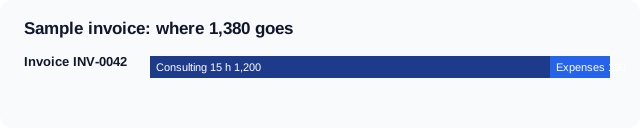
The sample below bills a freelance consultant's month. It has 15 hours at $80 an hour and $180 of reimbursable expenses, with payment due in 30 days.
| Field | Entry |
|---|---|
| Invoice number | INV-0042 |
| Issue date | March 1, 2027 |
| Due date | March 31, 2027 |
| Bill to | Northwind Studio, 12 Harbor Street, Portland, OR |
| Line 1 | Consulting, 15 hours at $80.00 = $1,200.00 |
| Line 2 | Domain and hosting, reimbursed at cost = $180.00 |
| Total due | $1,380.00 |
| Payment method | ACH transfer, details below the table |
| Message | Payment is due within 30 days. Thank you for the project. |
The total is $1,200.00 plus $180.00, which gives $1,380.00. The hourly rate of $80 is an assumed figure for the example, not a market benchmark. The message restates the due date once and adds a thank-you. That is enough.
For US contractors, the IRS says that for payments made in 2026, the Form 1099-NEC reporting threshold is $2,000, according to the IRS guidance on information returns. Clients may ask for your taxpayer details when you bill them near that level.
How to word the message for different clients
A message works best when it matches the relationship. A new client needs the full terms. A repeat client needs the due date and a short thank-you. A client who paid late last time needs the due date in the first sentence.
Use these rules when you write the message:
- Put the due date as a calendar date, such as March 31, 2027, not only "net 30".
- Name the payment method in plain words, such as "bank transfer to the account above".
- Use one thank-you at most, and place it last.
- Quote the invoice number if you expect the client to use it as a payment reference.
- Never add a term the client has not seen in the quote or contract.
A message that follows these rules is easy to quote in a follow-up email. If the client disputes the charge later, the invoice message is a dated record of what you stated at the time.
Optional fields that help you get paid
An optional field is a field that no law requires but a client's accounts team often wants. A purchase order number is the most common one, because many companies refuse to pay an invoice that does not quote it. A project name, a reference code and a contact person for queries are the next most useful.
Add a payment reference line that tells the client what to type in their bank transfer. Add a line for bank details or a payment link. Both cut the back-and-forth that delays payment.
Common mistakes when you fill an invoice
Most invoice problems come from a short list of habits. A wrong field costs time because the client's accounts team must send the invoice back before it can be paid:
- Reusing an invoice number, which makes records hard to trace.
- Leaving out the due date, so the client has no deadline.
- Merging tax into the price with no separate line where tax is charged.
- Writing "services rendered" instead of a description of the work.
- Adding a late fee on the invoice that the client never agreed to.
This guide covers general rules and does not give advice on a specific situation. If tax or contract details matter to your sale, ask a qualified adviser.
If you want to skip the manual steps, the Invoqk invoice generator turns a job description into a finished invoice with numbering and totals.
Frequently asked questions
What do you put in a message to the customer on an invoice?
Put the due date, the payment method and one line of thanks. Keep it to two sentences. The message should confirm terms already agreed, such as "Payment is due within 30 days of the invoice date."
What should I put on an invoice?
Put your details, the customer's details, a unique invoice number, the issue and due dates, itemised lines, totals with tax shown separately, and the payment terms. In Germany, section 14 of the UStG lists the mandatory items for a valid invoice.
Is a signed invoice required?
Not usually. Germany's UStG does not require a handwritten signature on an invoice. It requires the origin, integrity and legibility to be ensured. Add a signature only if your client asks or the invoice doubles as an acceptance record.
How do I fill out an invoice for the first time?
Fill it in this order: your details, the customer's details, the invoice number, the dates, the line items, the totals and the payment terms. Then add a short message. Check the numbers before you send.
Can I add a late fee to an invoice?
You can state one, but it is easiest to enforce when the contract or quote already includes it. For UK business sales, GOV.UK says statutory interest applies unless your contract sets a different rate.
Comments
0No comments yet
Be the first to share your thoughts on this article.
Leave a comment
Your email is never published. Comments appear after approval.