

- A collection letter names the invoice, the amount, the due date and a new deadline, and says what happens if the deadline passes.
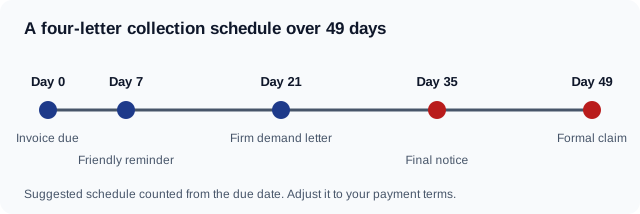
- Send three letters: a friendly reminder about 7 days late, a firm demand about 21 days late and a final notice about 35 days late.
- UK suppliers can add 8% interest over base rate plus a fixed £40, £70 or £100, and German business customers owe 9 percentage points over base plus €40 under § 288 BGB.
A client is three weeks late and has stopped answering. You do not need a lawyer yet. You need a short, dated letter that states the invoice, the amount and the next step. This guide gives you three collection letter templates in three stages, with free samples you can copy today, and the rules behind each one in the USA, the UK and Germany.
In brief: send a friendly reminder, then a firm demand with a deadline, then a final notice you are ready to act on.
What is a collection letter?
A collection letter is a written request for payment of an overdue invoice. It names the invoice, the amount, the due date and a new deadline, and it says what you will do if the deadline passes. It is also called a demand letter, a dunning letter or, in German, a Mahnung.
A collection letter does two jobs. It gives the client one more clear chance to pay. It also creates a dated record you can show a court, a collection agency or an accountant later.
Which collection letter format should you use?
Use the same format for every stage and change only the tone and the deadline. A collection letter format that works has seven parts:
- Your business name, address and contact details
- The date of the letter
- The client's name and address
- A subject line with the invoice number and amount
- The facts: invoice date, due date, amount and days overdue
- A new payment deadline and how to pay
- The consequence if the deadline passes
Keep it to one page. Do not add emotion, threats or accusations. A calm letter is easier to enforce and harder to dispute.
Letter 1: the friendly reminder (about 7 days late)
The friendly reminder assumes the client forgot. Most late invoices are paid after this letter, because most clients are slow rather than unwilling. Send it by email so the client can pay straight from the message.
Subject: Reminder: invoice [number] for [amount] was due on [date]
Hello [Name],
Our records show that invoice [number] for [amount], dated [invoice date], was due on [due date] and is still unpaid.
If you have already paid, please ignore this note and accept our thanks. If not, you can pay by [payment method and details].
A copy of the invoice is attached. Please let me know if anything is unclear.
Kind regards, [Your name], [Business]
This is the same message the free payment reminder email generator writes for you. Paste your invoice details and it produces a polite first reminder in a few seconds.
Letter 2: the firm demand letter (about 21 days late)
The firm demand letter is the first one that sets a hard deadline. It states that the invoice is overdue, gives 7 to 14 days to pay and names the consequence. Send it by email and by post if you have the client's address, so delivery is provable.
Subject: Second notice: invoice [number], [amount], now [X] days overdue
Dear [Name],
I wrote to you on [date of reminder] about invoice [number] for [amount], which was due on [due date]. I have not received payment or a reply.
Please pay the full amount by [date, 10 days from today]. Payment details are below.
If I do not receive payment by that date, I will charge the late-payment interest and fees described in our agreement [or: allowed by law] and I will begin formal recovery.
Yours sincerely, [Your name], [Business]
State the consequence you can actually carry out. If your contract has no late fee, do not invent one. The late fee calculator shows what interest or fee a late invoice has earned so far, which gives you an exact figure for the letter.
Letter 3: the final notice (about 35 days late)
The final notice is the last letter before a formal step. It gives a short deadline, usually 7 days, and says exactly what happens next. After this letter, you should be ready to follow through.
Subject: Final notice before formal action: invoice [number], [amount]
Dear [Name],
Invoice [number] for [amount] has been overdue since [due date]. My letters of [date 1] and [date 2] have not been answered.
Unless I receive full payment of [amount plus any interest and fees] by [date, 7 days from today], I will start formal recovery. That may include a claim in court, with interest and costs added.
This is the final reminder.
Yours sincerely, [Your name], [Business]
Only send a final notice if you will act on it. A threat you never carry out teaches the client that your deadlines do not matter.
What does a filled-in collection letter look like?
Here is a completed final notice with realistic numbers. A freelance designer invoices a client £2,400 on March 3, with payment due on March 17. The client does not pay and does not reply.
| Date | Action | Days overdue |
|---|---|---|
| March 24 | Friendly reminder by email | 7 |
| April 7 | Firm demand letter, deadline April 17 | 21 |
| April 21 | Final notice, deadline April 28 | 35 |
| April 28 | Decide: claim, agency or payment plan | 42 |
The final notice for that case reads: "Invoice 2025-014 for £2,400 has been overdue since March 17. Unless I receive £2,400 by April 28, I will start a court claim, with interest and the fixed sum allowed by the Late Payment of Commercial Debts (Interest) Act 1998." Every number is checkable, and every date is specific.
How do you write a collection letter that works?
A collection letter works when it is specific, calm and dated. Consider a client who ignores three vague emails but pays within days of a letter that names the invoice, the amount and the date. Specific means the invoice number, the amount and the due date appear in the first two lines. Calm means no insults and no exaggerated claims. Dated means each letter refers to the one before it.
Follow these rules for every stage:
- Quote the invoice number and the exact amount.
- Attach a copy of the invoice every time.
- Give one clear deadline and one clear way to pay.
- Name only the consequences you will carry out.
- Keep a copy of every letter and proof of sending.
Collection letter rules in the USA
In the USA, a business collecting its own invoice is generally outside the Fair Debt Collection Practices Act. The Consumer Financial Protection Bureau says the Act covers debts incurred for personal, family or household purposes, and it generally targets third-party collectors rather than the original creditor. The FTC debt collection FAQ also states that business debts are not covered.
That does not mean anything goes. State debt collection laws can reach original creditors and, in some states, business debts. Two practical consequences follow for a small business:
- For example, do not use a name that suggests a third party is collecting. The FTC business guidance on the FDCPA notes that a creditor who does this can become a covered debt collector.
- Do not threaten action you cannot take, and do not contact people other than the client about the debt.
If you sell to consumers, for example a photographer billing a family, the rules are stricter. In that case, keep letters factual and check your state's rules before sending a third letter.
Collection letter rules in the UK
In the UK, a business can add statutory late-payment interest to a business-to-business invoice. The Late Payment of Commercial Debts (Interest) Act 1998 sets that interest at 8% above the Bank of England base rate. The Act also lets a supplier claim a fixed sum on top of the interest.
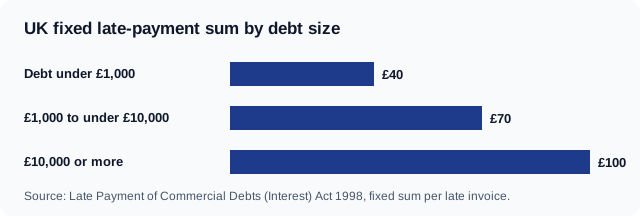
The fixed sum depends on the size of the debt:
| Debt size | Fixed sum |
|---|---|
| Under £1,000 | £40 |
| £1,000 to under £10,000 | £70 |
| £10,000 or more | £100 |
Mention the Act, for instance, in your second or third letter if your contract does not set its own late-payment terms. The Practice Direction on Pre-Action Conduct, published by the Ministry of Justice, then expects you to write to the debtor before you start a court claim. It treats 14 days as a reasonable time to reply in a straightforward case.
Collection letter rules in Germany
In Germany, a business customer falls into default without a reminder letter in one common case. Under § 286 of the German Civil Code (BGB), a debtor is in default 30 days after the payment falls due and the invoice is received. The same rule applies to a consumer only if the invoice pointed out this consequence. A reminder letter, called a Mahnung, causes default earlier if you send it after the due date.
Once the client is in default, § 288 BGB gives you two things when the customer is not a consumer:
- Default interest of nine percentage points above the base rate, according to § 288 BGB.
- A flat fee of €40, according to § 288 paragraph 5 BGB.
For the current rate, see our post on late payment interest in Germany from July 2026. Write the Mahnung in German and state the invoice number, the amount and a clear deadline. If the client still does not pay, the next step is a court payment order, the Mahnbescheid. The official portal of the German dunning courts explains that the debtor then has two weeks from service to pay or object.
What should you do after the final notice?
After the final notice, you choose between four routes. Pick the one that fits the amount and the relationship.
| Route | Best when | Cost to you |
|---|---|---|
| Phone call | The client is reachable and the amount is small | None |
| Payment plan | The client wants to pay but cannot pay in full | None, but agree it in writing |
| Collection agency | The debt is real and undisputed | Usually a share of what is recovered |
| Court claim | The amount justifies the cost and the debt is clear | Court fees and your time |
A payment plan is often the fastest route to cash. Put the plan in writing, with dates and amounts, and say that the full balance falls due again if a payment is missed.
Common mistakes in collection letters
Four mistakes cost small businesses the most. Each one weakens your position if the matter reaches a court.
- Vague amounts. "You owe us money" is not a demand. Name the invoice and the exact figure.
- Added fees with no basis. Charge interest or a fee only if your contract or the law allows it.
- No proof of sending. Email with a read receipt, tracked post or a courier receipt all count. A letter in a drawer does not.
- Missing the follow-through. If you say you will act on a date, act on that date.
A decision rule helps. If the client replied and disputes the invoice, stop the collection sequence and resolve the dispute first. If the client has gone silent, continue the sequence. If the client is clearly insolvent, speak to a professional before you spend more time on letters.
How to avoid sending these letters at all
The cheapest collection letter is the one you never send. Four habits reduce late payments more than any template:
- Send the invoice the day the work ends.
- State the due date, not only "net 30", on the invoice itself. The invoice due date calculator turns any set of terms into an exact date.
- Send a reminder two or three days before the due date.
- Track your average collection time. The DSO calculator shows how many days your customers really take to pay.
If you want a clean starting point, Invoqk creates an invoice with a due date, a payment note and your bank details from a plain-text description, free and without signup.
Frequently asked questions
How long should I wait before sending a collection letter?
Send a friendly reminder within a week of the due date. Send the firm demand letter around three weeks late and the final notice around five weeks late. Shorten the schedule if the client has a record of slow payment.
Can I charge interest in a collection letter?
Only if your contract or the law allows it. In the UK, the Late Payment of Commercial Debts (Interest) Act 1998 allows 8% above the base rate between businesses. In Germany, § 288 BGB allows nine percentage points above the base rate for business customers.
Is a collection letter legally binding?
A collection letter is a request, not a court order. It does not force payment. It does create a dated record, and in some countries it triggers default or interest from the date of the letter.
Should I send a collection letter by email or post?
Send the first reminder by email. Send the later letters by email and by tracked post. Tracked post gives you proof of delivery, which matters if you go to court.
What is the difference between a reminder and a demand letter?
A reminder assumes the client forgot and asks for payment. A demand letter assumes the client knows the invoice is overdue, sets a hard deadline and names the consequence.
Do I need a lawyer to send a collection letter?
No. You can send all three letters yourself. Ask a lawyer to review the final notice if the amount is large, the contract is complicated or the client disputes the invoice.
Comments
0No comments yet
Be the first to share your thoughts on this article.
Leave a comment
Your email is never published. Comments appear after approval.