

- A commercial invoice states the seller, buyer, goods, value and origin so customs can assess duty on a cross-border shipment.
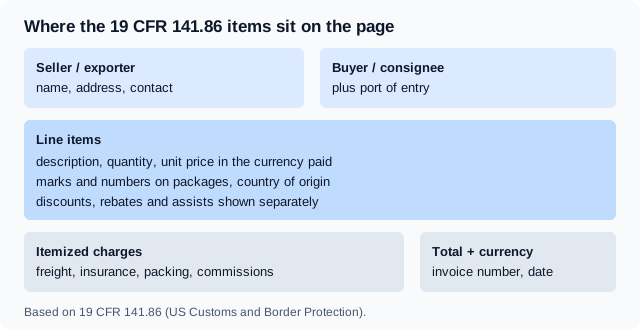
- For US customs, 19 CFR 141.86 requires the port of entry, item descriptions, quantities, prices in the currency paid, itemized charges, discounts and country of origin.
- A proforma invoice is a preliminary quote sent before shipment, while the commercial invoice records the actual transaction value.
A commercial invoice is the document an exporter sends with goods that cross a border, naming the seller, the buyer, the goods, their value and where they came from, so customs can assess duty. It differs from an ordinary sales invoice because a customs officer reads it, not only a bookkeeper. Every figure below went through a fact-check against the official source linked beside it.
This guide gives you a commercial invoice template to rebuild in Word or Excel. It shows a filled-in example for a shipment into the United States and the items US customs rules require. It also explains how a commercial invoice differs from a proforma invoice and which mistakes slow a shipment down.
What is a commercial invoice used for?
A commercial invoice states what the goods are and what they are worth. The importer or customs broker uses it to enter the shipment. In the United States, 19 CFR 141.83 says a commercial invoice shall be filed for each shipment that is not exempt. It must be prepared in the usual way for the trade and carry the information that 19 CFR 141.86 through 141.89 require. CBP may accept a copy in place of the original. For the fields every invoice needs, see what to put on an invoice, and for sending it, the invoice email template. See also the proforma invoice format covers a related case.
The same document often serves as the bill, so the buyer sees what they owe. The free commercial invoice template below keeps the pricing clear and adds the customs details a plain invoice leaves out.
What must a commercial invoice contain for US customs?
A commercial invoice for the United States must contain the items listed in 19 CFR 141.86. It must be in English or come with an accurate English translation. A template should have a place for each item.
- The port of entry where the goods are headed.
- The parties and the transaction. When, where and between whom the sale was made or agreed.
- A description of each item. The trade name, grade or quality, the seller's or manufacturer's marks or model numbers, and the marks and numbers on the packages.
- The quantities, in the origin country's units or in US units.
- The price of each item in the currency paid, if the goods were bought.
- The currency type of the payment.
- Itemized charges by name and amount, such as freight, insurance, commissions, containers and packing.
- Rebates, drawbacks and bounties, each listed separately.
- The country of origin.
- Assists, meaning goods or services supplied for production that are not in the invoice price, such as dies, molds, tools or engineering work.
- Every discount from the list or base price, for each class of merchandise.
The regulation also asks for consecutive numbering of invoices and pages. It asks for a statement of what each package contains. It asks for the name of an exporter employee who knows the transaction. Required information may appear on an attachment.
Commercial invoice example: Germany to the United States
Below is a filled-in commercial invoice for a small shipment from a German exporter to a buyer in Chicago. The goods, prices and names are illustrative, and the layout is what you copy.
<!-- ORIGINAL DATA: the sample invoice below is a worked example built for this guide, with totals checked line by line. -->Commercial invoice 2026-C-0207 · Issued October 13, 2026 Seller / exporter: Nordlicht Haushaltswaren GmbH, Musterstraße 12, 80331 Munich, Germany Buyer / consignee: Lakefront Home Supply LLC, 410 W. Ontario St., Chicago, Illinois, USA Port of entry: Chicago, Illinois · Currency of payment: EUR (euro) Terms of sale: agreed September 22, 2026, in Munich · Packages: 2 cartons, marks LHS-1/2 and LHS-2/2
| Description, model | Origin | Qty | Unit price | Amount |
|---|---|---|---|---|
| Stoneware mug, 12 oz, model MG-12 | Germany | 200 pcs | €4.20 | €840.00 |
| Linen tea towel, 50 x 70 cm, model TT-50 | Portugal | 150 pcs | €2.80 | €420.00 |
| Goods at list price | €1,260.00 | |||
| Volume discount, 5% of list price | -€63.00 | |||
| Net goods value | €1,197.00 | |||
| Freight to Chicago | €185.00 | |||
| Cargo insurance | €24.00 | |||
| Export packing | €40.00 | |||
| Total invoice value | €1,446.00 |
Package contents: carton 1 holds 200 mugs, carton 2 holds 150 tea towels. Exporter contact for the transaction: Anna Becker, export manager.
Four details keep an invoice like this moving. Each line states its own country of origin, because one shipment can hold goods from different countries. The discount is its own line, as the regulation asks. Freight, insurance and packing are named and priced separately. The currency is stated once in the header.
What changes if you resell goods you did not make?
A reseller must add purchase details that a manufacturer does not need. For goods bought from someone other than the manufacturer, 19 CFR 141.86(b) asks the invoice to state when and where the purchase was made, the seller's name, and the price paid with its currency. A distributor who ships a supplier's goods onward should therefore keep the supplier's invoice on file and copy those facts across.
A packing list is a separate document that states what each package contains, with no prices. The regulation asks the invoice to state package contents too, so a small exporter can print a short "Package contents" line under the table, as the example does. A longer shipment can put the detail in an attachment, which 19 CFR 141.86(i) allows.
The regulation also asks for the name of an exporter employee who knows the transaction or can readily find out about it. Put that name and a phone number or email in the declaration block. A broker who has a question about a price or an origin will then call a person instead of sending the shipment back through your sales team.
Commercial invoice template in Word: a layout you can rebuild
You can build a free commercial invoice template in Word or Excel with a header block, a line-item table and a totals block. Keep it to one page for a small shipment. Add an attachment for a long packing list.
- Header: the words "Commercial invoice", invoice number and date.
- Parties block: seller and buyer, side by side, with full addresses.
- Shipment block: port of entry, terms of sale, currency, package marks and numbers.
- Line-item table: description, model number, origin, quantity, unit price, amount.
- Charges and totals: discounts, freight, insurance, packing and the final total.
- Declaration: exporter contact and signature.
Number every invoice in sequence. Number each page too ("Page 1 of 2") if the invoice runs long, because the rule asks for consecutive numbering.
Commercial invoice vs proforma invoice
A proforma invoice is a preliminary bill sent before goods are shipped, used to quote a price, arrange payment or support a customs or licence application. A commercial invoice is the final document sent with the shipment. They carry similar fields, but only the commercial invoice records a completed sale and its actual values.
| Feature | Proforma invoice | Commercial invoice |
|---|---|---|
| When it is sent | Before shipment | With shipment |
| Purpose | Quote, prepayment, permits | Customs entry and payment |
| Binding value | An estimate | The actual transaction value |
| Needs country of origin | Helpful | Required for US customs |
If you already sent a proforma, copy its lines into the commercial invoice. Update any price, quantity or charge that changed. A buyer or broker will query a mismatch between the two documents first.
<!-- UNIQUE INSIGHT: the table contrasts the proforma and the commercial invoice on binding value and customs use, which most template pages leave out. -->Mistakes that slow a customs shipment
- No country of origin on each line. A single "Made in Germany" in the header misstates mixed shipments.
- Vague descriptions. The word "housewares" gives customs very little to assess, while a trade name, a model number and the material give it what the regulation asks for.
- Prices without a currency. The regulation asks for the price in the currency paid, so say it in the header and keep it consistent.
- Hiding freight in the price. The regulation expects freight, insurance and packing to be itemized by name and amount, not folded into the unit price.
- Leaving out discounts and assists. Both belong on the invoice as separate lines, and an unlisted assist can change the declared value.
- Missing English. An invoice in another language needs an accurate English translation.
The bottom line: give every line its own description and origin, state the currency, itemize charges and discounts, and number the pages. This guide covers the US rule and is not customs advice for your shipment. Contact your customs broker or freight forwarder before you ship, because other countries and other goods have their own rules.
Invoqk's invoice generator can build the itemized table, apply discounts and totals, and export a PDF you can attach to the shipment. Check the customs-specific header fields against the list above before you send it.
Frequently asked questions
What is a commercial invoice?
A commercial invoice is the document an exporter sends with goods crossing a border, naming the seller, buyer, goods, value and origin. Customs uses it to assess duty, and the buyer uses it as the bill. It carries more detail than a domestic sales invoice.
What does a commercial invoice need for US customs?
Under 19 CFR 141.86, it needs the port of entry, the parties, an item description, quantities, prices in the currency paid, itemized charges, rebates, country of origin, assists and discounts. It must be in English or carry an accurate English translation.
Is there a free commercial invoice template in Word?
You can build one in Word or Excel with a header, a parties block, a shipment block, a line-item table with origin, a charges and totals block, and an exporter declaration. This guide's example shows each field filled in, so you can copy the structure.
What is the difference between a commercial invoice and a proforma invoice?
A proforma invoice is a preliminary bill sent before shipment to quote a price or support a permit. A commercial invoice is the final document sent with the goods, recording the real transaction value. Copy the proforma lines across and update anything that changed.
Does a commercial invoice need a country of origin?
Yes, for US customs. The regulation lists country of origin among the required items, and a mixed shipment should state it per line. In the example above, the mugs show Germany and the tea towels show Portugal on their own lines.
Comments
0No comments yet
Be the first to share your thoughts on this article.
Leave a comment
Your email is never published. Comments appear after approval.