

- A statement of account lists every invoice, payment and credit for one customer over a period and ends with the balance owed, while an invoice bills one transaction.
- Send a statement when a customer has several open invoices or an ongoing account, and send an invoice for every new sale, because a statement never replaces it.
- A good statement shows the opening balance, each invoice and payment with its date, an ageing summary and the closing balance, and its total must reconcile to your records.
Create a statement of account: when to send one instead of an invoice
A statement of account is a summary of everything one customer has been billed and has paid over a period, ending with the balance they owe. An invoice is a bill for one sale or delivery. The statement lists invoices. It does not replace them.
Most small businesses need to create a statement once a customer has more than one open invoice. At that point, "what do I owe?" becomes a hard question to answer from a pile of separate bills. A statement answers it on one page.
This guide explains when to send a statement instead of an invoice, what it must show and how to build one. It follows a single customer with three invoices and a payment, shown first as an invoice list and then as a finished statement.
What is the difference between a statement and an invoice?
An invoice asks for payment for one transaction. A statement summarises the account across many transactions. The invoice is the legal bill. The statement is a reminder and a reconciliation.
| Feature | Invoice | Statement of account |
|---|---|---|
| Purpose | Bill one sale or delivery | Summarise the whole account |
| Covers | One transaction | A period, such as a month |
| Number | Unique invoice number | Statement date, often a statement number |
| Shows | Line items, tax, total due | Invoices, payments, credits, balance |
| Creates the debt? | Yes, it is the bill | No, it repeats debts already billed |
| Sent | Each time you sell | Monthly, or when a balance is overdue |
| Tax detail | Required fields apply | Not a substitute for a tax invoice |
The last row matters. A statement does not carry the information a tax authority expects on an invoice. In Germany, for example, section 14(4) of the VAT Act (UStG) lists the fields an invoice must contain, including the supplier and customer names, the invoice number, the date, the tax rate and the amount. A statement that lists invoice numbers and totals does not meet that list, so each underlying invoice must stand on its own.
When should you send a statement instead of an invoice?
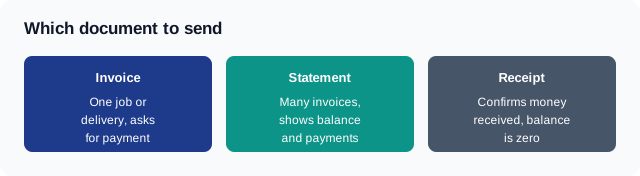
Send a statement when a customer has several open invoices, buys regularly on account, or has missed a due date. Send an invoice every time you make a new sale. A statement never replaces the invoice for a new sale.
Use this decision rule:
- One job, one amount? Send an invoice.
- Two or more open invoices, or a repeat customer? Send an invoice for the new work and a statement at month end.
- A payment is overdue? Send a statement showing the overdue amount, then a reminder.
- The customer paid in full? Send a receipt, not a statement.
Customers who ask "can you send me a statement?" usually want one of two things. Their accounts department wants to reconcile what they owe against their own ledger. Or they have lost track and want a single number to pay.
Statement vs invoice for a customer who pays late
A late payer is the best case for a statement. A single page showing three invoices and the due date of each makes the problem obvious. It also gives the customer one figure to pay, which is easier than chasing individual invoices.
For the next step, use the wording in your reminder email. Invoqk's guide Invoice email template: how to email an invoice covers how to attach a document and what to say alongside it.
What must a statement of account show?
A statement of account must show who it is from, who it is for, the period it covers, every transaction in that period and the balance owed at the end. Anything the customer needs to reconcile with their own records belongs on it.
Include these eight items:
- Your business name, address and contact details.
- The customer's name and address.
- The statement date, spelled out: September 30, 2026.
- The period covered, or "all open items as of" the statement date.
- Opening balance: what was owed at the start of the period.
- A line for every invoice, payment and credit, each with a date, a reference and an amount.
- A running balance after each line.
- The closing balance, clearly labelled "Balance due".
Add two more for a better statement. An ageing summary splits the balance into current and overdue amounts. And a payment instruction line says how and where to pay.
Keep invoice numbers exact. If the statement says INV-2041 and the invoice says INV-2014, the customer cannot match them, and the statement loses its value.
How do you create a statement of account?
You create a statement by listing every transaction for one customer in date order, calculating a running balance and totalling it at the end. The work is arithmetic. The risk is leaving an item out.
Follow these steps:
- Pick the customer and the period. A month is standard.
- Find the opening balance. Use the closing balance of the last statement. For a first statement, use zero.
- List every invoice issued in the period, with its number, date and total.
- List every payment and credit note received or issued, with its date and the invoice it applies to.
- Calculate the running balance. Add each invoice, subtract each payment or credit.
- Check the closing balance against your accounts receivable ledger. The two must match.
- Add an ageing summary. Split the closing balance by how many days overdue each invoice is.
- Send it with payment details and a contact for questions.
If your invoicing tool keeps a customer ledger, step 3 and step 4 are a filter, not typing. Invoqk's statement of account generator builds the page from the invoices you have already made.
What does a statement of account look like? A worked example
Take one customer: Harbor Tile Supply, buying on 30-day terms. In August and September the supplier issues three invoices. The customer pays one.
| Invoice | Issued | Due | Amount | Status on September 30 |
|---|---|---|---|---|
| INV-2041 | August 4, 2026 | September 3, 2026 | $1,200 | Paid September 1 |
| INV-2056 | August 18, 2026 | September 17, 2026 | $860 | Unpaid, 13 days overdue |
| INV-2063 | September 2, 2026 | October 2, 2026 | $1,540 | Unpaid, not yet due |
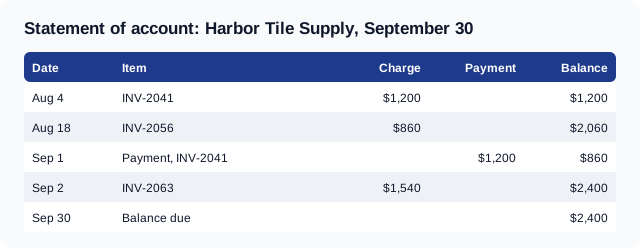
As a list of invoices, the customer has to work out the balance. As a statement, it is already done:
| Date | Item | Charge | Payment | Balance |
|---|---|---|---|---|
| August 1, 2026 | Opening balance | $0 | ||
| August 4, 2026 | INV-2041 | $1,200 | $1,200 | |
| August 18, 2026 | INV-2056 | $860 | $2,060 | |
| September 1, 2026 | Payment, INV-2041 | $1,200 | $860 | |
| September 2, 2026 | INV-2063 | $1,540 | $2,400 | |
| September 30, 2026 | Balance due | $2,400 |
The balance of $2,400 is the sum of the two unpaid invoices: $860 plus $1,540. The check takes ten seconds and catches most mistakes. If a payment was applied to the wrong invoice, the closing balance still agrees, but the ageing will not.
The ageing summary
The ageing summary groups the balance by how late each part is. It tells the customer which part to pay first.
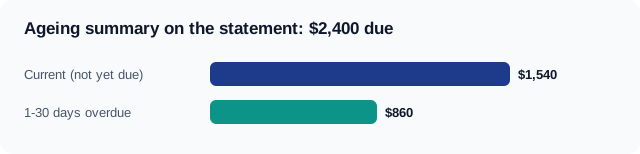
Here, $1,540 is current because INV-2063 is not due until October 2, 2026. The remaining $860 is overdue by 13 days, because INV-2056 fell due on September 17, 2026. A customer who reads only the ageing line knows to pay $860 now.
Statement of account template wording
Put the wording at the bottom of the statement. Short, polite and specific works best.
Standard monthly statement:
Statement of account as of [date]. Balance due: [amount]. Please pay by the due date shown on each invoice. If an item looks wrong, reply to this email with the invoice number and we will check it.
With an overdue amount:
Your account has [amount] past due. The oldest unpaid invoice is [number], due [date]. Please send payment by [date] or tell us when we can expect it.
When a payment is missing:
If you have paid since [date], thank you. Please send us the payment date and amount so we can match it.
The third block saves an argument. Customers often pay without telling you, and a statement with no payment recorded looks like an accusation unless it invites a correction.
How often should you send a statement?
Send a statement once a month for active accounts, usually at month end. Send one at any time when a customer asks, when you are about to change terms, or when an invoice is more than a week past due.
A fixed day helps. Customers who know a statement arrives on the first working day of each month plan their payments around it. Randomly timed statements get lost.
Do not send a statement for an account with a zero balance and no activity. It adds nothing and trains customers to ignore your emails.
What records should you keep?
Keep the statement together with the invoices and payments it summarises. The IRS Publication 583 lists sales slips, paid bills, invoices, receipts and deposit slips as supporting documents, and says to keep records for as long as they may be needed for the administration of any provision of the Internal Revenue Code. A statement is a summary, so the underlying documents are what you rely on.
In practice, store each month's statement beside the invoices it covers. If the customer later disputes the balance, you can show the whole chain in a few minutes.
The same habit applies when you issue credit notes. The layout of a credit note is covered in Credit invoice: what a credit note must show, with a template, and the statement should list the credit as a negative line.
A month-end checklist before you send statements
Run this list for every customer before the statement leaves:
- Every invoice issued in the period appears once, with its exact number.
- Every payment received is applied to the right invoice and dated.
- Every credit note shows as a negative line.
- The closing balance equals the customer's balance in your receivables ledger.
- The ageing buckets add up to the closing balance: here, $1,540 plus $860 equals $2,400.
- The currency is stated, and a UK customer sees pounds, a German customer sees euros.
- The statement date is spelled out, so a reader in the US or the UK cannot misread it.
A customer in the UK or Germany gets the same layout. Only the currency, the tax columns and the payment details change. If the underlying invoices carry VAT, add a VAT column to the statement so the customer can reconcile net, tax and gross against each invoice.
Common mistakes when you create a statement
These are the errors that cause most disputes:
- Treating the statement as the invoice. The customer still needs an invoice for each sale.
- Leaving out a payment. The balance looks too high and the customer stops trusting the page.
- Listing invoices without dates. The ageing cannot be checked.
- Mixing currencies. Convert or separate them. A single balance in two currencies is wrong in both.
- Changing an invoice amount silently. Issue a credit note and show it on the statement.
- Sending it to the wrong person. Statements go to accounts payable, not to the person who ordered the work.
Check the closing balance against your ledger every time. If the two disagree, fix the ledger before you send anything.
When is a receipt better than a statement?
A receipt is better when the customer has paid and owes nothing. A receipt confirms money received. A statement reports what is still owed. If the balance on the statement is zero, send a receipt instead and keep the statement for your own records.
The difference matters for expense claims. A customer claiming a cost usually needs the receipt or the paid invoice, not a statement. The comparison of the two documents is covered in What is the difference between an invoice and a receipt? Invoqk's receipt maker handles the paid case.
Frequently asked questions
What is a statement of account?
A statement of account is a summary of all invoices, payments and credits for one customer over a period, ending with the balance owed. It repeats debts already billed and does not create a new one. Businesses usually send it monthly.
How is a statement different from an invoice?
An invoice bills one sale and is the legal request for payment. A statement lists many invoices and payments and shows the balance. A statement never replaces an invoice, and it does not carry the tax fields an invoice must show.
How do I create a statement of account?
List every invoice, payment and credit for the customer in date order, calculate the running balance, and show the closing balance. Check the total against your receivables ledger, add an ageing summary and send it with payment details.
How often should I send customer statements?
Send one monthly for active accounts. Send one sooner when a customer asks, when an invoice is more than a week overdue or when terms change. Skip accounts with a zero balance and no activity.
Can a statement of account be used as proof of debt?
It supports a claim but is weaker than the invoices behind it. Keep the invoices, delivery records and payment records together with each statement. If a balance is disputed, those documents decide the matter, not the statement alone.
Comments
0No comments yet
Be the first to share your thoughts on this article.
Leave a comment
Your email is never published. Comments appear after approval.