

- A deposit invoice bills an advance payment and should state the total price, the deposit and the remaining balance.
- The final invoice must credit the deposit by invoice number so the client pays only the balance.
- HMRC says most UK deposits create a VAT tax point when received, and German UStG section 14 paragraph 5 requires earlier payments to be deducted.
A deposit invoice template is a bill that asks a client to pay part of the price before the work starts, and that later reconciles with the final invoice. Deposits protect your cash flow, but they also create paperwork, because the deposit has to appear again as a credit when the job ends. This guide gives a filled-in deposit invoice, the matching final invoice, and the tax rules that apply to advance payments in the UK and Germany.
What is a deposit invoice?
A deposit invoice is an invoice for an advance payment, issued before the goods or services are delivered. It names the job, the deposit amount, the total price and the date the deposit is due. It is not the final bill, so it should say what the deposit is for and what balance remains. For the fields every invoice needs, see what to put on an invoice, and for sending it, the invoice email template. See also the credit note guide covers a related case.
A deposit differs from a quote and from a proforma invoice. A quote offers a price and creates no payment obligation. A deposit invoice is a real request for payment, and the amount paid becomes part of your income records.
What should a deposit invoice include?
A deposit invoice should include your details, the client's details, a unique invoice number, the job description, the total agreed price, the deposit amount, the due date and what happens to the deposit if the job is cancelled. The cancellation term is the one writers of templates forget.
Use this order:
- Your name or business name, address and tax number if you have one.
- The client's name and billing address.
- A unique invoice number and the issue date.
- A description of the job and the date it is expected to start.
- The total agreed price.
- The deposit amount and the balance still to pay.
- The deposit due date, written as a calendar date.
- The refund or cancellation terms agreed with the client.
For German suppliers, section 14 paragraph 5 of the UStG says an invoice for a payment received before performance follows the same rules as any other invoice. That means the tax number, sequential number, tax rate and tax amount all apply to the deposit invoice.
Worked example: a deposit invoice and its final invoice
The example below bills a 6,000 kitchen design project. The client pays a deposit of 2,000 at the start, and the balance after delivery. All figures are invented for illustration.
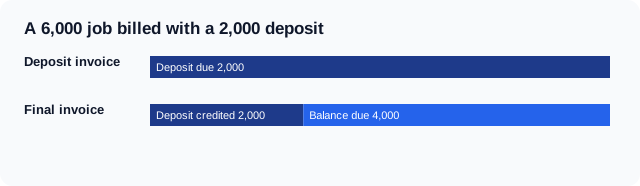
Invoice 1: the deposit invoice
| Field | Entry |
|---|---|
| Invoice number | D-2026-031 |
| Issue date | October 14, 2026 |
| Description | Deposit for kitchen design project, total price 6,000.00 |
| Deposit due | 2,000.00 |
| Balance after deposit | 4,000.00 |
| Due date | October 28, 2026 |
| Terms | Deposit is credited on the final invoice |
Invoice 2: the final invoice
| Field | Entry |
|---|---|
| Invoice number | D-2026-058 |
| Issue date | December 15, 2026 |
| Description | Kitchen design project, delivered |
| Project total | 6,000.00 |
| Less deposit paid (invoice D-2026-031) | minus 2,000.00 |
| Balance due | 4,000.00 |
| Due date | December 29, 2026 |
The final invoice states the full price first, then subtracts the deposit with a reference to the invoice that requested it. The client sees why the amount due is 4,000.00 and which earlier document it relates to.
How does VAT work on a deposit in the UK?
In the UK, most deposits count as advance payments and create a VAT tax point when you receive them. HMRC states in paragraph 14.2.3 of VAT Notice 700 that most deposits serve primarily as advance payments and create tax points when you receive them. A VAT-registered business may therefore need to account for VAT on the deposit before the work is finished.
HMRC also draws a line for deposits that are not payment for a supply. A security deposit on hired goods that is refunded or forfeited for loss or damage creates no tax point when received. Paragraph 8.13.1 adds that VAT is due on all charges, deposits and fees which are full or part payments for a supply.
If you keep a payment for a supply the customer does not take up, VAT is still due on the amount you keep. If you refund the payment, you can reclaim the VAT you accounted for in your next return. Confirm your own position with HMRC or an adviser, because the answer depends on what the deposit is for.
What must a UK deposit invoice show for VAT?
A UK VAT invoice for a deposit must show a unique sequential number, the time of supply, your name, address and VAT registration number, and the customer's name and address, according to paragraph 16.3.1 of HMRC's VAT invoice particulars. It must also describe the goods or services well enough to identify them. HMRC says a VAT invoice should normally be issued within 30 days of the tax point, per paragraph 16.2.3.
HMRC adds that a tax point cannot be created simply by preparing an invoice. The deposit creates the tax point when you receive it, and the invoice then records it. A less detailed invoice is allowed only for supplies of £250 or less where the customer agrees, according to paragraph 16.6.1 of the same Notice 700.
How does a deposit work in Germany?
A deposit in Germany is an advance payment, and the supplier issues an advance payment invoice (Anzahlungsrechnung). Section 14 paragraph 5 of the UStG applies the normal invoice rules to it. The final invoice must then deduct the earlier payments and the tax amounts shown on them, provided invoices were issued for those payments.
The mandatory content in paragraph 4 includes the date of supply or, for advance payments, the receipt date of the payment if it is fixed and differs from the issue date. A German deposit invoice should therefore show the date the payment is expected, and the final invoice should reference each earlier invoice by number.
How much deposit should you ask for?
A deposit is a part payment made before the work is done, and it counts towards the final price. The right deposit depends on your costs and the client's risk, and no law fixes the amount. Most suppliers choose an amount that covers their upfront costs, such as materials or booking fees, so a cancellation does not leave them out of pocket.
Consider these points when you set the figure:
- Cover the costs you must pay before the client sees any result.
- Match the deposit to the stage the work reaches in the first week.
- Use a larger deposit for custom work that cannot be resold.
- Agree a staged schedule for long projects instead of one large deposit.
- Write the amount into the quote so the invoice contains no surprises.
State the figure as a fixed amount rather than a share of the price when the job might change. A fixed deposit avoids an argument if the final scope moves up or down.
What happens to the deposit if the client cancels?
The cancellation term in your agreement decides what happens to a deposit. If the contract says the deposit is non-refundable, the supplier keeps it. If it says the deposit is refundable less costs incurred, the supplier returns the balance with an itemised statement.
Write the term in the quote and repeat it on the deposit invoice. A client who has seen the term twice before paying is less likely to dispute it. For VAT-registered UK suppliers, remember that keeping a payment does not remove the VAT due on it, as HMRC explains in VAT Notice 700.
This guide does not give legal advice. If a client disputes a deposit, check your contract and speak to a qualified adviser.
How do you reconcile the deposit on the final invoice?
A final invoice is the closing bill that credits every deposit and shows the balance. To reconcile a deposit, show the full price, subtract each deposit by invoice number and show the balance. Never issue a final invoice for the full price and expect the client to remember the deposit. That causes double payment and refund requests.
Take these steps when you prepare the final invoice:
- List every deposit invoice and the payment date for each.
- Show the project total on the first line.
- Subtract each deposit as its own line with the invoice number.
- Show the balance due and its due date.
- Check that the deposit and balance add up to the project total.
Where tax applies, the final invoice must also deduct the tax already shown on the deposit invoice, as section 14 paragraph 5 of the UStG requires in Germany.
Which mistakes cause deposit disputes?
Most deposit disputes come from a short list of habits:
- No written cancellation or refund term.
- A deposit invoice that does not say it is a deposit.
- A final invoice that ignores the deposit already paid.
- A deposit that is described as a fee but treated as refundable.
- VAT left off a deposit that created a tax point.
Send the deposit invoice as soon as the client accepts the quote. Start work only after the deposit arrives, unless your contract says otherwise.
If you want a ready layout, the Invoqk invoice generator can build both the deposit invoice and the final invoice from a job description.
Frequently asked questions
Why send a deposit invoice before starting work?
A deposit invoice is a bill for an advance payment, sent before the work or delivery. It states the total price, the deposit amount and the balance. The final invoice later credits the deposit so the client pays only the remainder.
What should a deposit invoice say?
It should say it is a deposit, name the job, show the total price, the deposit amount, the balance and the due date, and state what happens if the job is cancelled. Add your tax number if you are registered.
Is VAT due on a deposit in the UK?
Usually yes. HMRC says in VAT Notice 700 that most deposits are advance payments and create a tax point when received. Security deposits that are refunded or forfeited for damage are different and create no tax point.
How do I credit a deposit on the final invoice?
Show the full project price, subtract the deposit as its own line with the deposit invoice number, and show the balance due. In Germany, section 14 paragraph 5 of the UStG requires the earlier payments and their tax to be deducted.
Can I keep a deposit if the client cancels?
Only if your agreement says so. The cancellation term in the quote or contract decides whether the deposit is refundable. For UK VAT purposes, keeping the payment does not remove the VAT due on it.
Comments
2Leave a comment
Your email is never published. Comments appear after approval.