

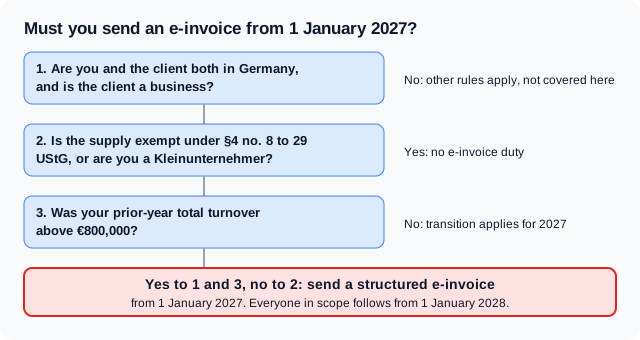
- A structured e-invoice is required for German B2B invoices from January 1, 2027 if prior-year total turnover was above €800,000, and from January 1, 2028 for everyone.
- Issuers with prior-year turnover up to €800,000 may use paper or, with the recipient's consent, a PDF for 2027 supplies, according to section 27 of the VAT Act.
- Kleinunternehmer may always send an ordinary invoice under section 34a, and invoices to foreign clients or consumers fall outside the duty.
As of October 21, 2026, there are 72 days until January 1, 2027, the date on which the German transition rules for paper and PDF invoices narrow for many businesses. This guide reads the statute text itself, and it answers one practical question: do you have to send a structured e-invoice in 2027, or can you still send a PDF? It also gives you a decision chart, a worked set of examples and a checklist to finish before the year ends.
Who must issue an e-invoice in Germany from 2027?
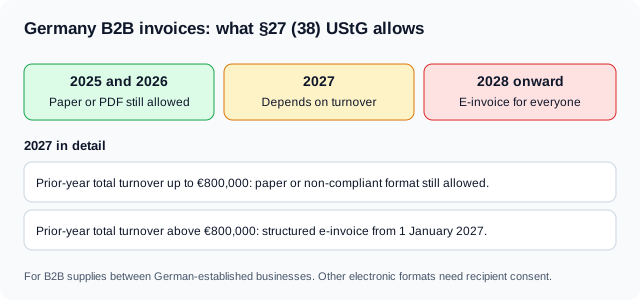
Every German business that invoices another business in Germany must issue a structured e-invoice from 2027, unless its prior-year total turnover was €800,000 or less, in which case a transition rule lets it use paper or another format until the end of 2027. From January 1, 2028, the statute offers no such transition for these invoices. Related: what a German Kleinunternehmer invoice must say.
The rule sits in the German VAT Act. Section 14 of the German VAT Act (UStG) requires an e-invoice for a supply to another entrepreneur for its business when the supplier and the recipient are both established in Germany. Section 27 paragraph 38 of the transition rules in the VAT Act then sets the dates and the €800,000 limit.
What is an e-invoice under German law?
An e-invoice is an invoice that is issued, sent and received in a structured electronic format and that allows electronic processing. That is the wording of section 14 paragraph 1 of the German VAT Act, which says an e-invoice is an invoice issued in a "strukturierten elektronischen Format".
The format must follow the European standard for electronic invoicing and the list of syntaxes under Directive 2014/55/EU, or it can be another format that the issuer and the recipient agree on. The statute refers to the European standard without naming it in this passage. In practice, XRechnung and ZUGFeRD are the formats that German businesses most often use to meet it.
A standard PDF is a document that a person reads. The law asks for a structured file that software can process, so an ordinary PDF does not meet the definition. A ZUGFeRD file is different, because it combines a readable PDF with structured data embedded inside it.
Which invoices does the e-invoice duty cover?
The duty covers invoices for supplies to another business, issued by a supplier established in Germany to a recipient established in Germany. Paragraph 2 of section 14 sets this out in its second sentence, number 1, and it excludes supplies that are tax-exempt under section 4 numbers 8 to 29 of the VAT Act.
Four situations fall outside the duty or follow other rules.
- Invoices to private customers, because the duty applies to supplies to another entrepreneur for its business.
- Invoices to clients in another country, because the supplier and the recipient must both be established in Germany.
- Invoices for supplies that are exempt under section 4 numbers 8 to 29, such as certain financial and medical services.
- Invoices from small businesses that use the Kleinunternehmer exemption, which the next sections explain.
If your client is in another EU country, a different treatment applies, usually the reverse charge with its own invoice wording.
How does the €800,000 turnover test work?
The test compares your total turnover in the previous calendar year with €800,000. Section 27 paragraph 38 number 2 of the VAT Act lets an issuer send paper or, with the recipient's consent, a non-compliant electronic format for supplies made in 2027, if the issuer's total turnover in the previous year was no more than €800 000.
The statute uses the term Gesamtumsatz, which it ties to section 19 paragraph 2 of the VAT Act. For 2027, the relevant year is 2026. Look at your full turnover for 2026, and compare it with the limit.
| Your total turnover in 2026 | Your position for invoices on 2027 supplies |
|---|---|
| €800,000 or less | Paper, or a non-compliant electronic format with the recipient's consent, remains possible until December 31, 2027 |
| More than €800,000 | A structured e-invoice is required from January 1, 2027 |
The test looks at the year before the supply, so a business that grows past the limit during 2027 is not caught until 2028. From January 1, 2028, the statute lists no turnover-based transition for these invoices.
What does the 2025 to 2028 transition look like?
The transition has three steps in the statute, and they differ by date and by turnover. Section 27 paragraph 38 numbers 1 to 3 describe them, and the table shows each one in plain English.
| Period | Who may still use paper or another format | Condition |
|---|---|---|
| Supplies in 2025 and 2026, invoice sent by December 31, 2026 | Every issuer | Recipient's consent for an electronic format that does not meet the standard |
| Supplies in 2027, invoice sent by December 31, 2027 | Issuers with prior-year total turnover up to €800,000 | Same consent rule for electronic formats |
| Supplies in 2027, invoice sent by December 31, 2027 | Any issuer using EDI | Recipient's consent |
| Supplies from 2028 | Nobody under these rules | Structured e-invoice required |
The third row covers electronic data interchange, known as EDI, where two companies exchange invoice data directly between their systems. It is relevant mainly to larger businesses with established data links.
The independent summary from the IHK Stuttgart chamber of commerce describes the same turnover limit and the end of the transition period for businesses above it.
What if you are a Kleinunternehmer?
A Kleinunternehmer is a small business that is exempt from charging VAT under section 19 of the VAT Act. If you are one, you are not forced into the structured e-invoice format. Section 34a of the German VAT implementing regulation says that an invoice for supplies exempt under section 19 paragraph 1 may always be sent as a "sonstige Rechnung", which means an ordinary invoice in another format.
Section 34a also lists what such an invoice must contain. Among the minimum details, it requires the amount in a single sum with a note that the small-business exemption applies under section 19 of the VAT Act. You can read the text of section 34a of the VAT implementing regulation on the official site.
This is a permission, not a ban. You may send a structured e-invoice if your client asks for one, and many small businesses will do so to keep large clients happy. A Kleinunternehmer who also sells a taxable service outside the exemption should ask a tax adviser how the rules apply to each invoice.
What do three real cases look like?
Here are three freelancers in Germany with different situations. Each shows how the rules apply to a normal invoice in 2027.
Case 1: Jonas, an IT consultant in Hamburg. Jonas had total turnover of €62,000 in 2026 and invoices a software company in Munich. Because his turnover is below €800,000, he may still send a PDF in 2027 if the recipient agrees to receive it, and from 2028 he must send a structured e-invoice. He decides to switch in 2027 anyway, to avoid a rush later.
Case 2: Studio Nord GmbH, a design agency in Berlin. Studio Nord had total turnover of €1.1 million in 2026. It invoices business clients in Germany. Its invoices for supplies on or after January 1, 2027 must be structured e-invoices.
Case 3: Lena, a Kleinunternehmer in Leipzig. Lena's turnover is below the small-business limit, and she charges no VAT. Under section 34a, she may keep sending an ordinary invoice that carries the small-business note. She chooses to offer an XRechnung to one large client who requires it.
What is inside a structured e-invoice?
A structured e-invoice carries the same facts as a paper invoice, but each fact sits in a labelled field that software can read without guessing. The seller, the buyer, the invoice number, the date, each line item, the tax and the total all have their own place in the file.
This matters because a missing or misplaced field can make a file fail a check, even though a human would understand the invoice at a glance. Prepare these items in advance.
- Your full name, address and tax or VAT ID.
- The client's full name and address, entered exactly as in the contract.
- A unique invoice number that never repeats.
- The invoice date and the date or period of the service.
- One line per service or product, with quantity, unit price and tax treatment.
- The payment terms and your bank details, including a payment reference.
If your client uses a routing reference or a purchase order number, ask for it before you invoice. Larger clients often reject an invoice that lacks one.
What should you tell your clients about the change?
Write to your main business clients now, because they decide how invoices reach their accounting system. A short message avoids surprises in January and shows that you are prepared.
Hello, from January 2027 I will send invoices as structured e-invoices (XRechnung or ZUGFeRD) in line with the German e-invoice rules. Please tell me which format your accounting system prefers and which address or reference I should use. Until then, my invoices stay as they are.
Keep a record of each reply. If a client cannot yet receive structured files, note the date you asked, and ask a tax adviser how to proceed under the transition rules.
What happens to a December 2026 job that you invoice in January 2027?
On a plain reading of section 27 paragraph 38, a supply made in December 2026 is covered by the first transition rule only if you send the invoice by December 31, 2026. The first rule applies to an invoice transmitted until December 31, 2026 for a supply made before January 1, 2027. The second rule applies only to supplies made after December 31, 2026.
That wording leaves a possible gap for a supply made in 2026 and invoiced in 2027. This is a plain reading of the statute, and it is not a statement of official guidance. The Federal Ministry of Finance publishes letters that explain how the tax authorities apply these rules, so read the latest one, or ask your tax adviser, before you rely on any late-invoicing practice.
The safe habit is simple. Finish and send every invoice for work done in 2026 by December 31, 2026, in the format you use today. You then stay clearly inside the first transition rule.
What should you do before January 1, 2027?
Use the 72 days to move from decision to working setup. The steps below take a small business roughly one afternoon.
- Add up your total turnover for 2026, as soon as you can estimate it, and compare it with €800,000.
- List your business clients in Germany, and mark those who are also businesses established in Germany.
- Ask each of them how they want to receive invoices, and note whether they can read XRechnung or ZUGFeRD files.
- Choose a tool that produces a structured e-invoice, and create a test invoice.
- Check the test file with a validator before you send a real one.
- Update your invoice template so that it carries the fields that the structured format needs, such as your VAT ID and a payment reference.
- Send all invoices for 2026 work by December 31, 2026.
Invoqk's e-invoice validator checks an e-invoice file before you send it, and the PDF to e-invoice converter turns an existing PDF invoice into structured data. When you are ready to issue a new document, Invoqk's invoice generator can export XRechnung and ZUGFeRD files.
Which mistakes will cause trouble with an e-invoice?
Most problems come from sending the right content in the wrong form. The table lists common mistakes and how to avoid them.
| Mistake | What goes wrong | Fix |
|---|---|---|
| Sending a plain PDF after the transition | The invoice is not a structured e-invoice | Send XRechnung or ZUGFeRD |
| Assuming the €800,000 test uses the current year | The test uses the previous year | Check last year's total turnover |
| Applying the duty to a foreign client | The duty needs both parties in Germany | Use the cross-border rules |
| Skipping validation | A file with errors may be rejected | Validate before you send |
| Mixing credit notes into the old format | A correction should match the invoice it fixes | Issue the credit note in the same format |
| Forgetting the Kleinunternehmer note | The invoice lacks the required exemption wording | Add the section 19 note |
Credit notes deserve a short mention. A credit note corrects an invoice you have already issued, so match its format to the original. The Invoqk guide to credit invoices explains what a credit note must show.
Where can you check the rules yourself?
Read the statute text on the official legal portal of the German federal government. Section 14 defines the e-invoice and the duty, section 27 paragraph 38 holds the transition rules, and section 34a of the implementing regulation covers small-business invoices.
For borderline cases, such as a business that changes its legal form or crosses the turnover limit, ask a tax adviser. This guide describes the general rules and cannot assess your own facts.
What to do next
Decide this week which of the three groups you belong to: above €800,000, below it, or Kleinunternehmer. Then pick the date on which you will switch to structured invoices, test one file with a validator and tell your main clients. For related reading, see "What is a tax invoice? UK, German and Australian rules" and "Credit invoice: what a credit note must show, with a template".
Frequently asked questions
Do freelancers in Germany have to send e-invoices in 2027?
Only if their prior-year total turnover was above €800,000 and the client is a business in Germany. Below that limit, section 27 of the VAT Act lets them keep paper or, with the client's consent, a PDF until December 31, 2027.
Is a PDF invoice an e-invoice in Germany?
No. Section 14 of the German VAT Act defines an e-invoice as an invoice in a structured electronic format that allows electronic processing. An ordinary PDF is a readable document, not structured data. ZUGFeRD embeds structured data inside a PDF.
Does a Kleinunternehmer have to send e-invoices in Germany?
No. Section 34a of the VAT implementing regulation says an invoice for supplies exempt under section 19 may always be sent as an ordinary invoice. A Kleinunternehmer may still send an e-invoice if a client asks.
When do all German B2B invoices have to be e-invoices?
From January 1, 2028. The transition rules in section 27 paragraph 38 of the VAT Act end with supplies made in 2027, and the statute lists no turnover-based exception for 2028 onward.
Which year counts for the €800,000 turnover limit?
The previous calendar year. For supplies made in 2027, compare your total turnover for 2026 with €800,000. Growth during 2027 does not remove the transition for that year.
Comments
0No comments yet
Be the first to share your thoughts on this article.
Leave a comment
Your email is never published. Comments appear after approval.