

- A Kleinunternehmer invoice in Germany shows no VAT line and carries a sentence saying the § 19 UStG exemption applies.
- Since January 1, 2025, the limits are €25,000 for the prior year and €100,000 for the current year, according to the Bundesfinanzministerium (BMF).
- The invoice that pushes turnover past €100,000 must already show VAT.
- Small businesses under § 19 UStG do not have to issue e-invoices, but they must be able to receive them.
This guide shows what a German small-business invoice must say, with the 2026 limits and a filled-in example.
What is a Kleinunternehmer invoice?
A Kleinunternehmer invoice is a German invoice issued by a business that uses the small-business scheme in § 19 of the Umsatzsteuergesetz (UStG). The business charges no VAT and shows no VAT amount. The invoice still needs the usual details of a German invoice, plus one sentence that names the exemption. In short, the invoice must say that § 19 UStG applies. Related: the German e-invoice duty from 2027, what a tax invoice must show.
The Kleinunternehmerregelung is the small-business scheme in § 19 UStG, and it exists so that a solo freelancer with modest turnover does not have to register for VAT returns. The trade-off is simple. You cannot charge VAT to your clients, and you cannot reclaim the VAT you pay on your own purchases.
In this guide, you will learn the wording, the fields, a filled-in example, and the limits for 2026. It also covers three things most guides skip. It shows what happens to the invoice that crosses €100,000, what the e-invoice duty means for you, and when leaving the scheme is the smarter move.
What are the Kleinunternehmer limits in 2026?
The limits are €25,000 turnover in the previous calendar year and €100,000 in the current calendar year, according to the Bundesfinanzministerium letter on § 19 UStG of March 18, 2025. Both limits apply from January 1, 2025. Before that date the limits were €22,000 and €50,000, so older guides are out of date.
The two limits work together, as the table shows.
| Test | Limit | What happens if you pass it |
|---|---|---|
| Prior-year turnover (2025 for a 2026 invoice) | €25,000 | You must charge VAT for the whole of 2026 |
| Current-year turnover (2026) | €100,000 | VAT starts with the invoice that crosses the limit |
The same BMF letter calculates turnover from the payments you actually receive, and it does not add a notional VAT amount. For a Kleinunternehmer this matters little in practice. You never charge VAT, so your net and gross figures are the same number.
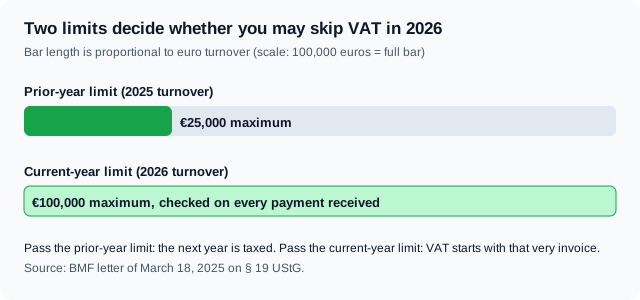
The prior-year limit is checked once, at the start of the year. If your 2025 turnover was €27,000, you cannot use the scheme in 2026, even if you expect a quiet year. The current-year limit is checked continuously, and a single large project can trip it.
What must a Kleinunternehmer invoice contain?
A Kleinunternehmer invoice must contain the standard invoice fields from § 14 Abs. 4 UStG, minus the VAT items, plus a reference to the exemption. The BMF letter confirms that the invoice must state that the small-business exemption under § 19 UStG applies.
Use this checklist for every invoice:
- Your full name and address, as it appears in your tax registration.
- Your client's full name and address.
- Your Steuernummer is the tax number issued by the Finanzamt, and it goes on the invoice. A VAT ID is not required on a domestic invoice.
- The invoice date.
- A unique invoice number that never repeats.
- The date or month in which you delivered the service.
- A clear description of what you delivered, with quantity or hours.
- The total price, with no VAT line.
- The § 19 UStG sentence.
- Payment terms, such as a due date and your bank details.
Invoices for small amounts have lighter rules. For invoices of up to €250 net, German law allows shortened content, and the BMF letter points to § 34a UStDV for these simplified invoices. Do not rely on this when you invoice a business, because business clients usually want the full set of fields to book the cost.
If you want a ready-made layout, Invoqk's invoice generator includes a Kleinunternehmer template with zero VAT on every line (BMF guidance, 2025).
What is the exact wording for the § 19 UStG sentence?
The invoice needs a sentence that tells the reader no VAT is charged because of § 19 UStG. The BMF letter accepts a plain-language notice, such as "steuerfreier Kleinunternehmer", as long as it clearly signals that the exemption applies.
These formulations are in common use:
| Wording | Language | Notes |
|---|---|---|
| Gemäß § 19 UStG wird keine Umsatzsteuer berechnet. | German | The most common wording |
| Kein Umsatzsteuerausweis aufgrund Anwendung der Kleinunternehmerregelung nach § 19 UStG. | German | Longer, fully explicit |
| No VAT is charged under § 19 UStG (small-business scheme). | English | Useful for an English-speaking client |
Put the sentence directly under the total, where a bookkeeper will see it. Do not hide it in the footer. A client's accountant looks for this sentence to decide why no VAT appears.
What does a filled-in Kleinunternehmer invoice look like?
A filled-in Kleinunternehmer invoice has all ten fields from the checklist and ends with one clear total and the § 19 UStG sentence. The example below is for a freelance web designer who delivers a website and five hours of logo revisions to a company in Hamburg.
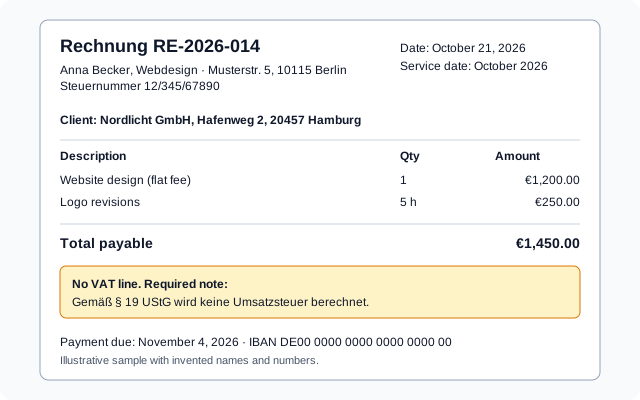
The names and numbers in the example are invented. The structure is the part to copy.
Here is how the example is built, line by line:
- Header: invoice number RE-2026-014, invoice date October 21, 2026, and the service period "October 2026".
- Line items: a flat fee of €1,200.00 for the website and €250.00 for five hours of revisions at €50 per hour.
- Total: €1,450.00. The client pays exactly this amount, with no VAT added.
- Note: the § 19 UStG sentence, directly below the total.
- Payment line: a due date two weeks out and the freelancer's bank details.
Two details save time later. First, write the service period, even when it is only a month. Second, keep one running invoice-number sequence. If you use the prefix RE-2026-, never reset it mid-year.
What changes when one invoice pushes you past €100,000?
When one invoice pushes your current-year turnover above €100,000, regular VAT rules apply from that invoice onward. The BMF letter states that the turnover which exceeds the limit is already taxable, and the IHK Stuttgart explainer on the Kleinunternehmer limits describes the same rule: earlier invoices in the year stay tax-free, with no retroactive tax.
A worked example shows the effect. A freelance consultant has invoiced €96,000 from January to September 2026. In October, the consultant sends an €8,000 invoice.
- Cumulative turnover would reach €104,000, which is above the €100,000 limit.
- The October invoice must show VAT at the standard German rate of 19% (§ 12 UStG, BMF letter 2025): €8,000 plus €1,520 equals €9,520.
- The January to September invoices stay VAT-free.
- Every invoice from November onward shows VAT.
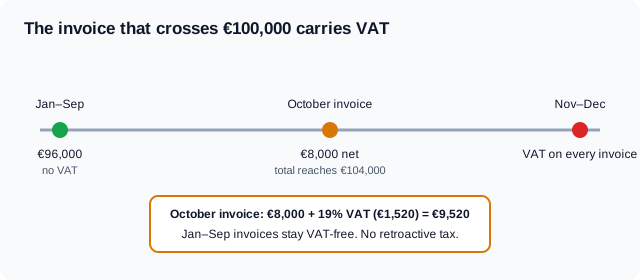
This example treats the whole October invoice as taxable. If a single invoice straddles the limit, the BMF letter and § 19 UStG decide how to split it, and a Steuerberater (tax adviser) should confirm the split before you send the invoice.
The practical rule is to track your running total every month. Add each payment as it arrives. When the total gets within about €10,000 of the limit, plan for VAT before the next large invoice goes out.
Does a Kleinunternehmer have to issue e-invoices?
A Kleinunternehmer under § 19 UStG does not have to issue invoices as e-invoices, according to the IHK Rhein-Neckar e-invoice guidance, which cites § 34a UStDV introduced by the Jahressteuergesetz 2024. A Kleinunternehmer must still be able to receive e-invoices, because the receiving duty applies to every business since January 1, 2025.
This is easy to mix up with the wider German e-invoice rules, so the three cases are worth separating:
| Situation | Duty |
|---|---|
| You issue invoices as a Kleinunternehmer | No e-invoice duty; a PDF or paper invoice is allowed |
| You receive an invoice from a regular supplier | You must be able to receive an e-invoice (XRechnung or ZUGFeRD) |
| You leave the scheme and charge VAT | The normal e-invoice timetable applies to you, including the 2027 and 2028 steps for smaller suppliers |
The transition steps for regular suppliers use an €800,000 prior-year turnover line in 2027, according to the IHK Dresden e-invoice overview. A Kleinunternehmer is far below it, so the line only matters if you grow out of the scheme. Our guide on the e-invoice duty in Germany from 2027 explains who must issue one and when.
One practical step is worth doing now. Open an email address that can receive XML attachments, and tell your regular clients where to send e-invoices.
Should you stay in the Kleinunternehmer scheme?
Staying in the scheme is usually right for a freelancer who sells to private customers, because VAT would raise the price or cut the margin. Leaving the scheme is often right for a freelancer who sells to businesses and buys expensive equipment, because business clients reclaim the VAT you charge.
A short calculation shows the difference. A freelancer wants to keep €1,000 per job.
| Kleinunternehmer | Regular VAT | |
|---|---|---|
| Net price | €1,000 | €1,000 |
| VAT added (19%) | €0 | €190 |
| Client with VAT deduction pays net | €1,000 | €1,000 (reclaims €190) |
| Private client pays | €1,000 | €1,190 |
| Input VAT on a €2,000 laptop | Not reclaimable | €380 reclaimable |
For a business client, VAT is cost-neutral, so regular taxation costs you nothing in sales. For a private client, regular taxation either raises the price by 19% or cuts your margin. The laptop line shows the other side: regular VAT lets you reclaim input VAT on purchases.
The BMF letter of November 10, 2025 deals with input VAT when you move between the two regimes, so read it before you switch. Leaving the scheme voluntarily is a decision to take with your Steuerberater.
What mistakes do Kleinunternehmer make on invoices?
The most common Kleinunternehmer invoice mistakes are showing a VAT line, forgetting the § 19 sentence, and missing the €100,000 trigger. Each one is cheap to prevent with a template and a running total.
| Mistake | Why it matters | Fix |
|---|---|---|
| Adding a 19% line out of habit | The scheme means no tax is charged | Use a template with every line at 0% |
| Leaving out the § 19 sentence | The client's accountant cannot see why VAT is missing | Put the sentence under the total |
| Using the old €22,000 and €50,000 limits | They ended on December 31, 2024 | Use €25,000 and €100,000 |
| Not tracking the running total | The €100,000 trigger is immediate | Keep a monthly turnover sheet |
| No service period | The invoice is incomplete | Write the month or the date |
| Restarting invoice numbers | Numbers must be unique | Keep one sequence per year |
A second group of mistakes comes from mixing up documents. A quote or estimate is not an invoice, and a payment reminder should repeat the same exemption sentence if it restates the amount. Our guide on what to put on an invoice, including the message, signature and fields, covers the wording around the numbers.
Does the same rule apply to clients outside Germany?
A Kleinunternehmer invoice to a client in another country starts from the same no-VAT principle, but this article only covers German domestic invoices. For services to a business, the EU taxes the supply where the business customer is established, under Article 44 as amended by Directive 2008/8/EC on the place of supply of services. The client's country may impose its own requirements, and this article does not verify them.
If your client is a business in another EU country, you also need to think about reverse charge wording, which applies to VAT-registered suppliers. Our guide on invoicing a client in another EU country explains what to write. Check with your Finanzamt before you assume the German exemption sentence is enough for a cross-border client.
What should you do this week?
Pick the three tasks that fit your situation, and finish them before your next invoice.
- Add up your 2025 turnover and confirm it was €25,000 or less.
- Start a running 2026 total and compare it with €100,000 every month.
- Check that your invoice template has no VAT line and includes the § 19 UStG sentence.
- Open an inbox that can receive e-invoices.
- Save your last five invoices as PDFs with the exemption sentence visible.
You can build the invoice in minutes with Invoqk's free invoice generator, then download it as a PDF.
Frequently asked questions
What do I write on an invoice as a Kleinunternehmer?
Write the standard invoice fields without a VAT line, and add a sentence such as "Gemäß § 19 UStG wird keine Umsatzsteuer berechnet." The BMF accepts a clear plain-language notice, as long as it signals that the small-business exemption applies. Place the sentence under the total so the client's accountant sees it at once.
Which turnover limits apply to Kleinunternehmer this year?
The limits are €25,000 turnover in the previous year and €100,000 in the current year, according to the BMF letter of March 18, 2025. If 2025 turnover was above €25,000, regular VAT applies for all of 2026. If 2026 turnover passes €100,000, VAT starts with the invoice that crosses the limit.
Can I show VAT on a Kleinunternehmer invoice?
No, you should not show VAT on a Kleinunternehmer invoice, because the exemption means you do not charge tax. A VAT line is a sign that regular taxation applies. If your turnover has crossed the €100,000 limit, you must switch to regular invoices with VAT from the invoice that crosses it.
Do Kleinunternehmer need an e-invoice in 2027?
No, a Kleinunternehmer under § 19 UStG does not have to issue e-invoices, according to the IHK chambers, which cite § 34a UStDV. You must still be able to receive e-invoices, since the receiving duty has applied to all German businesses since January 1, 2025. If you leave the scheme, the normal e-invoice timetable applies to you.
What happens if I go over €100,000 during the year?
You lose the scheme during the year. The invoice that carries your turnover past €100,000 must show VAT, and every later invoice follows regular rules. Earlier invoices in the same year stay VAT-free, and there is no retroactive tax, according to the BMF letter of March 18, 2025.
Is a Kleinunternehmer invoice valid without a Steuernummer?
No, a Kleinunternehmer invoice needs your tax number from the Finanzamt, because the standard invoice fields in § 14 Abs. 4 UStG still apply. You do not need a VAT ID for a domestic invoice. Check your tax registration letter for the number, and copy it exactly onto every invoice.
Comments
0No comments yet
Be the first to share your thoughts on this article.
Leave a comment
Your email is never published. Comments appear after approval.