

- A tax invoice is a sales document that shows VAT or GST separately so the buyer can reclaim it.
- UK VAT invoices need a unique number, tax point and VAT number, and are normally issued within 30 days of the tax point.
- Germany requires a unique sequential number and no handwritten signature, while Australia requires a tax invoice within 28 days of a customer request.
A tax invoice is a sales document that shows the tax charged on a supply, separately from the price, so the buyer can reclaim that tax. In the UK it is called a VAT invoice, in Germany a Rechnung under section 14 of the UStG, and in Australia a tax invoice for GST. This guide shows what each country requires, with one worked example per country.
Tax invoice definition and purpose
A tax invoice is an invoice that meets a tax authority's content rules. The buyer needs it as evidence to claim back the VAT or GST it paid. An ordinary invoice only asks for payment, while a tax invoice also proves the tax. Related: what a German Kleinunternehmer invoice must say, the German e-invoice duty from 2027, invoicing a client in another EU country.
The key point is that the rules belong to a jurisdiction. HMRC sets the UK rules in VAT Notice 700. The German Federal Ministry of Justice publishes section 14 of the UStG. The Australian Taxation Office (ATO) sets the GST rules on its tax invoices page.
How does a tax invoice differ from a normal invoice?
A normal invoice can contain any details the two parties agree on. A tax invoice must also contain the items the tax law lists. The table compares the three systems covered here.
| Point | UK (HMRC) | Germany (UStG section 14) | Australia (ATO) |
|---|---|---|---|
| Name of the document | VAT invoice | Rechnung | Tax invoice |
| Fewer details allowed | Up to £250 | Not covered here | Under $1,000 needs seven details |
| Issue deadline | Normally within 30 days of the tax point | Within six months for business customers | Within 28 days of a customer request |
| Handwritten signature | Not listed in the particulars | Not required | Not listed in the details |
What must a UK VAT invoice show?
A UK VAT invoice must show a unique sequential number, the time of supply (the tax point), your name, address and VAT registration number, and your customer's name and address. It must also describe the goods or services well enough to identify them. HMRC lists these particulars in paragraph 16.3.1 of its VAT invoice rules.
Three further UK rules matter for most small suppliers:
- HMRC says you should normally issue a VAT invoice within 30 days of the tax point, under paragraph 16.2.3 of VAT Notice 700.
- A less detailed invoice is allowed only when the supply is £250 or less and the customer agrees, according to paragraph 16.6.1 of Notice 700.
- GOV.UK says your invoice must include your VAT number and display the VAT separately.
An invoice does not create a tax point by itself. HMRC states in VAT Notice 700 that a tax point cannot be created simply by preparing an invoice.
What must a German invoice show under UStG section 14?
A German invoice must show the full names and addresses of supplier and customer, the supplier's tax number or VAT ID, and the issue date. Section 14 paragraph 4 of the UStG also requires a unique, sequential invoice number. It requires the quantity and type of goods or the scope of the service, and the date of supply.
The invoice must then split the net amount by tax rate, show the tax rate and the tax amount, or state the exemption that applies. Any agreed discount that is not already in the price must also be shown.
Two German rules answer common questions. First, section 14 paragraph 3 does not require a handwritten signature. It requires that the origin, integrity and legibility of the invoice are assured. Second, under section 14 paragraph 2, an invoice to another business is mandatory within six months after the supply, unless the supply is tax-exempt under section 4 numbers 8 to 29.
What must an Australian tax invoice show?
An Australian tax invoice must be issued within 28 days if the customer asks for one, unless the sale is $82.50 or less including GST, according to the ATO's GST guidance. For taxable sales under $1,000, the ATO lists seven details the invoice must make clear. These cover the document's purpose, your identity and ABN, the issue date, a description of the items, the GST amount, and the taxable extent of each sale.
At $1,000 or more, the ATO also requires the buyer's identity or ABN on the invoice. The document should state the words "tax invoice" so the buyer can see what it is.
How a recipient created tax invoice works
A recipient created tax invoice (RCTI) is a tax invoice that the buyer writes instead of the supplier. It exists for cases where the buyer already knows the amount owed, such as a platform paying many small sellers.
In Australia the ATO requires a written agreement before the buyer may issue one. The ATO says the Recipient Created Tax Invoice Determination 2023 decides which supplies qualify and what the agreement must contain. Both sides must be registered for GST. The document is labelled "Recipient Created Tax Invoice" and carries the usual tax invoice details, including both ABNs.
Germany has a similar idea. Section 14 paragraph 4 of the UStG says that when the recipient issues the invoice, the document must carry the word Gutschrift (self-billing credit note). This is not a credit note in the English sense, which cancels an earlier invoice.
Practical rules for suppliers who receive an RCTI:
- Do not issue your own invoice for the same supply. Two invoices for one sale cause double counting.
- Keep the written agreement with your records.
- Check the amounts, because the buyer prepared the document.
Worked example: one job, three tax invoices
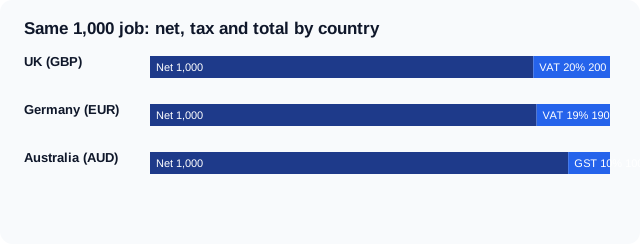
Take a design job priced at 1,000 in net terms, with assumed tax rates of 20% UK VAT, 19% German VAT and 10% Australian GST. The totals differ because the rates differ.
| Country | Net price | Tax rate | Tax amount | Total |
|---|---|---|---|---|
| UK | £1,000.00 | 20% | £200.00 | £1,200.00 |
| Germany | €1,000.00 | 19% | €190.00 | €1,190.00 |
| Australia | A$1,000.00 | 10% | A$100.00 | A$1,100.00 |
The UK invoice must carry the VAT number, a sequential number such as INV-0042, the tax point and the VAT amount shown separately. The German invoice needs the tax number or VAT ID, the date of supply and the split by tax rate. The Australian invoice is above $1,000, so it needs the buyer's identity or ABN, and the words "tax invoice".
The rates in this table are assumptions for the example. Confirm the current rate for your supply with the tax authority before you issue.
Tax invoice checklist before you send
A tax invoice checklist is a short list of fields to confirm before the document leaves your desk. Run through these six steps for every invoice that carries VAT or GST:
- Write your legal name, address and tax registration number (UK VAT number, German tax number or VAT ID, or Australian ABN).
- Write the customer's name and address, and add their ABN when an Australian sale is $1,000 or more.
- Give the invoice a unique number in a sequence with no gaps you cannot explain.
- State the date of issue and the date of supply, because the two can differ.
- Describe each line well enough for a stranger to identify what was sold, with quantity and unit price.
- Show the net amount, the tax rate, and the tax amount on separate lines, and add the word "tax invoice" or "VAT invoice" at the top.
Keep a copy of each invoice you issue. Tax authorities expect the supplier and the buyer to hold matching records, so a missing copy is a problem for both sides.
Selling across borders
A tax invoice for a cross-border sale follows the rules of the country where the supply is taxed. The same freelancer can need a UK VAT invoice for a London client and a German Rechnung for a Berlin client in the same week. Reverse-charge cases add a note, and section 14 of the UStG requires an indication of the recipient's retention duty in those cases. Before you invoice a customer abroad, confirm with the tax authority of your own country which rules apply to that sale.
Common mistakes on tax invoices
Most rejected tax invoices fail on a small number of points:
- A missing supplier VAT number or tax number.
- VAT folded into the price without a separate line.
- A date of supply that is absent or different from the issue date with no note.
- A non-sequential invoice number that cannot be traced.
- A description too vague to identify the goods or services.
This post describes the general rules and does not give advice on a specific situation. A tax adviser can confirm how the rules apply to your sales.
If you want a ready layout, the Invoqk invoice generator adds the VAT line and sequential numbering for you.
Frequently asked questions
What is a tax invoice?
A tax invoice is a sales document that shows the tax charged separately from the price. The buyer uses it to reclaim VAT or GST. Each country sets its own list of required details, so check the rule of the country where the supply is made.
Is a tax invoice the same as a VAT invoice?
In the UK, a VAT invoice is the tax invoice. HMRC sets the required particulars in VAT Notice 700. In Australia the same document type is called a tax invoice and carries GST. The name changes by country, but the purpose is the same.
Do I need a signature on a tax invoice?
Germany does not require a handwritten signature under section 14 paragraph 3 of the UStG. It requires the origin, integrity and legibility of the invoice to be assured. HMRC's VAT Notice 700 and the ATO do not list a signature among the tax invoice details covered here.
What is a recipient created tax invoice?
A recipient created tax invoice is a tax invoice that the buyer issues on the supplier's behalf. In Australia the ATO requires a written agreement first. The document is labelled "Recipient Created Tax Invoice" and shows both parties' ABNs.
How long do I have to issue a tax invoice?
In the UK, HMRC says to normally issue a VAT invoice within 30 days of the tax point. In Germany, an invoice to a business is mandatory within six months of the supply. In Australia, you have 28 days after a customer asks for one.
Comments
0No comments yet
Be the first to share your thoughts on this article.
Leave a comment
Your email is never published. Comments appear after approval.