

- A trucking invoice bills one load with the load, rate confirmation and BOL numbers, linehaul, fuel surcharge, accessorials and the signed proof of delivery attached.
- Under 49 CFR 376.12(f), an authorized carrier must pay an owner-operator lessor within 15 days after delivery documents are submitted.
- The 2026-2027 IRS transportation per diem is $80 per day in the continental US, and meals for drivers under DOT hours-of-service rules are 80% deductible.
A trucking invoice is a bill for one load. It lists the linehaul rate, fuel surcharge, accessorial charges and the proof of delivery that backs them. A trucking invoice template keeps the load numbers, dates and extras in one place, so the broker or shipper can pay without a phone call. This guide shows what to include, a filled-in $2,438.40 example and the 2026 rules that matter to owner-operators.
What should a trucking invoice include?
A trucking invoice should include the load references, the pickup and delivery details, itemized charges and the proof of delivery. Billing departments match the invoice to the rate confirmation and the bill of lading. If any number differs, the invoice goes back in the queue.
Use this free trucking invoice template checklist. Trucking invoice forms in Word or Excel follow the same layout:
- Your carrier name, address, MC and DOT numbers. Add your remit-to address.
- Invoice number and date. Sequence them, one per load.
- Customer name and billing contact. This is the broker or shipper that hired you.
- Load number, rate confirmation number and bill of lading (BOL) number. Copy them exactly as printed.
- Origin, destination, pickup date and delivery date. Include the city and state for each stop.
- Linehaul charge. State flat rate or rate per mile.
- Fuel surcharge and accessorial charges. List each one on its own line.
- Payment terms and the signed proof of delivery (POD) attached.
If a factoring company buys your invoices, put the factor's name and remit-to address on the invoice. Without that, the customer pays you, not the factor. The post called Contractor invoice template: what to include, with examples covers fields shared by all trades, and the contractor invoice template page offers a ready layout.
What are accessorial charges on a trucking invoice?
Accessorial charges are extra fees for services beyond the basic haul, such as detention, layover, lumper fees and truck ordered not used. Each one needs support. A broker pays an accessorial more readily when the rate confirmation names it and the paperwork shows the times.
The usual accessorials are:
- Detention. Payment for waiting past the free time at a pickup or delivery. The rate confirmation sets the free time and the hourly rate.
- Layover. Payment when a delay forces the driver to stay overnight.
- Lumper fee. The cost of a third party who unloads the trailer. Attach the receipt.
- Truck ordered not used (TONU). A fee when the load cancels after the truck is dispatched.
- Stop-off charge. A fee for each extra pickup or delivery.
Save timestamps. Arrival time, loaded time and departure time on the BOL or gate receipt are the evidence behind every detention line. Request approval for extras by email while the truck is still on site.
Worked example: a $2,438.40 trucking invoice
A Dallas-to-Atlanta load can invoice at $2,438.40 with a $1,950 linehaul, $218.40 fuel surcharge, $150 detention and a $120 lumper reimbursement. The route is about 780 miles. The rates are illustrative, not market prices.
| Line | Detail | Amount |
|---|---|---|
| Linehaul | Dallas, TX to Atlanta, GA, flat rate | $1,950.00 |
| Fuel surcharge | 780 miles at $0.28 per mile | $218.40 |
| Detention | 5 hours on site, 2 hours free, 3 hours at $50 | $150.00 |
| Lumper | Unloading fee, receipt attached | $120.00 |
| Total | Net 30 per rate confirmation | $2,438.40 |
The header shows load number 48213, rate confirmation RC-7731 and BOL 90455. The pickup was on October 12, 2026, and the delivery was on October 14, 2026. The signed POD and the lumper receipt are attached.
Check the arithmetic before you send it. A total that does not match the rate confirmation plus approved extras is the fastest way to a short payment.
How fast should a trucking invoice be paid?
Under federal leasing rules, an authorized carrier must pay an owner-operator within 15 days after the delivery documents are submitted. The rule is in 49 CFR 376.12(f), which says "payment to the lessor shall be made within 15 days after submission of the necessary delivery documents," per the Code of Federal Regulations text of 49 CFR 376.12. It applies to leases between a carrier and an owner-operator.
The rule does not govern a broker or shipper invoice. Those payment terms come from the rate confirmation or the contract, and they are often longer. Net 30 is common in practice.
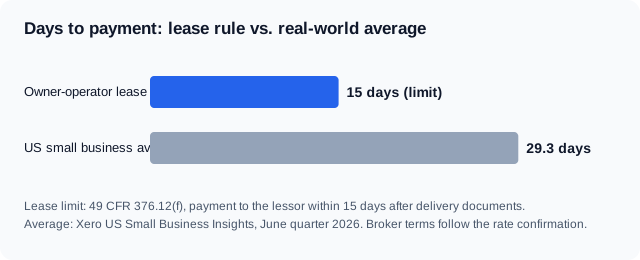
The chart above sets the 15-day lease limit against real payment behavior. Xero's data for the June quarter of 2026 shows US small businesses waited an average of 29.3 days to be paid, according to the Xero US Small Business Insights release. Invoices ran an average of 8.5 days late.
Two habits shorten the wait. Submit the POD and invoice together the day you deliver. Use the customer's electronic portal if there is one, because email attachments are easy to lose.
Should you use a factoring company?
Factoring is the sale of your invoice to a third party for immediate cash, minus a fee. It shortens the wait for payment, and it costs part of the invoice. Compare the fee to the cost of waiting.
A factored invoice needs a notice of assignment to the customer. The invoice should name the factor in the remit-to block. If the customer pays you directly after assignment, you may have to forward the payment.
Ask your factor for these terms before you sign:
- The fee rate, and how it changes with days outstanding.
- Whether the factor has recourse if the customer does not pay.
- How disputes and short payments are handled.
- Whether you can pick which invoices to sell.
Not every carrier needs one. A carrier with steady cash flow and customers on short terms can skip it. A new owner-operator with fuel and payroll due this week may find it worth the cost.
What is the 2026 per diem rate for truckers?
The IRS special meal and incidental expense rate for transportation workers is $80 per day in the continental United States and $86 outside it. IRS Notice 2026-60 sets those figures for travel on or after October 1, 2026. The CPA Practice Advisor report on the 2026-2027 per diem rates says they are unchanged from the previous year.
The rate covers employees and self-employed individuals whose work directly involves moving goods by truck and who regularly travel away from home. That includes owner-operators. It replaces tracking each meal receipt.
Meals for drivers subject to Department of Transportation hours-of-service limits are 80% deductible, instead of 50%. IRS Publication 463 lists interstate truck operators in that group. As an example, 200 days away from home at $80 equals $16,000, and 80% of that is a $12,800 deduction. Count only days you were actually away on business.
Per diem is a tax deduction, not a line on your customer's invoice. Your invoice covers the freight. Keep a log of days and locations to support the deduction.
What is the Form 2290 heavy vehicle use tax?
Form 2290 is the annual federal tax return for heavy highway vehicles with a taxable gross weight of 55,000 pounds or more. The IRS Instructions for Form 2290 set the current tax period from July 1, 2026, to June 30, 2027. For vehicles first used in July, the return was due August 31, 2026.
The tax amount depends on the vehicle's weight. Keep the stamped Schedule 1 that proves payment, because states ask for it when you register the truck. Treat the tax as a business cost when you set your rate per mile.
How do you price a load so the invoice covers your costs?
Price a load on cost per mile plus the unpaid time that surrounds it. The invoice records what you were paid, not what you needed. Check each load against your costs before you accept it. The markup calculator shows the margin on a quoted rate.
Your cost per mile should include fuel, tires, maintenance, insurance, truck payment, permits and the Form 2290 tax. Add the unpaid hours of waiting, empty miles and paperwork. The late fee calculator shows what a slow payer costs you. Many owner-operators find that a rate that sounds high leaves little after deadhead miles.
When detention or layover is likely, ask for it in the rate confirmation before you move the truck. An accessorial that was agreed in writing gets paid. One added after the fact gets disputed.
Invoqk can turn load notes into a finished trucking invoice, with the linehaul, fuel surcharge and extras itemized and a PDF ready to send. Open the invoice generator and check the load numbers against the rate confirmation before you send it.
Key points to remember
A trucking invoice works when the numbers match the paperwork. Put the load, rate confirmation and BOL numbers on the page. Attach the POD and the receipts behind every extra charge.
Owner-operators under a lease are owed payment within 15 days of delivery documents. The 2026 per diem is $80 per day in the continental US, and meals for drivers under hours-of-service rules are 80% deductible. Heavy vehicles of 55,000 pounds or more owe Form 2290. Corrections are welcome on the contact page, and the about page explains who writes these guides.
Frequently asked questions
What goes on a trucking invoice?
A trucking invoice should include your carrier name with MC and DOT numbers, an invoice number, the customer, the load, rate confirmation and BOL numbers, origin and destination, pickup and delivery dates, itemized charges, payment terms and the signed proof of delivery.
Is there a free trucking invoice template?
Yes. Use the checklist and sample in this guide in any document or spreadsheet. A free trucking invoice template needs one invoice per load, the matching reference numbers, itemized charges and the attached POD. Save it as a PDF before sending.
How soon must an owner-operator be paid?
Under 49 CFR 376.12(f), an authorized carrier must pay an owner-operator lessor within 15 days after the necessary delivery documents are submitted. The rule covers leases with a carrier. Broker and shipper invoices follow the terms in the rate confirmation.
What is the trucker per diem rate for 2026?
IRS Notice 2026-60 sets the special transportation meal and incidental rate at $80 per day in the continental US and $86 outside it, effective October 1, 2026. Meals for drivers under DOT hours-of-service rules are 80% deductible, per IRS Publication 463.
Comments
0No comments yet
Be the first to share your thoughts on this article.
Leave a comment
Your email is never published. Comments appear after approval.