

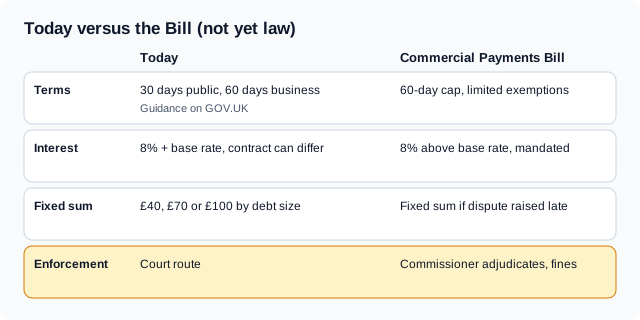
- The Commercial Payments Bill would cap UK business payment terms at 60 days and mandate 8% interest above the Bank of England base rate, according to GOV.UK, but it is not yet law.
- Today a UK business supplier can already claim 8% plus base rate and a fixed sum of £40, £70 or £100 by debt size, unless the contract sets a different interest rate.
- On a £4,800 invoice at 11.75% the interest is about £1.55 a day, so the £70 fixed sum is the larger figure for the first 45 days.
The Commercial Payments Bill would cap payment terms at 60 days and mandate interest of 8% above the Bank of England base rate, but it is not law yet, because GOV.UK says it was introduced in May 2026 and gives no start date. Today's rules still apply, and they already give a UK freelancer a right to interest and a fixed fee. This guide compares the two, runs a £4,800 invoice through the numbers and lists what to write on your invoices now.
What is the Commercial Payments Bill?
The Commercial Payments Bill is a UK government Bill that sets maximum payment terms between businesses and tightens late payment remedies. GOV.UK says the government introduced it to Parliament in May 2026. A GOV.UK press release dated May 19, 2026 calls it the "Small Business Protections Bill (formally known as the Commercial Payments Bill)".
The press release says the Bill aims to back "millions of sole traders, freelancers, and family firms" by placing the duty on large firms to pay smaller suppliers on time. A Hansard record lists a House of Lords debate on the Bill on July 21, 2026.
This guide could not confirm what stage the Bill has reached today, and the Bill's explanatory notes, which hold the detailed clauses, could not be read for it, so check the Bill page on bills.parliament.uk before you rely on any date or clause.
What does the Bill change for a freelancer?
The Bill changes five things, according to the GOV.UK Commercial Payments Bill overview.
- A 60-day cap. The overview describes "imposing maximum payment terms of 60 days, with strictly limited exemptions".
- Mandatory interest. It describes "mandating interest on late payments at 8% above the Bank of England base rate".
- A fixed sum in disputes. Suppliers get "the right to a fixed sum where a purchaser raises a dispute late or without sufficient information".
- Stronger enforcement. The Small Business Commissioner could investigate firms that persistently pay late and "adjudicate contractual payment disputes". Penalties could follow.
- A retention ban. The Bill prohibits "the deduction and withholding of retention payments under the terms of a construction contract".
The overview also says the measures "will not be applied retrospectively", so payments, contracts and disputes "will be judged according to the rules in place at the relevant time", and the government promises a lead-in period and a transition period before the powers start.
What are today's late payment rules?
Today's rules come from late payment legislation described on GOV.UK, and they already give a business supplier interest and a fixed fee when another business pays late. Payment terms are the agreed number of days a customer has to pay an invoice after receiving it. Statutory interest is the interest rate the law sets on a late commercial debt when the contract has no rate of its own.
The GOV.UK page on charging interest on commercial debt says the rate "is 8% plus the Bank of England base rate for business to business transactions". The same page says: "You cannot claim statutory interest if there's a different rate of interest in a contract."
That second sentence is the gap the Bill targets, because today a contract can replace the statutory rate, but although GOV.UK describes the Bill as mandating the 8% rate, the overview page does not say how the contract rule changes, so check the Bill text for that point.
When is a payment late?
A payment is late 30 days after the invoice arrives if no date is agreed. GOV.UK states: "If you do not agree a payment date, the law says the payment is late 30 days after either: the customer gets the invoice; you deliver the goods or provide the service (if this is later)."
An agreed date usually falls "within 30 days for public authorities or 60 days for business transactions", according to the same GOV.UK page. A longer period between businesses is allowed if it is fair to both businesses.
This means 60 days is already the normal outer limit for business terms in the guidance, and the Bill would turn that guidance into a cap with limited exemptions, although the overview does not list those exemptions.
The practical consequence of the thirty-day default is that an invoice without a stated due date still carries an enforceable deadline, although relying on the default invites disagreement about the date of receipt, particularly when an invoice travels through a client's accounts department before reaching the person who approved the work. A written due date, combined with evidence of delivery, therefore converts an arguable position into a documented one. The due upon receipt guide shows what that term requires.
What fixed fee can you claim?
You can claim a fixed sum for each late debt, set by the size of the debt. The GOV.UK page on claiming debt recovery costs lists three bands.
| Debt size | Fixed sum |
|---|---|
| Up to £999.99 | £40 |
| £1,000 to £9,999.99 | £70 |
| £10,000 or more | £100 |
GOV.UK says "You can only charge the business once for each payment." You can also claim "reasonable costs each time you try to recover the debt".
How much interest is 8% above base rate?
On a £4,800 invoice, 8% above the base rate costs about £1.55 a day. The Bank of England page showed a Bank Rate of 3.75% on October 22, 2026, with a Bank Rate announcement page listing the next decision for November 5, 2026. Eight points above 3.75% is 11.75% a year.
GOV.UK tells you to check the Bank of England rates but does not say which date's rate applies, so the example below uses 3.75% for simplicity, and a real claim should use the rate that GOV.UK points you to.
The formula is simple:
Interest = invoice amount × annual rate × days late ÷ 365
For £4,800 at 11.75%, the yearly interest is £564. That is £1.55 a day, rounded to the nearest penny.
| Days late | Interest | Fixed sum | Total claim |
|---|---|---|---|
| 30 | £46.36 | £70 | £116.36 |
| 45 | £69.53 | £70 | £139.53 |
| 60 | £92.71 | £70 | £162.71 |
The numbers are illustrative and assume that no contract rate replaces the statutory one and that the Bank Rate stays flat for the whole period.
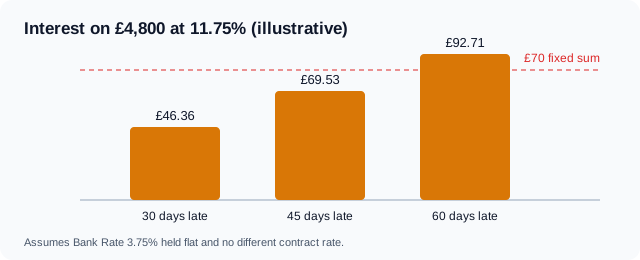
The £70 fixed sum is larger than the interest for the first 45 days, so on an invoice of this size the fixed fee is the bigger number for weeks, which is the reason to put late payment terms on every invoice. Germany's rules are in late payment interest in Germany.
The relationship between the fixed sum and the interest deserves attention, because the two remedies behave differently as an invoice ages: the fixed sum is a single charge that depends only on the size of the debt, whereas the interest grows with every additional day. Consequently, a small invoice produces a modest interest figure for several weeks, and the fixed sum represents most of the early recovery, while a large invoice generates interest that quickly exceeds the fixed sum.
Which payment terms should you write now?
Write a clear due date and state your late payment rights on every invoice, which protects you under today's law, fits the direction of the Bill and removes the arguments that cost freelancers the most time.
A short wording block you can copy:
Payment is due within 30 days of the invoice date. Late payments may incur statutory interest at 8% above the Bank of England base rate and a fixed recovery sum under UK late payment legislation.
Use this checklist when you set terms:
- State the due date as a calendar date, not only "net 30".
- State the invoice date and the invoice number.
- Mention statutory interest and the fixed sum.
- Do not agree a contract rate that is lower than the statutory rate without a reason.
- Keep proof of the day the client received the invoice.
- Keep a record of every reminder you send.
A due date written as a calendar date avoids a dispute about when the clock starts, and because GOV.UK says the clock runs from the day the customer gets the invoice, proof of delivery matters. Our guide to the due upon receipt meaning covers when that wording suits a short job.
Should you offer 60-day terms?
Only if you must, because a 60-day cap is a ceiling rather than a target, and a freelancer who offers 60 days when the client would accept 30 gives away a month of cash flow for nothing.
The Bill is aimed at long terms from big buyers. GOV.UK describes a "60-day cap on payment terms on all large firms paying smaller suppliers". Treat 30 days as your default and move to 45 or 60 only in return for something, such as a higher rate.
What can you do when a client pays late?
Follow a fixed sequence and keep each step on record, because the fixed sum and the interest both depend on a clear due date and on proof that the invoice reached the client.
- Send a friendly reminder on the day after the due date.
- Send a second reminder that names the interest and the fixed sum.
- Send a final written demand with a new deadline.
- Calculate interest to the day of the demand.
- Consider a formal route if the debt stays unpaid.
Our guide on how to calculate interest on a late invoice in the UK explains the same sum step by step. The guide on past due invoices covers what you can charge and how to word the notice.
A reminder that works is short, dated and specific: it names the invoice number, the amount, the due date and the sum now owed, states the interest and the fixed sum on separate lines, and says when you will take the next step. The past due invoice guide has full wording.
Who does the Bill protect?
The Bill is aimed at large firms paying smaller suppliers, according to the GOV.UK press release, although the pages read for this guide do not define "large firm" or list which small suppliers count.
The overview says existing reporting rules require "the UK's largest companies and limited liability partnerships" to report half-yearly on payment practices. It says the government plans to require large companies to report "the amount of interest they have paid and the interest they owe". It also plans to require boards of persistently late-paying large companies to publish commentary on why performance is poor.
The overview does not say whether a sole trader buyer is covered, so a freelancer billing a small client should not assume the cap applies.
How should you read the gaps in the public information?
Consequently, the sensible approach for an independent contractor is to separate what the government has confirmed from what remains undecided, because commercial arrangements made on the basis of an unconfirmed provision can become difficult to enforce. The confirmed items are the 60-day cap, the 8% interest rate above base rate, the absence of retrospective effect and the promise of a transition period. The undecided items include the list of exemptions, the treatment of terms that exceed the cap, the point from which the payment period runs and the precise meaning of a large purchaser.
Particularly important for a freelancer is the definition of the trigger event, since the practical value of any cap depends on when the period begins. The overview pages read for this guide do not address that question, and documentation of the Bill itself would be required to answer it. Until the explanatory notes and the final text are available, maintain thorough written records of every invoice, delivery and communication, because that documentation will support a claim under either the current rules or the new ones.
What mistakes cost freelancers the most?
Four mistakes cause most of the lost interest.
- Agreeing a lower contract rate. GOV.UK says you cannot claim statutory interest when the contract sets a different rate.
- Not proving the invoice arrived. The 30-day clock runs from receipt.
- Charging the fixed sum twice. GOV.UK says you can charge the business once for each payment.
- Treating the Bill as law. It is not in force, so rely on today's rules.
A fifth mistake is waiting. A freelancer who sends the first reminder after 90 days has lost weeks of influence.
What should you do before the Bill starts?
Prepare now, because the overview promises "an appropriate lead-in time" and a transition period, although no dates are published in the pages read for this guide.
Work through this list:
- Review your standard payment terms and cut anything above 30 days.
- Add the interest and fixed-sum wording to your invoice template.
- Check any existing contracts for a lower interest rate.
- Log the date every invoice is sent and received.
- Follow the Bill on bills.parliament.uk and re-read this guide when it passes.
Invoqk's invoice generator can add a due date and payment terms to every invoice you create, and it can email the invoice with a record of when it was sent. A dated send record is useful evidence if a client later says the invoice never arrived.
This guide was fact-checked against GOV.UK and Bank of England pages read on October 22, 2026. The Bill may change as it moves through Parliament. If a rule has changed since, contact us through the Invoqk site and the editorial team will correct this page. It is general information, not advice on your own contract.
Frequently asked questions
Is the 60-day payment cap law yet?
No. The Commercial Payments Bill was introduced to Parliament in May 2026, according to GOV.UK. It has no published start date. The government promises a lead-in period and a transition period before the powers begin.
What interest can I charge a business that pays late today?
You can charge 8% plus the Bank of England base rate, according to GOV.UK. You cannot claim statutory interest if your contract sets a different rate. The Bank Rate was 3.75% on October 22, 2026.
How much is the fixed fee for a late invoice?
The fixed sum is £40 for debts up to £999.99, £70 for £1,000 to £9,999.99 and £100 for £10,000 or more. GOV.UK says you can charge it once for each payment.
When does an invoice count as late?
If no date is agreed, a payment is late 30 days after the customer gets the invoice, or after delivery if that is later. GOV.UK states this rule. A written due date avoids a dispute.
Will the Bill apply to contracts I already have?
GOV.UK says the measures will not be applied retrospectively. Payments, contracts and disputes are judged by the rules in place at the relevant time. The start date is not yet published.
Comments
0No comments yet
Be the first to share your thoughts on this article.
Leave a comment
Your email is never published. Comments appear after approval.