

- A credit memo is a document a seller issues to reduce what a customer owes, and it is the same document as a credit note under a different name.
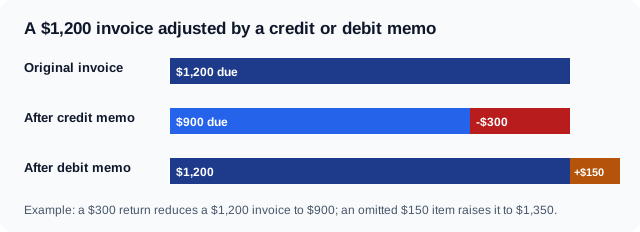
- A credit memo lowers a balance, a debit memo raises it, and a refund is the payment of money back, not a document.
- In Germany, a Gutschrift under § 14 UStG is an invoice issued by the recipient of a service, so label price corrections Rechnungskorrektur or Stornorechnung instead.
You invoiced $1,200. The client returned part of the order and now owes less. You cannot edit the invoice you already sent. You issue a credit memo instead. This guide explains what a credit memo is, how it differs from a credit note and a debit memo, and what each country expects on the page.
In brief: a credit memo lowers a balance, a debit memo raises it, and "credit note" is the same document as a credit memo under a different name.
What is a credit memo?
A credit memo is a document a seller issues to reduce the amount a customer owes. It is also called a credit memorandum. Sellers issue one after a return, an overcharge, a pricing correction or a cancelled order.
A credit memo leaves the original invoice untouched. It records a reduction against that invoice, so both documents stay in your books and the trail is complete. The credit can be applied to a future invoice or paid out as a refund.
Why do businesses issue a credit memo?
Businesses issue a credit memo whenever the amount on an invoice turns out to be too high. Five situations cover most cases:
- Returned goods. The customer sends back some or all of the items.
- Overbilling. The invoice charged the wrong quantity or price.
- Damaged or faulty work. You agree a discount instead of a redo.
- Cancelled order. The customer cancels after you invoiced.
- Goodwill. You reduce the bill to keep the relationship.
In every case, the credit memo is the clean way to fix the amount. Editing or deleting a sent invoice breaks the numbering sequence and can create problems with an auditor or a tax office.
What is the difference between a credit memo and a credit note?
A credit memo and a credit note are the same document. Credit memo is the common term in the USA, and credit note is the common term in the UK and the EU. The purpose, the layout and the effect on the balance are identical.
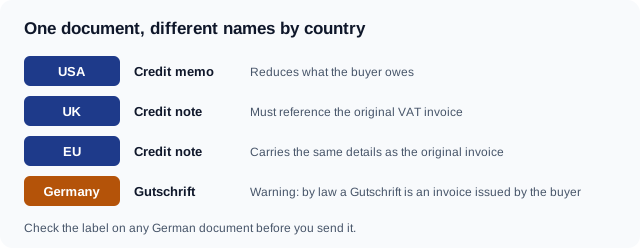
The words differ, but the rules attached to the document can differ by country. In the UK, for example, VAT rules decide what the credit note must show. In Germany, the word Gutschrift has a special legal meaning, covered below.
Our post on what a credit note must show, with a template, lists the fields in detail. This guide focuses on the terms and the decision between documents.
What is a debit memo?
A debit memo is a document that increases the amount a customer owes. It is the opposite of a credit memo. Sellers use one when the original invoice was too low, for example when an item was left off or extra work was done after invoicing.
Sources differ slightly on who issues a debit memo. In accounts receivable, the seller usually issues it to raise the customer's balance. A buyer can also send a debit memo when returning goods bought on credit. State clearly who issues the document and why, so there is no confusion.
The table shows the difference.
| Document | Effect on the balance | Typical reason |
|---|---|---|
| Credit memo or credit note | Reduces what the customer owes | Return, overcharge, discount, cancellation |
| Debit memo | Increases what the customer owes | Underbilling, omitted item, extra work |
| Corrected invoice | Replaces the original | Wrong details before the invoice is paid or booked |
What does a credit memo look like? A worked example
Here is a completed example. A US supplier sends invoice 1042 for $1,200: 12 units at $100 each. The client returns 3 units. The supplier issues a credit memo for 3 units at $100, which is $300.
| Line | Amount |
|---|---|
| Invoice 1042, dated October 1 | $1,200 |
| Credit memo CM-0007, dated October 12, for 3 returned units | -$300 |
| Balance now due | $900 |
The credit memo should show these items:
- The words "Credit memo" at the top
- A unique credit memo number, for example CM-0007
- The date of issue
- The original invoice number, 1042
- Both parties' names and addresses
- The items credited, with quantity, price and amount
- The reason for the credit
- The total credited, shown as a negative amount
- How the credit will be used, as a refund or against a future invoice
If the client had already paid in full, the supplier would either refund the $300 or deduct it from the next invoice. Agree which one in writing.
What are the rules for a credit memo in the UK?
In the UK, a credit note for VAT purposes has to carry specific information. According to VAT Notice 700 on GOV.UK, the credit note should show an identifying number and issue date, both parties' names and addresses and your VAT registration number. It must describe the goods or services, give the quantity and amount for each and state the total credited excluding VAT, along with the VAT rate and the VAT amount credited.
The same notice requires the credit note to reference the number and date of the original VAT invoice. If you cannot link it to an invoice, you must be able to show HMRC by other means that you accounted for the VAT on the original supply. HMRC's credit note conditions manual sets out what makes a credit note valid.
For invoices to EU customers, the same notice says the credit note carries the same information as the original invoice.
What are the rules for a credit memo in the USA?
In the USA, there is no single federal form for a credit memo. The document is an accounting record that follows your own books and your state's sales-tax rules. Treat it as a mirror of the original invoice.
Keep three habits:
- Number credit memos in their own sequence, separate from invoices.
- Show the original invoice number on every credit memo.
- Adjust sales tax when you credit taxable goods, and check your state's rules on how to report the adjustment.
The Internal Revenue Service expects your records to support what you report, so keep the credit memo, the original invoice and the reason together.
What are the rules for a credit note in Germany?
In Germany, the word Gutschrift is a trap. Under § 14 UStG, a Gutschrift is an invoice that the recipient of a service issues on behalf of the supplier, when both sides agreed to this in advance. It is a self-billing invoice, not a price reduction.
This matters because a document labelled Gutschrift can be read as a legal invoice for the supplier's service. If you want to reduce an earlier German invoice, consider a clearer label such as Rechnungskorrektur or Stornorechnung, and reference the original invoice number and date. The Federal Ministry of Finance explains the self-billing rules in its UStG handbook on the Gutschrift.
The tax side also matters. When you reduce the price of a taxable supply, the VAT on it changes too. Speak to your tax adviser about how to report the adjustment.
Credit memo or refund: which one do you need?
A credit memo and a refund are different things. A credit memo is a document that reduces the balance. A refund is a payment of money back to the customer. Often you issue the memo first and then decide whether to pay it out.
Use this decision rule:
- If the customer has not paid, issue a credit memo and send the corrected balance.
- If the customer has paid and will buy again, offer the credit against the next invoice.
- If the customer has paid and will not buy again, issue the memo and refund the amount.
In both cases, the credit memo is the record. The refund is only the payment.
Credit memo or corrected invoice: when do you need which?
Use a corrected invoice when the original invoice has not been paid or booked and you can replace it. Use a credit memo when the invoice has been sent, booked or paid and you need to reduce it without erasing it.
A simple test helps. If the original invoice is already in your client's books, do not change it. Issue a credit memo, and if needed, a new invoice for the right amount. Our post on what a credit note must show lists the fields to include.
How do you number and store credit memos?
Give every credit memo a unique number from its own sequence. A prefix keeps the two document types apart, for example INV-1042 for invoices and CM-0007 for credit memos. Never reuse a number, and never leave a gap without a note explaining it.
Store each credit memo next to the invoice it adjusts. A simple folder per client works: the invoice, the credit memo, the return slip or email that caused it and any refund confirmation. If your accountant or an auditor asks why a balance changed, you can answer in one minute.
How does a credit memo affect your books?
A credit memo reduces the amount your customer owes, so it reduces your accounts receivable and your recorded sales by the credited amount. If the credit covers returned goods, it may also return stock to your inventory. The details depend on your accounting method.
Here is the effect of the $300 example on a simple ledger:
| Account | Before | Credit memo | After |
|---|---|---|---|
| Customer balance (receivable) | $1,200 | -$300 | $900 |
| Sales for the period | $1,200 | -$300 | $900 |
Ask your accountant how to record the tax portion and any returned stock. The rules differ by country, and a general guide cannot cover your situation.
What wording can you copy onto a credit memo?
A short, neutral reason line is enough. Copy one of these and adjust the details:
- "Credit for 3 units returned from invoice 1042, dated October 1."
- "Credit for pricing error on invoice 1042: unit price corrected from $100 to $90."
- "Credit for cancelled order 887, invoiced on invoice 1042."
- "Goodwill credit agreed on October 12 following a delayed delivery."
Add one line that states how the credit will be used: "This credit will be deducted from your next invoice" or "A refund of $300 will be sent to your account within 5 working days." A clear instruction avoids a follow-up email from the client.
When is a credit memo not enough?
A credit memo is not enough when the customer disputes the whole invoice or when the work was never delivered. In those cases, agree the outcome first, then document it. If you cancel the invoice in full, a credit memo for the full amount closes the balance to zero and keeps the record.
It is also not enough when money has already moved and the client expects a refund. Send the refund and note the date and method on the credit memo. Keep the bank confirmation with the file, so the credit, the payment and the original invoice tell one clear story.
Common mistakes with credit memos
Four mistakes appear again and again. Each one makes reconciliation harder.
- Deleting the original invoice. Keep it. The credit memo exists to adjust it.
- No reference to the invoice. Always quote the invoice number and date.
- Reusing the invoice sequence. Give credit memos their own numbers.
- Forgetting the tax. If the invoice included tax, the credit must adjust it.
How do you create a credit memo quickly?
You can create a credit memo in two minutes. Open the credit note template, replace the sample lines with the items you are crediting and add the original invoice number. Then download the PDF or send it from the editor.
Invoqk builds the document from a plain-text description, so you can type "credit 3 returned units from invoice 1042" and review the result.
If the client is slow to apply the credit, the invoice due date calculator helps you set a new due date for the remaining balance, and the payment reminder email generator writes the follow-up.
Frequently asked questions
What is a credit memo in simple terms?
A credit memo is a document a seller sends to reduce what a customer owes. It is issued after a return, an overcharge or a discount. It does not change the original invoice.
Is a credit memo the same as a credit note?
Yes. Credit memo is the usual US term and credit note is the usual UK and EU term. Both documents reduce the amount owed and refer back to the original invoice.
What is the difference between a credit memo and a debit memo?
A credit memo reduces the amount a customer owes. A debit memo increases it. Sellers issue a debit memo when they underbilled or left an item off an invoice.
Does a credit memo mean a refund?
No. A credit memo is a record that lowers the balance. You can then apply it to a future invoice or pay it out as a refund. Agree which option in writing.
Can I issue a credit memo instead of deleting an invoice?
Yes, and you should. Deleting a sent invoice breaks your numbering and your audit trail. A credit memo reduces the amount while keeping the original on file.
What does a German Gutschrift mean?
Under § 14 UStG, a Gutschrift is an invoice issued by the recipient of a service on behalf of the supplier, by prior agreement. It is not a normal price reduction, so use a clearer label for corrections.
Comments
0No comments yet
Be the first to share your thoughts on this article.
Leave a comment
Your email is never published. Comments appear after approval.