

- A freelance writer invoice lists each piece with its title, rate and amount, plus separate lines for revisions, rush fees and expenses.
- A kill fee can only be invoiced when the contract or commissioning email states it before the work starts.
- For payments made in 2026, the IRS Form 1099-NEC reporting threshold is $2,000.
A freelance writer invoice template is a reusable bill that lists each article, the rate you agreed and the date payment is due. Writers get paid late more than most freelancers, because an editor often approves the work weeks after sending it. This guide gives you a filled-in invoice for a writer, the line items that belong on it, and the rules that decide how fast the client has to pay.
What should a freelance writer invoice include?
A freelance writer invoice should include your name and address, the client's name and address, a unique invoice number, the issue date and due date, a line for each piece, and the total. Add the title of each piece so the client's accounts team can match the invoice to the work they commissioned. For the fields every invoice needs, see what to put on an invoice, and for sending it, the invoice email template. See also the hourly invoice template covers a related case.
Use this order from top to bottom:
- Your legal name or business name, address and email.
- The client's company name and billing address.
- An invoice number such as FW-017 and the issue date.
- The due date written as a calendar date, such as November 30, 2026.
- One line per piece: title, word count or unit, rate and amount.
- Extra lines for revisions, rush work and expenses.
- The total due, the payment method and any late-payment terms.
For German clients, the UStG section 14 adds a tax number or VAT ID, a unique sequential number and the date of supply. A writer in Germany must also show the tax rate and tax amount, or state the exemption that applies.
How do you bill a writer: per word, per piece or per hour?
A per-word rate is a price multiplied by the final word count, a flat piece rate is one agreed fee for a deliverable, and an hourly rate bills the time spent. Each fits a different kind of work, and the invoice should show the method so the client can check the maths.
| Billing method | Best for | How it appears on the invoice |
|---|---|---|
| Per word | News, features, blog posts | "2,000 words at $0.60 per word = $1,200.00" |
| Flat piece rate | Case studies, white papers | "Case study, 1,800 words = $900.00" |
| Hourly | Editing, research, interviews | "Interviews and research, 6 hours at $75 = $450.00" |
The rates in this table are examples, not market benchmarks. Use the rate in your contract or the email where the editor accepted your pitch.
Say which word count you bill on. Agree before you start whether it is the word count you delivered or the count the client published. A line that reads "2,000 words delivered" ends most disputes.
Worked example: a filled-in writer invoice
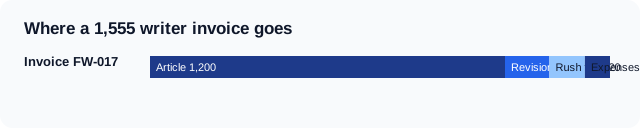
The example below bills a magazine for one feature. The editor asked for a second round of revisions and a rush delivery, and the writer paid for a transcription service.
| Field | Entry |
|---|---|
| Invoice number | FW-017 |
| Issue date | November 2, 2026 |
| Due date | December 2, 2026 |
| Bill to | Harbor Review, 40 Wharf Road, Boston, MA |
| Line 1 | Feature article "The Quiet Return of Paper Maps", 2,000 words at $0.60 = $1,200.00 |
| Line 2 | Second round of revisions, 2.5 hours at $60 = $150.00 |
| Line 3 | Rush delivery within 48 hours, flat fee = $120.00 |
| Line 4 | Transcription service, reimbursed at cost = $85.00 |
| Total due | $1,555.00 |
| Payment | ACH transfer, details below the table |
The total is $1,200.00 plus $150.00 plus $120.00 plus $85.00, which gives $1,555.00. The revision and rush lines appear on separate lines so the editor sees exactly what was added to the agreed fee. These figures are invented for illustration.
How do you charge a kill fee on an invoice?
A kill fee is a payment for work a client commissioned and then cancelled, and it only works when it is written into the contract or commissioning email. Invoice it as its own line after the cancellation, for the share the contract states.
A kill fee line reads like this: "Kill fee for cancelled feature, one quarter of the $1,200.00 agreed fee = $300.00". Attach the agreement that states the share. Without it, the client has no obligation to pay for unpublished work, so write the term before you accept the job.
This guide does not give legal advice. If a client disputes a kill fee, check your contract and ask a qualified adviser.
How should a freelance writer bill expenses?
A freelance writer should bill expenses as separate lines at cost, with the receipt kept on file. Typical expenses are transcription, travel to an interview, stock images, database access and postage for a print piece.
List each expense with a short description and the amount. Do not add a mark-up unless the contract allows it. If the client's accounts system needs receipts, attach them to the same email as the invoice.
What are the payment rules for a freelance writer?
Payment terms for a freelance writer come from the contract first and the law second. The contract sets the number of days. The law sets what happens if the client is late, and the rule depends on the country.
In the UK, statutory interest on a late business payment is "8% plus the Bank of England base rate", according to GOV.UK guidance on commercial debt interest. You cannot claim it if your contract sets a different rate. GOV.UK also says to send a new invoice if you add interest to the money you are owed.
For a UK VAT-registered writer, HMRC says you should normally issue a VAT invoice within 30 days of the tax point, per paragraph 16.2.3 of VAT Notice 700. Most writers below the VAT registration threshold do not charge VAT, so check your own status before adding tax lines.
Commissioning organisations frequently administer disbursements through accounts payable departments, which process invoices according to scheduled payment runs and require supplementary documentation, including purchase order references and tax identification details. Consequently, a writer who anticipates these administrative requirements and incorporates them into the original invoice typically experiences considerably fewer delays than a writer who supplies the information retrospectively.
What does a US writer need to know about Form 1099-NEC?
A US client may send a writer a Form 1099-NEC at the end of the year to report what it paid. The IRS says that for payments made in 2026, the Form 1099-NEC reporting threshold is $2,000, according to the IRS guidance on information returns. The threshold was $600 for earlier years.
Keep your invoices so the total on your records matches the form. If a client reports a different total, your invoice copies show which payments were made and when. Clients below the threshold may not issue a form, but the income is still yours to report. A tax adviser can confirm how that applies to you.
Should the invoice mention rights and licences?
A rights line on a writer invoice states what the client is buying, such as first publication rights or an exclusive licence for a set period. It matters because the fee on the invoice should match the rights in the contract. If the client wants more than was agreed, a new fee belongs on a new line.
You do not need legal wording on the invoice itself. A short reference works: "Fee covers first publication rights as agreed in the commissioning email of October 20, 2026." That sentence points the client's accounts team to the agreement without repeating it.
How should a writer follow up on an unpaid invoice?
Follow up on a schedule, in writing, with the invoice attached each time. A calm, dated sequence keeps the relationship intact and builds the record you need if the debt goes further.
- Send the invoice on the day you file the final draft.
- Send a reminder two days before the due date.
- Send a short message the day after the due date.
- Send a firmer message one week after the due date, quoting the late-payment term in your contract.
- If a UK business client still has not paid, consider adding statutory interest on a new invoice, as GOV.UK describes.
Keep every message factual. Quote the invoice number, the amount, the due date and the days overdue. Never threaten action you do not intend to take.
Which mistakes slow a writer's payment?
Most late payments come from a short list of invoice problems:
- No purchase order number when the client's company requires one.
- A piece title missing, so accounts cannot match the invoice to a commission.
- Revisions or rush fees added without an earlier written agreement.
- A due date written as "net 30" with no calendar date.
- The invoice sent to the editor instead of the accounts payable address.
Establishing a consistent invoicing routine also improves your cash-flow forecasting, because predictable submission dates allow you to anticipate when commissioning organisations will complete their payment runs. Send the invoice the day you file the final draft. Many publications pay on a fixed monthly run, and a late invoice can miss it by a week.
If you want a ready layout, the Invoqk invoice generator turns a pitch email or job description into a finished invoice with numbering and totals.
Frequently asked questions
What should a freelance writer put on an invoice?
Put your details, the client's details, an invoice number, the dates, one line per piece with the title and rate, extra lines for revisions or expenses, and the total due. Add the payment method and the due date as a calendar date.
Should a freelance writer bill per word or per piece?
Per word suits news and features where the length varies. A flat piece rate suits case studies and white papers with a fixed scope. Show the method on the invoice line so the client can verify the amount.
How do I invoice a kill fee as a freelance writer?
Add a separate line for the kill fee with the share and the base fee, such as one quarter of the agreed fee. It is only enforceable when the contract or commissioning email states it before you start the work.
When must a US client send a writer a 1099-NEC?
For payments made in 2026, the IRS reporting threshold for Form 1099-NEC is $2,000. Earlier years used $600. Keep your invoices so your records match what the client reports.
Can I charge extra for revisions and rush work?
Yes, if you agreed to it in writing before the work began. List revisions and rush fees on separate lines so the client sees what was added to the original fee.
Comments
0No comments yet
Be the first to share your thoughts on this article.
Leave a comment
Your email is never published. Comments appear after approval.