

- A business client in the United States normally gets an invoice with no EU or UK VAT, because the service is taxed where the client is established.
- A US invoice carries no reverse charge sentence. That sentence belongs on invoices to business clients inside the EU.
- Keep proof that the client is a business and that it sits outside your country. HMRC expects this kind of commercial evidence.
- A US client may ask for IRS Form W-8BEN before it pays you. Give the form to the client, not to the IRS.
This guide shows what an EU or UK freelancer writes on an invoice to a US business client, and which proof to keep.
Do you charge VAT on an invoice to a US client?
You do not charge EU or UK VAT on a service sold to a business client in the United States, in the usual case. The EU rule says a service supplied to a business is taxed where the business customer is established, under Article 44 as amended by Directive 2008/8/EC on the place of supply of services. A US company is established outside the EU, so the service falls outside EU VAT. Related: invoicing a client in another EU country, what a tax invoice must show.
The UK reaches the same result by its own guidance. HMRC says that if the place of supply is outside the UK, you do not charge UK VAT, in VAT Notice 741A on the place of supply of services. The notice also tells you to keep records that prove the overseas place of supply.
The word "usual" matters. Three cases change the answer: a private customer instead of a business, a US client with an office in your country, and goods instead of services. This article covers services to a business only.
What is a place of supply?
The place of supply is the country whose VAT rules apply to a sale. For a business-to-business service, it is the country where the customer is established. For a US client, that place is the United States.
This is why you can sit in Berlin or Manchester and still charge no German or UK VAT. The place of supply decides which country taxes the sale, and your own address does not. The rule applies to services. Goods follow different rules, which this article does not cover.
How does a US invoice differ from an EU reverse charge invoice?
An invoice to a US business shows no VAT and no reverse charge sentence, while an invoice to an EU business shows no VAT and a reverse charge sentence. The EU Directive requires the words "reverse charge" only where the customer owes the VAT, as the Commission's explanatory notes on the VAT invoicing rules describe for Article 226. A US client does not owe EU VAT, so the sentence would be wrong.
Reverse charge is a VAT mechanism in which the customer, not the supplier, accounts for the tax. The comparison below shows the three client types side by side.
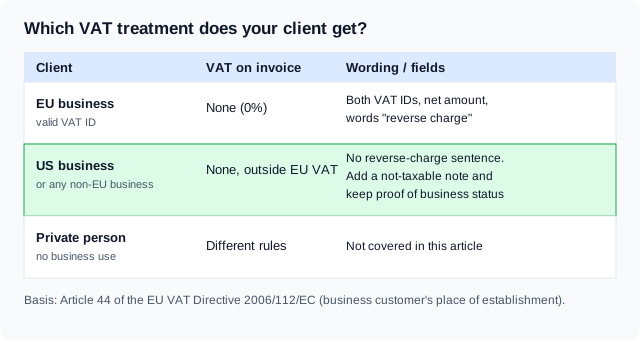
Use this decision rule to pick the right column:
- Is the client a business acting as a business? If not, stop. Private customers follow different rules.
- Is the client established in the EU? If yes, use the reverse charge invoice and both VAT IDs.
- Is the client established outside the EU, such as in the US? If yes, charge no VAT and omit the reverse charge sentence.
Our guide on invoicing a client in another EU country explains the EU branch in full. This article covers the branch that guide leaves out. A freelancer guide to non-EU invoicing makes the same distinction, but treat it as a secondary source and verify your own country's rules.
What must the invoice say?
The invoice needs your normal invoice fields, the client's full legal details, and a short sentence that explains why no VAT appears. The sources reviewed for this article give no mandatory sentence for this case, so a plain statement works as a practical choice.
Include these fields:
- Your name, address and tax number. Add your VAT ID if you have one.
- The client's full legal name and address in the United States.
- The client's tax number, such as an EIN, if the client gives you one.
- A unique invoice number and the invoice date.
- The service period.
- A description of each service, with hours and rate.
- The total in the currency your contract names.
- A sentence that explains why there is no VAT.
- Payment terms and bank details.
Here are wording options you can adapt. They are suggestions, not forms prescribed by a tax authority.
| Your country | Suggested sentence |
|---|---|
| Germany | Nicht steuerbare sonstige Leistung, Leistungsort Drittland (§ 3a Abs. 2 UStG). |
| UK | Outside the scope of UK VAT: the place of supply is the United States. |
| Any | No VAT charged: service to a business customer established outside the EU. |
Put the sentence directly under the total. A bookkeeper then sees why VAT is missing without reading the whole invoice.
What does a filled-in invoice to a US client look like?
A filled-in invoice to a US client shows hours, a rate in US dollars, one total and the no-VAT sentence. The example below is for a Berlin UX consultant who bills a Texas company for 40 hours at $105.
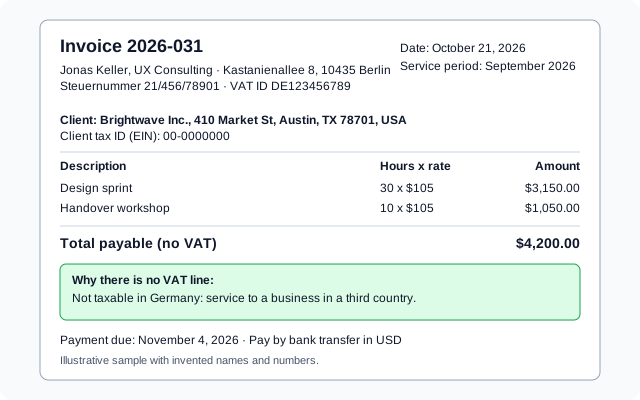
The names and numbers are invented. Here is how the numbers work:
- Design sprint: 30 hours at $105 equals $3,150.
- Handover workshop: 10 hours at $105 equals $1,050.
- Total payable: $4,200, with no VAT added.
A UK freelancer would build the same invoice. Only the currency, your tax details and the wording of the no-VAT sentence change.
Write the invoice in the currency your contract names. A US client usually prefers dollars. For your own bookkeeping, you will convert the amount into euros or pounds, so ask your tax adviser which exchange rate your tax office accepts.
You can build this invoice in a few minutes with Invoqk's free invoice generator, and you can set the currency to US dollars.
What proof should you keep for a US business client?
You should keep proof that the client is a business and that it is established outside your country. HMRC expects commercial evidence of business status and of where the customer belongs, according to HMRC's guidance on evidence for overseas business customers. For EU customers a VAT number is the strongest proof, and other documents can serve when no number exists.
A US company has no EU VAT number, so build the file from other documents.
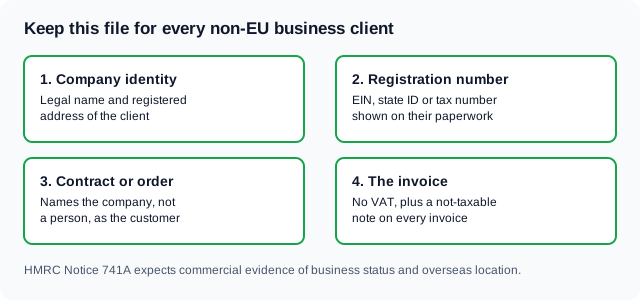
Keep these four items for every non-EU business client:
- Company identity. The client's legal name and registered address.
- Registration number. An EIN, a state business ID or a similar number from their paperwork.
- Contract or order. A document that names the company, not a person, as the customer.
- The invoice itself. It shows no VAT and carries the explanatory sentence.
Store the file with the invoice. A tax audit asks one question: how do you know this client is a business abroad? The file answers it in a minute.
When does the US client rule not apply?
The no-VAT rule stops applying when the customer is a private person, when the service goes to an office inside your country, or when the sale is of goods. The most overlooked trap is the office. EU case law, discussed in EUR-Lex judgment C-333/20, treats a customer's fixed establishment as the place of supply when the service goes to that establishment.
A practical example makes this concrete. A US software company has a branch office in Munich, and your work serves the Munich team. The branch, not the US head office, may be the place of supply. Ask each new client three questions before you invoice:
- Which legal entity signs the contract?
- Which office receives the work?
- Does that office have its own staff and its own address in your country?
If the answers point to an office in your own country, stop and ask your tax adviser. This is the single most common reason a "no VAT" invoice turns out to be wrong.
What if you are the US freelancer invoicing an EU client?
If you are a US freelancer who invoices a business in the EU, the EU client owes the VAT, and your invoice shows none. The VAT Directive puts the liability on the customer when the supplier is not established in the customer's country, as set out in the consolidated EU VAT Directive text. That is the reverse charge mechanism.
Your invoice should show the client's VAT ID, no VAT amount, and the words "reverse charge", which Article 226 requires where the customer owes the VAT. Your client then reports the VAT on its own return. The US has no federal VAT, so no US VAT line appears either way.
Will a US client ask you for tax forms?
A US client may ask you for IRS Form W-8BEN before it pays you. The IRS instructions say a nonresident alien who is the beneficial owner of an amount subject to withholding must give the form to the payer, according to the instructions for Form W-8BEN. Give it to the client, and do not send it to the IRS.
The stakes are real. Without the form, the payer may withhold tax at the foreign-person rate of 30% or at the backup withholding rate (IRS instructions, October 2021). The IRS instructions also say that a nonresident alien claiming exemption for services performed in the United States uses Form 8233 or Form W-4 instead.
Two points follow from this:
- Many clients ask for the form as a routine onboarding step, even when no withholding applies.
- Whether your payments are subject to US withholding depends on where you perform the work and on your tax treaty position. This article does not decide that. Ask the client's finance team what it needs, and confirm with your tax adviser.
Fill the form once, keep a copy, and renew it when the client asks.
What mistakes do freelancers make with US clients?
The most common mistakes are copying the reverse charge sentence, charging VAT out of habit, and skipping the proof file. Each is cheap to prevent.
| Mistake | Why it matters | Fix |
|---|---|---|
| Adding "reverse charge" to a US invoice | The sentence is for EU customers who owe the VAT | Use the no-VAT sentence instead |
| Charging local VAT to a US business | You overcharge the client and invite disputes | Check the place of supply first |
| No proof the client is a business | You cannot defend the no-VAT treatment | Keep the four-item file |
| Billing the US head office for an office abroad | The place of supply may be the local office | Ask which office receives the work |
| Ignoring the W-8BEN request | The client may withhold tax | Complete the form when asked |
| Using the wrong currency | Payment disputes and exchange confusion | Name the currency in the contract |
If you are unsure which document you need for a given job, our guide on what a tax invoice is, with UK, German and Australian rules, explains how the three countries define it.
What should you do before your first US invoice?
Work through this list before you send the first invoice to a US business client.
- Confirm the client is a business and note its legal name and address.
- Ask which office receives the work.
- Save the client's EIN or business registration details.
- Put the client's legal entity, not a person, in the contract.
- Write the invoice in the contract currency, with no VAT.
- Add the sentence that explains why no VAT appears.
- Ask whether the client needs Form W-8BEN.
- File the proof with the invoice.
Invoqk's free invoice generator exports a PDF, so you can send the finished invoice the same day.
Frequently asked questions
Do I charge VAT to a US client?
No, you normally charge no EU or UK VAT to a US business client. The service is taxed where the business customer is established, which is the United States. Keep proof that the client is a business abroad. A private customer or a US client's office in your own country changes the answer.
Should a US invoice say reverse charge?
No, an invoice to a US business should not carry a reverse charge sentence. The words are required where the customer owes VAT, which is the case for business clients inside the EU. A US client owes no EU VAT, so the sentence would be misleading. Use a short no-VAT explanation instead.
What do I write on an invoice instead of VAT for a US client?
Write a short sentence that explains why no VAT appears, such as "No VAT charged: service to a business customer established outside the EU." German freelancers often cite § 3a Abs. 2 UStG. The sources reviewed here give no mandatory wording, so choose a clear sentence.
What proof do I need that my US client is a business?
Keep the client's legal name and address, its EIN or other registration number, a contract that names the company, and the invoice itself. HMRC expects commercial evidence of business status and location. A VAT number is the best proof for EU customers, and other documents can serve when none exists.
Does a US client need Form W-8BEN from me?
A US client may ask for Form W-8BEN, which a nonresident alien gives to the payer, not to the IRS. Without it, the payer may withhold at 30% or at the backup rate. Ask the client what it needs and confirm your position with a tax adviser.
Can I invoice a US client in dollars?
Yes, you can invoice in dollars if your contract names that currency. Show the dollar total on the invoice and keep the amounts consistent with the contract. For your own books, convert to euros or pounds with the exchange rate your tax office accepts.
Comments
0No comments yet
Be the first to share your thoughts on this article.
Leave a comment
Your email is never published. Comments appear after approval.