

- A service sold to a VAT-registered business in another EU country is invoiced with 0% VAT and the words "reverse charge".
- The invoice must show your VAT ID and your client's VAT ID, and a German supplier must issue it by the 15th day of the month after the service.
- Check the client's VAT ID in VIES first; private customers and clients outside the EU follow different rules.
Selling to a business in another EU country raises one question before you write a single line: do you charge VAT or not? This guide gives the answer, the exact wording and a filled-in example for a freelancer invoicing a business client in another member state.
How do you invoice a business client in another EU country?
You issue the invoice with no VAT, show your VAT ID and your client's VAT ID, and add the words "reverse charge". That is the standard treatment for a service sold to a VAT-registered business in a different EU member state. The client, not you, accounts for the VAT in their own country.
This guide shows the exact lines to write, a filled-in example in euros, the deadline that applies to a German supplier, and the mistakes that cause invoices to bounce back. It covers business clients with a VAT ID inside the EU. Private customers and clients outside the EU follow different rules, which the last sections explain only at the level of "where to look".
What is the reverse charge on an invoice?
The reverse charge is a VAT procedure in which the customer, not the supplier, owes the VAT on a sale. Under it, the supplier issues an invoice without VAT. The customer reports the VAT in their own VAT return and, in most cases, deducts the same amount at once.
For you as a freelancer, the practical effect is simple. The price on your invoice is the price the client pays. No VAT is added, and you do not collect VAT for another country's tax office.
On your invoice the VAT line reads 0%, and the total payable equals the net price. The European Commission describes the rule on its VAT invoicing page. If the customer is liable for the tax, which is the reverse-charge case, the invoice must carry the words "reverse charge".
Which lines must the invoice contain?
A full VAT invoice is an invoice that lists the supplier, the customer, the service and the amounts, plus a unique number and the issue date. The Commission's list of invoice particulars sets them out. Use them as your checklist.
| Invoice line | What to write | Why it matters |
|---|---|---|
| Date of issue | The day you create the invoice | Starts the clock for the deadline |
| Unique sequential number | For example 2026-041 | Each invoice needs its own identifier |
| Your full name and address | As registered with your tax office | Identifies the supplier |
| Client's full name and address | The legal entity, not the contact person | Identifies the customer |
| Your VAT ID | For example DE123456789 | Required on the invoice |
| Client's VAT ID | For example FR12345678901 | The Commission lists it when the customer is liable for the tax |
| Description and quantity | What you did, with hours or units | Describes the service |
| Unit price without tax | Price per hour, day or item | Shows the net price |
| Date of service or payment | Only if it differs from the issue date | Fixes the period |
| VAT rate and amount | 0% and 0.00 | Shows that no VAT is charged |
| The words "reverse charge" | Put them where the VAT would be | Tells the client they owe the VAT |
A German supplier has one more line to think about. Section 14a of the German VAT Act, available on gesetze-im-internet.de, calls for the phrase "Steuerschuldnerschaft des Leistungsempfängers" when the recipient owes the tax in another member state. The sentence is long, and the invoice must also show both VAT IDs. Write the English and German wording together and you cover both.
What does a filled-in reverse charge invoice look like?
Here is a complete example. Mia Weber is a freelance web designer in Berlin. She invoices Atelier Lune SAS, a business in Lyon, France, for 30 hours of work at EUR 80 per hour. The net total is EUR 2,400.00.
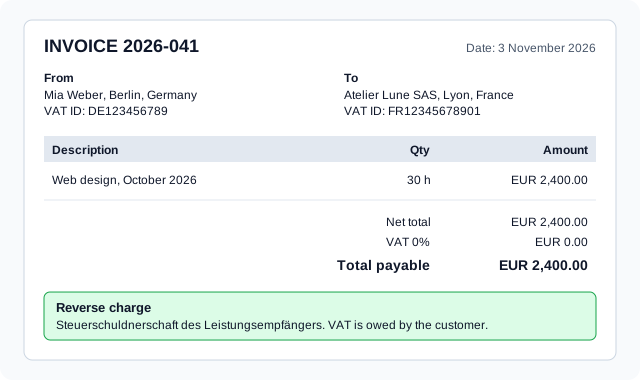
The invoice shows four things that a domestic invoice would not.
- Both VAT IDs appear, DE123456789 for Mia and FR12345678901 for the client.
- The VAT line reads 0% and EUR 0.00.
- The total payable equals the net total, EUR 2,400.00.
- A reverse charge note sits below the totals in English and in German.
If Mia had wrongly added German VAT, for example EUR 456.00, the invoice would total EUR 2,856.00. The client would be billed VAT that the reverse charge procedure says the client owes in their own country. A wrong VAT line like this usually gets the invoice sent back.
What exact wording should you use?
Use a short, fixed line at the bottom of the invoice. Short wording is easy for the client's accounts team to match against the rule.
For an English-language invoice from Germany, copy this block:
- Reverse charge. VAT is owed by the customer.
- Steuerschuldnerschaft des Leistungsempfängers.
The first sentence uses the words the Commission names. The second is the German phrase that section 14a of the German VAT Act uses. If you are based in another EU country, check your own national invoicing rules for the local phrase. The Commission's page states the common EU requirement. National rules may add details.
One independent guide for German freelancers, Accountable's reverse charge explainer, says the same in plain terms. You need your VAT ID, your client's VAT ID, and a clear statement that the reverse charge applies. It also notes that the procedure is for business clients and not for private persons.
When must you issue the invoice?
A German supplier of services to a business in another EU country must issue the invoice by the 15th day of the month after the month in which the service was performed. Section 14a of the German VAT Act sets this deadline for services covered by section 3a(2). The invoice must carry both VAT IDs by then.
Here is the rule applied to a calendar.
| Service performed in | Invoice due by |
|---|---|
| October 2026 | November 15, 2026 |
| November 2026 | December 15, 2026 |
| December 2026 | January 15, 2027 |
Do not treat the 15th as a payment term. It is the latest date for issuing the invoice. You can set the payment due date separately, for example 14 or 30 days after the invoice date.
A simple habit solves this. Send the invoice on the last working day of the month in which you finish the work. You then never come close to the deadline.
How do you check that a client's VAT ID is valid?
Check the client's VAT ID before you send the first invoice, and keep a record of the check. VIES is the EU's free validation service, and it confirms whether a VAT number is currently registered for cross-border trade. A valid result tells you that the client is a registered business.
Follow this order.
- Ask the client for the full VAT ID, including the country prefix, such as FR or NL.
- Look up the number in VIES and note the company name it returns.
- Compare that name and address with the name on your quote or contract.
- Save a screenshot or a PDF of the result with the invoice.
- Repeat the check if the client changes legal entity.
If the number is not valid, do not apply the reverse charge. Ask the client for the correct ID or for confirmation of their registration. A missing or wrong ID is the most common reason a reverse charge invoice is questioned later.
What if the client is a private person or outside the EU?
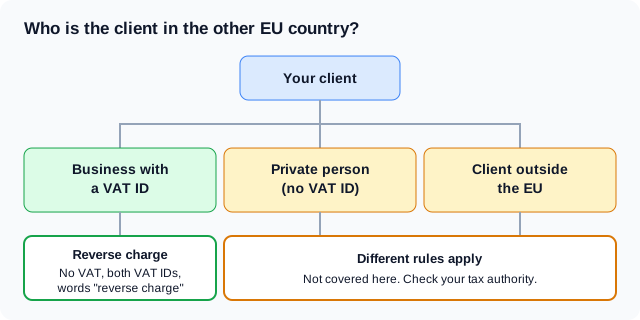
The reverse charge in this guide is for a business customer with a VAT ID in another EU country. If the customer is a private person, or the customer is outside the EU, a different VAT treatment applies. This article does not cover those cases.
Start with these official sources.
- For a private customer in another EU country, read the Commission's VAT pages and your own tax authority's guidance for sales to consumers.
- For a customer outside the EU, read your tax authority's guidance on services to non-EU customers.
- If you are in the United Kingdom or the United States, your national tax authority's rules govern your invoice, and EU VAT rules apply only where you are registered or the sale is in scope.
Treat the question "is my client a business with a VAT ID?" as the first gate. Everything else follows from the answer.
What if you sell goods instead of services?
A sale of goods to a business in another EU country is usually a VAT-exempt supply, and the invoice needs both VAT IDs. An intra-Community supply is the German legal name for such a sale of goods between EU member states. Section 14a of the German VAT Act applies the same 15th-day deadline to such supplies. It names them "innergemeinschaftliche Lieferung" and requires both VAT IDs on the invoice.
The Commission's invoicing page adds a rule for exempt supplies. The invoice must refer to the legislation that exempts the transaction, or give another reference showing that it is exempt, at the supplier's choice. A goods invoice therefore looks like the services example, with an exemption reference where the services invoice has the reverse charge note.
Mixed jobs need care. If you deliver a physical product together with a service, record each line separately so the right treatment is visible. When the split is unclear, ask your tax adviser before you invoice.
Which mistakes make a cross-border invoice fail?
Most failed invoices break one of six simple rules. This table lists them with the fix for each.
| Mistake | What goes wrong | Fix |
|---|---|---|
| Charging home-country VAT | The client cannot use it and refuses to pay | Show 0% and the reverse charge note |
| Leaving out the client's VAT ID | The invoice is incomplete for a reverse charge sale | Collect and check the ID first |
| Writing "VAT exempt" instead of "reverse charge" | The wording does not match the procedure | Use the words "reverse charge" |
| Sending the invoice late | The deadline in your country is missed | Invoice by month end |
| Using a consumer's details | No VAT ID exists, so the procedure does not fit | Treat the sale under consumer rules |
| Skipping the VAT ID check | An invalid ID makes the zero-VAT treatment doubtful | Check VIES and keep the proof |
Check your invoice against this table before you send it. The whole check takes about two minutes.
How do you set this up once and reuse it?
Create one reverse charge template and reuse it for every EU business client. The template holds your details, a 0% VAT line and the standard wording. For each new client you fill in the name, address, VAT ID and the service lines.
Here is a short setup list.
- Set the default VAT rate on the template to 0%.
- Add the reverse charge block as a fixed footer.
- Add a field for the client's VAT ID, and make it required.
- Use a numbering scheme that never repeats, for example year and a running number.
- Set the currency to euros for euro-zone clients.
- Save a copy of each issued invoice as a PDF.
Invoqk's invoice generator supports multi-currency invoices, VAT handling and PDF export, so the template steps above map to settings you fill in once.
Three clients, three outcomes: how do you decide?
Run every new client through the same three questions before you write a single line. The answers decide which invoice you issue. Here are three realistic cases for a freelancer in Berlin.
Case 1: a French company with a VAT ID. The client is a registered business in another EU country, and VIES confirms the number. You issue the reverse charge invoice from the example above. VAT is 0%, both IDs appear, and the note sits below the totals.
Case 2: a Dutch sole trader who gives no VAT ID. The client says they are a business but cannot give you a VAT number. You cannot confirm that the reverse charge fits. Pause the invoice and ask for the ID or for written confirmation of their status. Do not guess, and do not issue a zero-VAT invoice on trust alone.
Case 3: a company in Zurich, Switzerland. Switzerland is not an EU member state. The EU reverse charge note in this guide is not the right tool. Read your tax authority's guidance on services to non-EU customers before you invoice.
The pattern is clear. The VAT ID check is the gate. A confirmed ID inside the EU leads to the reverse charge. A missing ID or a non-EU address leads to a stop and a question.
What should the email with the invoice say?
Send the invoice with a short email that repeats the key facts. A short message prevents questions and speeds up payment. This is a text you can copy and adapt.
Hello, please find attached invoice 2026-041 for EUR 2,400.00 for web design in October 2026. VAT is not charged because the reverse charge applies. The invoice shows your VAT ID and mine. Payment is due within 14 days of the invoice date. Please tell me if any detail is wrong.
Keep the email under 70 words. Put the invoice number, the amount, the due date and the reverse charge sentence in it. That gives the client's accounts team everything needed to book the invoice without a reply.
How do you stop this problem before it starts?
Put the VAT facts into your quote and your contract, so the invoice holds no surprises. A client who sees "price excluding VAT, reverse charge applies" at the quote stage will not ask about VAT at invoice time.
Add these three items to your quote template.
- Your VAT ID and the client's VAT ID, once confirmed.
- A line stating that the quoted price excludes VAT and that the reverse charge applies to business clients with a VAT ID in another EU country.
- The invoice currency and the payment term in days.
If you also need to estimate VAT for domestic sales, Invoqk's VAT calculator shows the net, VAT and gross amounts for a given rate.
What to do next
Gather three facts before your next cross-border invoice: the client's legal name, their VAT ID, and the date you finish the work. Check the ID, write the 0% VAT line, add the reverse charge words, and send the invoice by the 15th of the next month at the latest if you are a German supplier. If any fact is missing, pause the invoice and ask the client.
Rules differ between member states, and your own situation may add details this guide cannot know. When the sums are large or the facts are unusual, ask a tax adviser or your tax office. For related reading on the fields every invoice needs, see "What to put on an invoice: the message, signature and fields" and "What is a tax invoice? UK, German and Australian rules". For the other beat that matters here, see "Construction invoice template: fields, CIS and reverse charge".
Frequently asked questions
Do I charge VAT to a business client in another EU country?
Usually no. For a service sold to a VAT-registered business in another EU member state, the customer owes the VAT under the reverse charge. You issue the invoice with 0% VAT, both VAT IDs and the words "reverse charge".
What words must a reverse charge invoice contain?
The European Commission says the invoice must carry the words "reverse charge" when the customer is liable for the tax. A German supplier should also add "Steuerschuldnerschaft des Leistungsempfängers", the phrase used in section 14a of the German VAT Act.
Do I need my client's VAT ID on the invoice?
Yes. The Commission lists the customer's VAT ID among the invoice particulars when the customer is liable for the tax. Check the number in the EU's VIES service before you send the invoice, and keep proof of the result.
When must a German freelancer issue an invoice to an EU business client?
By the 15th day of the month after the month in which the service was performed, according to section 14a of the German VAT Act. A service performed in October 2026 therefore needs an invoice by November 15, 2026.
Does the reverse charge apply to private customers?
No. The reverse charge in this guide is for business customers with a VAT ID. Sales to private persons and to customers outside the EU follow different VAT rules, so check your tax authority's guidance before you invoice.
Comments
0No comments yet
Be the first to share your thoughts on this article.
Leave a comment
Your email is never published. Comments appear after approval.