

- A plumbing invoice should itemize the trip charge, labor, parts, permit and disposal as separate lines, with a total and payment terms.
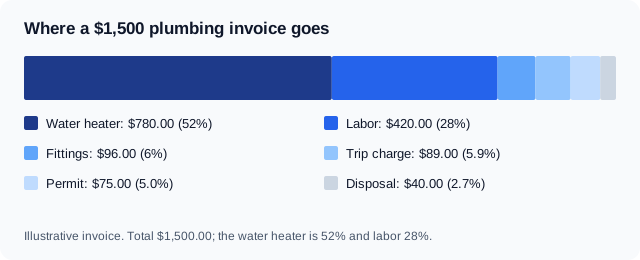
- The sample $1,500 water heater invoice splits as $780 unit, $420 labor and $300 of fees, which shows customers where the money goes.
- For 2026, the IRS business mileage rate is 72.5 cents before July 1 and 76 cents after, and the Form 1099-NEC threshold for subcontractors is $2,000.
A plumbing invoice is a bill that lists the trip charge, labor, parts, permits and disposal for one job, with a total and a payment date. A good plumbing invoice template keeps those lines separate so the customer sees what they paid for. This guide shows what to include, a filled-in $1,500 example and the 2026 tax rules that now touch plumbing invoices.
What should a plumbing invoice include?
A plumbing invoice should include your business details, the job address, an invoice number, itemized labor and parts, the total and the payment terms. Missing one of these is the most common reason a customer delays payment. Plumbing invoices also need a few fields that other trades skip.
Use this checklist for every plumbing invoice:
- Your business name, phone number and state license number. Many states require the license number on contracts and invoices, so check your state licensing board.
- The customer's name and the service address. The billing address and the job address are often different, especially for landlords.
- An invoice number and issue date. Sequential numbers make records easier to find.
- A short job description. "Replaced 40-gallon gas water heater, kitchen utility closet" tells the customer and their insurer what happened.
- Itemized lines for labor, parts and fees. Keep each line on its own row.
- Permit fees, disposal and sales tax. Show each as a separate line.
- The total, the payment terms and the accepted payment methods.
- A warranty note. State how long the labor and the parts are covered.
The post titled Contractor invoice template: what to include, with examples covers the fields common to all trades. See the contractor invoice template for the shared layout. This guide focuses on what is specific to plumbing.
How do you itemize labor, parts and trip charges?
Itemize a plumbing job in three groups: time, materials and fees. Each group answers a different customer question. Time covers how long you worked, materials cover what you installed, and fees cover everything else.
A trip charge is a flat fee for the service call. This fee covers travel and the first diagnostic minutes. Many plumbers apply it to every visit, then credit it against the repair. Write which of the two you do, because customers ask.
Labor. Show hours and the hourly rate, such as 3.5 hours at $120. Some shops bill in half-hour or one-hour minimums, so state the minimum on the invoice.
Parts and materials. List each major part by name, quantity and price. Group small items, such as fittings and sealant, under one line. A marked-up price is normal, and the markup calculator shows the margin. The line should still read as a clear price, not a mystery number.
Fees. Permits, inspection fees, dump fees and fuel surcharges belong here. Pass-through costs should match the receipt, so the customer sees no hidden margin.
Flat-rate pricing or time and materials?
Flat-rate pricing is one price per task, while time and materials bills the hours and parts actually used. The invoice looks different under each method. Pick the method before the work starts and quote it in writing.
| Method | Best for | What the invoice shows |
|---|---|---|
| Flat rate | Standard jobs with known scope, such as a water heater swap | One price per task, plus any approved extras |
| Time and materials | Repairs where the cause is unknown, such as hidden leaks | Hours, hourly rate, each part and each fee |
| Hybrid | Larger jobs with a diagnostic first | Diagnostic fee, then a flat quote for the repair |
Flat rate protects the customer from a long job. Time and materials protects you from an unexpected one. If the scope changes mid-job, write a change line on the invoice and get the customer's approval before you continue. The post called Estimate maker: how to write a job estimate clients accept explains how to put the scope in writing first.
Worked example: a $1,500 water heater replacement
A water heater replacement invoice totals $1,500 when the unit is $780, labor is $420 and the remaining fees add $300. The numbers below are illustrative, not market prices. Your rates, costs and local taxes will differ.
| Line | Detail | Amount |
|---|---|---|
| Trip charge | Service call and site assessment | $89.00 |
| Labor | 3.5 hours at $120 | $420.00 |
| Water heater | 40-gallon gas unit (cost $600, 30 percent markup) | $780.00 |
| Fittings | Expansion tank, flex connectors, gas fittings | $96.00 |
| Permit | Municipal permit, billed at cost | $75.00 |
| Disposal | Removal and haul-away of old unit | $40.00 |
| Total | Due upon receipt | $1,500.00 |
The sample invoice carries the note "Installed October 14, 2026. Labor warranty: 1 year. Manufacturer warranty on the tank: 6 years." Those warranty details settle most callbacks before they start.
The chart above shows where the money goes. The water heater itself is 52 percent of the total, labor is 28 percent and the four remaining lines make up the last 20 percent. Customers who see this split understand why a $1,500 invoice is not $1,500 of labor.
If your state taxes materials or repair services, add a tax line under the subtotal. Rules differ by state, and some states tax labor on repairs while others do not. Check your state revenue department for the rate and the taxable items.
What does a plumber's hourly rate need to cover?
An hourly rate must cover wages, vehicle costs, insurance, tools and idle time, so it is well above the wage a plumber earns. The U.S. Bureau of Labor Statistics reports that plumbers, pipefitters and steamfitters earned a median of $63,800 per year, or $30.67 per hour, in May 2025. The same source projects 7% employment growth from 2025 to 2035, or 34,500 new jobs, per the BLS Occupational Outlook Handbook entry for plumbers.
The wage is what an employee takes home from the median job. It excludes your truck, your liability cover, your tools and the hours you spend quoting and driving. In the example above, the $120 hourly rate is about 3.9 times the BLS median wage. That ratio is a sanity check, not a rule.
Use your own costs to set the rate, and the hourly rate to invoice calculator turns hours into a total. Add your wage, payroll taxes, vehicle running costs, insurance and overhead, then divide by the billable hours you expect to work. Billable hours are always fewer than hours worked.
What is the 2026 mileage rate for trip charges?
The IRS business mileage rate is 76 cents per mile for travel from July 1 through December 31, 2026, up from 72.5 cents earlier in the year. The IRS first set 72.5 cents in Notice 2026-10, announced on December 29, 2025. It then raised the rate mid-year because of fuel prices, as the Thomson Reuters summary of Announcement 2026-11 explains.
The rate is a tax deduction figure, not a price you charge the customer. It still works as a cost benchmark for your trip charge. An 18-mile round trip costs about $13.68 at 76 cents per mile (18 × $0.76). In the example, the $89 trip charge covers that drive, the first diagnostic minutes and the time spent not billing.
Split your mileage log at July 1, 2026. Miles from January through June are deducted at 72.5 cents, and miles from July onward at 76 cents. A plumber who logs miles in a single total will misstate the deduction.
Do you need to send a 1099 to subcontractor plumbers?
Yes, if you pay a subcontractor $2,000 or more in a calendar year, you file Form 1099-NEC for payments made in 2026. The reporting threshold rose from $600 to $2,000 for tax years beginning after 2025, according to the IRS Instructions for Forms 1099-MISC and 1099-NEC. The amount may be adjusted for inflation beginning in calendar year 2027.
Ask every subcontractor for a Form W-9 before the first payment. It gives you their legal name, address and tax ID. Without it, you may have to withhold tax from payments.
A higher threshold changes only the reporting. The income is still taxable, and you can still deduct what you paid. Keep each subcontractor invoice, because it is your record of the expense.
How do you get a plumbing invoice paid?
Send the plumbing invoice on the day the job ends, and show the payment methods you accept. A plumbing invoice sent a week later is paid a week later. Most customers pay faster when they can pay by card or bank transfer on the spot.
Three habits help:
- Hand over or email the invoice before you leave the property.
- Put a clear due date on the invoice, not only a term.
- Take a deposit on larger jobs, such as a repipe or a bathroom rough-in.
For emergency calls, ask for payment on completion. The HVAC Invoice Template: What to Include, With an Example post shows the same approach for another trade, with refrigerant and equipment lines in place of water heater parts.
Invoqk can turn a short job description into a finished plumbing invoice, with the lines, the total and a PDF ready to send. Open the invoice generator, then paste the notes you wrote on site and review the result before you send it.
Key points to remember
A plumbing invoice works when each line has a clear purpose. Separate the trip charge, labor, parts, permit and disposal. State your warranty and your payment terms on the invoice itself.
Use current 2026 figures for tax records. Log mileage at 72.5 cents before July 1 and 76 cents after. File Form 1099-NEC for subcontractors paid $2,000 or more. The contact page is open for corrections, and the about page lists who writes these guides.
Frequently asked questions
What goes on a plumbing invoice?
A plumbing invoice should include your business details and license number, the customer and job address, an invoice number and date, itemized labor and parts, permit and disposal fees, the total, payment terms and a warranty note. Separate lines help customers understand and approve the charges.
Is there a free plumbing invoice template?
Yes. Any plumbing invoice template works if it has the fields listed in this guide. Use a document or spreadsheet, keep one line per charge, and save the result as a PDF before sending. Free plumbing invoice templates in Word or Excel follow the same layout.
Should a plumber charge flat rate or time and materials?
Flat rate suits standard jobs with a known scope, such as a water heater swap. Time and materials suits repairs with an unknown cause, such as hidden leaks. State the method in the quote, and add a written change line if the scope grows.
Do I send a 1099 to a subcontractor plumber?
File Form 1099-NEC if you pay a subcontractor $2,000 or more for payments made in 2026. The threshold rose from $600 for tax years beginning after 2025, per the IRS instructions. Collect a Form W-9 from the subcontractor before the first payment.
Comments
0No comments yet
Be the first to share your thoughts on this article.
Leave a comment
Your email is never published. Comments appear after approval.