

- A register receipt must show who sold, when, what was sold, the price, the tax and the total, and in Germany a receipt for each recorded sale is a legal duty.
- Number receipts in one unbroken sequence per register and reconcile each day's receipts to cash and card takings, which catches missing sales and errors the same day.
- Keep register tapes, sales slips and the daily summary as records, because they support your income figure if a tax authority asks.
Register receipt: what a till receipt must show and how to number it
A register receipt is the slip a till prints to prove a sale: what was bought, what it cost, what tax was added and how it was paid. It is also called a till receipt, a sales receipt or a point-of-sale receipt. The customer uses it to return an item or claim an expense. The seller uses its copy, or the register's record, to prove the day's income.
Getting it right takes four decisions. Decide which fields go on every receipt. Decide how to show tax. Decide how to number receipts. And decide how to close the day so the receipts add up to the money in the drawer.
This guide covers all four. It shows a worked receipt with sales tax on each line, a daily close that reconciles to the cent and the rules in Germany, the USA and the UK. It also covers the online sales receipt, which follows the same fields.
What must a register receipt show?
A register receipt must show the seller, the date, what was sold, the price paid and the tax. Those five items answer the questions a customer or a tax inspector will ask.
Print these ten fields on every receipt:
- Seller's name and address.
- Date and time of the sale.
- A receipt number that is unique on that register.
- Each item, with a short description, quantity and price.
- Tax on each line or tax by rate, so the buyer can see what was taxed.
- Subtotal, tax total and grand total.
- Payment method, such as cash or card.
- Amount tendered and change, for cash sales.
- Return policy, in one line.
- Register or cashier identifier, so a query can be traced.
Tax identifiers matter in some places. In Germany, the minimum fields for a small receipt are set by statute. In the USA, state sales tax rules decide what the receipt must show, and they vary. Check your state's tax authority for your own requirements.
The most useful field is the one people skip: the receipt number. It lets you find the sale again in seconds and it exposes gaps.
How does a register receipt look with sales tax per line?
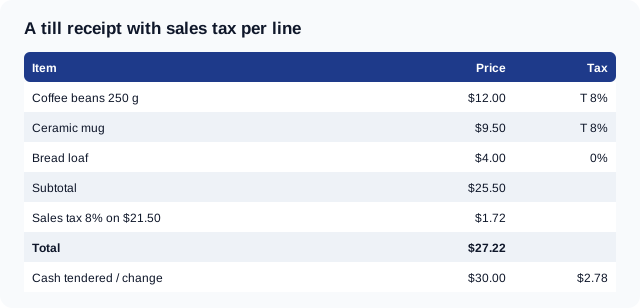
A register receipt with tax per line marks each item as taxable or not and totals the tax at the end. This makes the sum easy to check. The example uses a combined sales tax rate of 8 percent, chosen for illustration.
| Item | Price | Tax |
|---|---|---|
| Coffee beans, 250 g | $12.00 | T 8 percent |
| Ceramic mug | $9.50 | T 8 percent |
| Bread loaf | $4.00 | 0 percent |
| Subtotal | $25.50 | |
| Sales tax, 8 percent on $21.50 | $1.72 | |
| Total | $27.22 | |
| Cash tendered | $30.00 | |
| Change | $2.78 |
The arithmetic runs in four steps. Add the three prices: $12.00 plus $9.50 plus $4.00 is $25.50. Add up only the taxable items: $12.00 plus $9.50 is $21.50. Multiply by 8 percent: $21.50 times 0.08 is $1.72. Add the tax to the subtotal: $25.50 plus $1.72 is $27.22. The customer pays $30.00 and gets $2.78 back.
A "T" next to the taxable lines tells the customer which items carried tax. Whether bread or any other product is taxable depends on the state, so mark each item by your own state's rules.
Invoqk's receipt template page shows the same layout. The guide Itemized receipt example: retail, restaurant and delivery has more layouts, including a restaurant receipt with a tip line.
How do you number register receipts?
You number register receipts with one unbroken sequence per register, starting at 0001 each day or continuing without a reset. Every receipt takes the next number, and no number is skipped or reused.
Two patterns work:
- Daily reset: 20261028-0001, 20261028-0002. The date prefix keeps numbers unique and makes the day's range obvious.
- Continuous count: R1-000412, R1-000413. The register prefix keeps two tills apart.
If you run more than one register, put a register prefix in front. R1-0007 and R2-0007 are different receipts and they must not look identical.
Voided sales are the usual place a sequence breaks. Do not delete the number. Print or record a "VOID" against it, with a reason. A sequence with a documented void is easy to defend. A sequence with a hole is not.
The wider rules for receipts are covered in Receipt numbering: how to number receipts and where it goes. The register version adds the register prefix and the daily reset.
What do the USA, UK and Germany require?
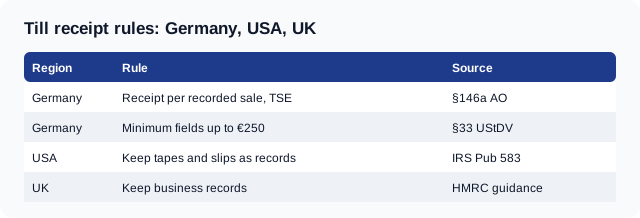
The rules differ sharply, and Germany is the strictest. The table gives the overview, and the sections below explain each row.
Germany: a receipt for every recorded sale
German law makes the receipt a duty. Under section 146a of the Fiscal Code (AO), a business using an electronic recording system must issue a receipt for each recorded transaction and make it available to the other party. The system must be protected by a certified technical security device (TSE), which consists of a security module, a storage medium and a uniform digital interface.
Authorities may waive the receipt duty for sales of goods to many unknown customers, on grounds of reasonableness, and may revoke the waiver. It is not a right the seller can simply claim.
For small amounts, section 33 of the VAT implementation regulation (UStDV) sets the minimum content of an invoice up to 250 euros. It must show the supplier's full name and address, the issue date, the quantity and type of the goods or the scope and type of the service, and the total with the tax rate. If the supply is tax-exempt, the receipt says so instead.
A German example: an item with a gross price of €11.90 at the 19 percent rate has a net price of €10.00 and VAT of €1.90. At the 7 percent rate, a gross price of €10.70 has a net price of €10.00 and VAT of €0.70. The receipt shows the total and the rate.
Receipts are also records you must keep. Section 147 of the Fiscal Code (AO) sets a retention period of eight years for accounting vouchers (Buchungsbelege) and six years for other listed business documents, according to the statute text.
United States: no federal format, but keep the records
The US has no federal rule for the layout of a register receipt. State sales tax rules decide what must appear. At the federal level, the IRS asks that you keep records that support your income. IRS Publication 583 lists sales slips, paid bills, invoices, receipts and deposit slips as supporting documents. It also lists cash register tapes among the documents that show gross receipts.
The IRS publication describes a daily summary as a record of cash sales for the day, drawn from the register tape. It adds that it is generally best to record transactions daily. The next section builds that summary.
United Kingdom: keep your business records
For the UK, the requirement worth knowing is retention. HMRC's guidance on business records for the self-employed says to keep business records for at least five years after the 31 January submission deadline of the relevant tax year, according to its record-keeping page. A business with VAT records should check the separate VAT period. The details of what a VAT receipt must show depend on the type of supply and the VAT scheme, so confirm them with HMRC or an accountant.
This post gives general information, not tax advice for a particular business.
How do you reconcile a day's receipts?
You reconcile a day by adding up the day's receipts and checking that the total matches the money taken. If the two agree, every sale was recorded. If they differ, the receipts show where to look.
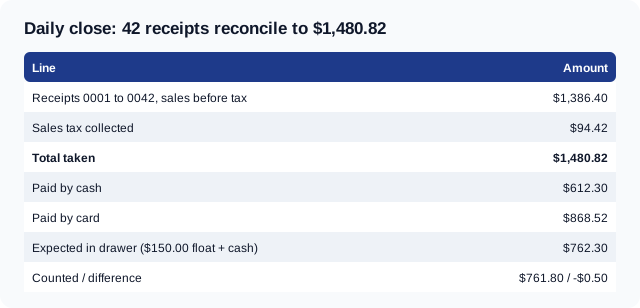
Take a shop that rang up receipts 0001 to 0042 on one day.
| Line | Amount |
|---|---|
| Sales before tax (receipts 0001 to 0042) | $1,386.40 |
| Sales tax collected | $94.42 |
| Total taken | $1,480.82 |
| Paid by cash | $612.30 |
| Paid by card | $868.52 |
Two checks follow:
- Sales plus tax equals tender. $1,386.40 plus $94.42 is $1,480.82. Cash plus card is $612.30 plus $868.52, which is also $1,480.82.
- Drawer count equals expected cash. The drawer started with a $150.00 float. Add $612.30 of cash sales and the drawer should hold $762.30. The count is $761.80, so the drawer is $0.50 short.
A 50-cent shortage is normal and is recorded as "over/short". A shortage of $50 would call for a check of voided sales and change given. Because every receipt has a number, the search is quick.
Write the result on a daily summary and keep it with the register tape. Invoqk's receipt generator produces a numbered receipt for each sale, and the day's list is the start of the summary.
How should a refund or exchange appear on a register receipt?
A refund appears as a new receipt with its own number, negative lines and a reference to the original sale. It never edits the first receipt. The original stays as issued, and the refund receipt reverses it.
For example, the customer returns the .50 mug from the earlier sale. The refund receipt shows the mug at minus .50, sales tax at minus /bin/zsh.76 (8 percent of .50), and a total of minus .26. It carries a line such as "Refund of receipt R1-000412, March 4, 2026". The register pays out .26, and the daily close subtracts it from sales and from tax.
Three rules keep refunds clean:
- Refund to the original payment method where you can. A card sale goes back to the card.
- Record the reason, such as "faulty" or "wrong size", so the pattern shows over time.
- Keep both receipts together. An auditor who sees only the refund cannot see what it reversed.
An exchange is a refund plus a new sale. Print two receipts, not one adjusted slip. The customer ends up with a clear record of both events, and your numbering stays unbroken.
What is a TSE and who needs one?
A TSE (technische Sicherheitseinrichtung) is a certified security device that protects electronic cash records in Germany. It consists of a security module, a storage medium and a uniform digital interface, according to section 146a AO. Businesses in Germany that use an electronic recording system need one. Sellers elsewhere do not, but the idea carries over: a register that locks its records is easier to trust than one that lets you edit yesterday's sales.
What is different about an online sales receipt?
An online sales receipt carries the same fields as a register receipt, and it arrives by email or on screen. The customer needs the seller, date, items, tax, total and payment method, whether the slip is paper or a PDF.
Three details change:
- Delivery address and shipping appear as their own lines, with their own tax if any.
- The order number sits beside the receipt number, because the customer quotes both.
- The payment reference replaces "cash tendered", for example the last four digits of the card.
Keep the digital copy exactly as sent. A receipt that can be edited after the fact is weaker evidence than one that is stored as issued. The guide Online receipt generator: how to make a valid receipt covers the PDF side, and the walk-through in How do I write a receipt? Steps, wording and examples covers the manual case.
Which receipt does a customer need for an expense claim?
A customer claiming a business expense needs a receipt that shows the seller, date, items, tax and total. A register slip with those fields usually works. If the buyer needs the seller's tax details on the document, they ask for an invoice, which carries more fields. The difference is set out in What is the difference between an invoice and a receipt? and the claim side in Purchase receipt: what it must show to claim an expense. If a business customer asks for an invoice at the till, Invoqk's invoice maker can produce one from the same sale.
Common mistakes with register receipts
These mistakes appear again and again at the till:
- Skipping the tax line. The customer cannot tell what was taxed.
- Reusing a receipt number after a void. Two sales share one reference.
- Mixing two registers in one sequence. Without a prefix, the order is a guess.
- Rounding each line instead of the total. Penny differences build up. Pick one rule and apply it everywhere.
- Printing no date. A return or an expense claim needs it.
- Never closing the day. Errors surface weeks later, when nobody remembers the sale.
Each fix takes seconds: a template with the fields, a register prefix and a fixed closing routine.
A closing checklist for every trading day
Before you lock up:
- The last receipt number is written on the daily summary.
- Voided numbers are listed with a reason.
- Sales before tax, tax and total are totalled by rate.
- Cash and card totals add up to the total taken.
- The drawer count is compared with float plus cash sales.
- Any difference is written down, even if small.
- The register tape and the summary are filed together.
Seven lines, five minutes. A shop that does this every day has its books half done before the month ends.
Frequently asked questions
Which fields must a register receipt contain?
A register receipt must show the seller's name and address, the date, each item with its price, the tax, the total and the payment method. A unique receipt number is also needed to trace the sale. Local rules add to this list.
Does a business have to give a receipt?
In Germany, yes. Section 146a AO requires a receipt for each transaction recorded by an electronic system, unless the authorities grant a waiver. The US has no federal rule on giving receipts, though state rules may apply, and sellers must keep records of sales.
What is the right way to number till receipts?
Use one unbroken sequence per register, with a register prefix if you have more than one till. Either reset daily with a date prefix or count continuously. Never delete or reuse a number. Record a void against it instead.
How long should I keep register tapes and receipts?
Keep them as long as they may be needed for tax purposes. The IRS says records should be kept until the period of limitations for the return runs out. HMRC's self-employed guidance says at least five years after the 31 January deadline.
How do I reconcile cash register receipts at the end of the day?
Total the day's receipts by rate, then check that cash plus card equals sales plus tax. Compare the drawer count to the opening float plus cash sales. Write down any difference, however small, together with the last receipt number.
Comments
0No comments yet
Be the first to share your thoughts on this article.
Leave a comment
Your email is never published. Comments appear after approval.