

- An estimate is an approximate price, so an invoice may legitimately differ from it, but a large unexplained jump invites a dispute and sometimes breaks the law.
- Tell the client the new figure before the extra work is done and keep their written yes, because that single message decides whether the higher invoice gets paid.
- California auto repair rules, the UK Consumer Rights Act and section 649 of the German BGB each treat an overrun differently, so state the rule that applies to your job.
Estimate vs invoice: can you bill more than the estimate?
An estimate is an approximate price for work that has not been done yet. An invoice is the bill for work that has. Because an estimate is a forecast, the invoice does not have to match it to the cent. The harder question is how far over it can go before the client can refuse to pay the difference.
The short answer is this. You can bill more than an estimate when the extra cost is real, the client agreed to it before it was incurred, and the invoice shows where it came from. You get into trouble when the client first sees the higher number on the invoice.
This guide covers the estimate invoice question from both sides. It shows how to convert an estimate into an invoice, what the US, UK and German rules say about overruns, and a worked job that ends 12% over.
Can an invoice be higher than the estimate?
An invoice can be higher than the estimate when the final cost really was higher and the client was told. An estimate is not a fixed price, so a modest difference with a clear reason is normal. A large jump that the client first meets on the invoice is the pattern that leads to disputes.
Three tests decide whether the higher invoice will hold:
- Was the estimate labelled as an estimate? A document headed "Quote" with a total price reads as a fixed offer. A document headed "Estimate" with a range reads as a forecast.
- Did the client agree to the extra cost first? A dated email, text or signature beats a phone call nobody can prove.
- Can every extra dollar be traced? Hours worked, parts bought and a receipt for each.
If all three are yes, the invoice is on solid ground. If any is no, expect the client to pay the estimate and argue about the rest.
How much can you go over an estimate?
No single percentage applies everywhere. The United States has no federal cap on how far a final bill can exceed an estimate, and the answer depends on state law and on the wording of your document. Some trades have their own rules. Auto repair is the best known.
In California, Title 16 of the California Code of Regulations, section 3354, requires a repair shop to give the customer a revised estimate and get authorization before charges exceed the original authorized price, according to the state's Bureau of Automotive Repair. The shop must describe the extra parts and labor and state a new total.
The practical rule is the same in every trade: tell the client when you see the overrun coming, not after you have spent the money.
Estimate vs invoice: what is the difference?
The two documents answer different questions, so they carry different fields. An estimate says what the job is expected to cost. An invoice says what is owed now.
| Feature | Estimate | Invoice |
|---|---|---|
| Purpose | Forecast the price before work starts | Request payment for work done |
| Binding on the price? | Usually not | Yes, once the client has agreed the amounts |
| Number | Estimate number (EST-0212) | Invoice number (INV-1087) |
| Total | Approximate, often a range | Exact |
| Contains | Scope, expected hours and materials, validity date | Delivered work, final amounts, due date, payment details |
| Payments | None | Deposits credited, balance due |
| Tax | Often shown as a forecast | Calculated on the final amounts |
An estimate invoice pair works best when the invoice repeats the estimate's wording. Use the same job description and the same unit prices so the client can compare line by line.
If you are not sure which document to send before work begins, the choice is covered in Invoqk's guide to a quote or an estimate. The estimate page there shows the layout.
How do you convert an estimate to an invoice?
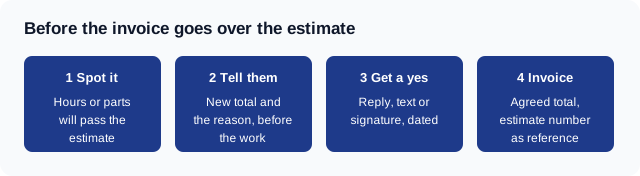
You convert an estimate to an invoice by copying its line items into a new invoice, replacing forecast quantities with actual ones, adding an invoice number, an issue date and payment terms, and crediting any deposit. The estimate number stays on the invoice as a reference.
Follow these steps:
- Start from the estimate, not a blank page. Copy each line with its description and unit price.
- Replace forecast quantities with actual quantities. An estimate of 40 hours becomes 46 hours if 46 were worked.
- Add every approved change as its own line. Label it "Additional work approved on March 12" so the date is visible.
- Assign the next invoice number. The estimate number is not an invoice number.
- Add the issue date, due date and payment terms. The validity date on the estimate no longer applies.
- Subtract deposits and earlier payments. Show each credit as a separate line.
- Write one sentence explaining any difference from the estimate. For example: "Final total is 12% above the estimate because the subfloor needed replacing."
The last step is the one most people skip, and it is the one that stops the phone call. Invoqk's AI invoice generator lets you paste the estimate text in and get the invoice lines back, so steps 1 and 2 take seconds.
What does a 12% overrun look like on paper?
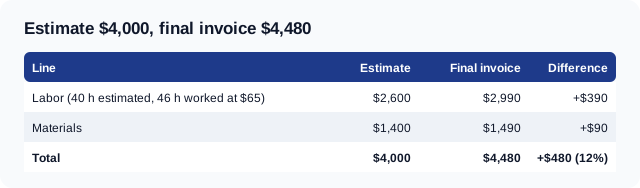
A worked example makes the rule concrete. A contractor estimates a bathroom floor repair at $4,000: 40 hours of labor at $65, which is $2,600, plus $1,400 of materials. During the job, rotten subfloor adds six hours and $90 of extra screws, underlay and adhesive.
| Line | Estimate | Final invoice | Difference |
|---|---|---|---|
| Labor, 40 hours estimated, 46 worked at $65 | $2,600 | $2,990 | +$390 |
| Materials | $1,400 | $1,490 | +$90 |
| Total | $4,000 | $4,480 | +$480 |
The final invoice is $480 higher, which is 12% over the estimate. Whether the client pays it depends on one thing: what happened on the day the contractor found the rot.
Version one. The contractor pauses, sends a photo and a message: "The subfloor under the tub is soft. Replacing it adds about six hours and $90 in materials, so the new total is about $4,480. Reply YES to go ahead." The client replies yes. The invoice lists "Subfloor replacement, approved by email on March 12" and is paid.
Version two. The contractor says nothing and invoices $4,480. The client sees a 12% increase with no explanation, pays $4,000 and disputes the rest. The contractor now has a harder case, even though the cost was real.
Both versions cost the same. Only the first one gets paid in full.
What does the law say in the USA, UK and Germany?
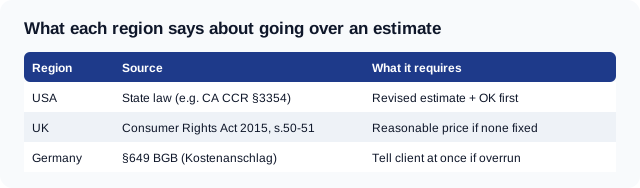
The rules differ by country, and in the US by state. In each place, the safest course is the one in the steps above. The table summarises what each source says.
United States: state rules and the wording of your document
The US has no federal rule that caps an invoice at the estimate. State law applies, and some trades are regulated. California's Bureau of Automotive Repair requires a revised estimate and authorization before auto repair charges go over the authorized price, under Business and Professions Code section 9884.9 and its regulation, 16 CCR section 3354.
Outside regulated trades, the contract terms and the words you used decide the outcome. An estimate that says "approximate" and gives a range is easier to defend than one that gives one total with no caveat. Check your own state's rules for contractors, because some require written change orders above a stated amount.
United Kingdom: the Consumer Rights Act and a reasonable price
For consumer contracts in the UK, section 51 of the Consumer Rights Act 2015 applies where the contract does not fix a price or say how to work it out. In that case the consumer must pay a reasonable price, according to legislation.gov.uk. Section 50 treats things the trader said or wrote about the service as part of the contract.
In practice, an estimate that reads as a firm price can fix the price, which takes the job outside section 51. An estimate that clearly says it is approximate leaves the final price to be reasonable. What is reasonable is a question of fact, so keep the evidence: hours, receipts and the client's agreement.
This post covers consumer work only. Business-to-business jobs follow the contract the parties signed.
Germany: the Kostenanschlag under section 649 BGB
German law has a named term for an estimate: the Kostenanschlag. Section 649 of the German Civil Code (BGB) covers a contract based on one where the contractor has not guaranteed ("Gewähr") that the work can be done without a substantial overrun. If an overrun of that kind is expected, the contractor must tell the customer without delay, according to the statute text. If the customer ends the contract for that reason, the contractor's claim is limited to the payment set out in section 645(1) BGB.
The word "substantial" is not defined as a percentage in the statute. The lesson for an invoice is the same as in the other countries: warn early, in writing, and give the new figure.
Invoqk's estimate template includes a line for the price basis, so the client can see whether the total is approximate or guaranteed.
What wording protects an estimate that may grow?
Wording on the estimate decides how much room you have later. A single clause can make the difference between a forecast and a promise.
Use this block on every estimate:
This is an estimate, not a fixed price. The final amount is based on actual hours and materials. If the total is likely to exceed this estimate by more than 10%, we will tell you the new figure and ask for your approval before continuing. The estimate is valid until [date].
Three details in that block do the work. "Not a fixed price" signals a forecast. "Actual hours and materials" ties the bill to evidence. "Before continuing" commits you to ask first.
The 10% trigger is a choice, not a legal rule. Pick the number that suits the job and use it consistently. A $200 job and a $200,000 job should not share one threshold. Many contractors use a flat amount for small jobs and a percentage for large ones.
Wording for the message that asks for approval
When the overrun appears, send a message that stands on its own:
Update on [job]: we found [reason]. This adds about [hours] and [amount] in materials. The new total is [amount], up from the [amount] estimate. Please reply YES to approve. If you would rather stop here, tell us and we will invoice only what is done.
Keep the reply. Paste its date and a line from it into the invoice: "Approved by email on March 12."
Common mistakes that cost the difference
These five mistakes show up in most disputed estimates:
- Sending a quote and calling it an estimate. A fixed total with no caveat reads as a firm price.
- Raising the price silently. A client who feels surprised pays the estimate and fights the rest.
- Bundling the extra into an existing line. If labor goes up, show the extra hours on their own line.
- Using different unit prices. An hourly rate of $65 on the estimate and $72 on the invoice looks like padding.
- Leaving out the estimate reference. The client cannot compare two documents that do not point at each other.
The cost of each is the same: an invoice that is paid late, paid in part or not paid.
When should you send a quote instead of an estimate?
Send a quote when the scope is clear and you can stand behind the price. Send an estimate when the scope depends on what you find once work starts, such as repairs, renovations and anything hidden behind a wall or under a floor.
A quote protects the client, who knows the maximum. An estimate protects you, because the price follows the real cost. If you want certainty and the client wants certainty, quote with a clause covering changes in writing. The related guides on Quote template: what to include, with a free example and Estimate maker: how to write a job estimate clients accept go through the layout of each.
How do you handle an estimate when the client pays a deposit?
Treat the deposit as a credit against the final invoice, not as a change to the estimate. The estimate stays as the forecast, and the deposit appears on the final invoice as a payment already received.
For the bathroom example, a $1,000 deposit leaves a balance of $3,480 on the $4,480 invoice. The invoice shows the full amount, the deposit and the balance, so the client can reconcile all three. The step-by-step layout is in Deposit invoice template: bill upfront and credit it later.
In the UK and Germany, where a deposit invoice may carry its own VAT, the final invoice must also deduct the VAT already billed. Confirm the treatment with your accountant, because it depends on your VAT scheme.
A checklist before you send an invoice that exceeds the estimate
Run through this before pressing send:
- The invoice references the estimate number and date.
- Every line from the estimate is present with the same wording.
- Actual quantities replace forecast ones.
- Every extra has its own line and its own approval date.
- The client's yes is saved and quoted on the invoice.
- One sentence explains the difference in plain English.
- Deposits and earlier payments are credited.
- The total reconciles: estimate plus approved changes, minus payments, equals the amount due.
If a line fails the check, fix it before sending. A correct invoice takes five minutes to prepare and saves weeks of chasing.
The free invoice maker at Invoqk can draft the invoice from the estimate text, with the estimate number carried across as the reference.
Frequently asked questions
Can I charge more than my estimate?
Yes, if the extra cost is real, the client agreed to it before it was incurred and the invoice explains it. An estimate is a forecast, not a fixed price. Without the client's prior agreement, expect them to pay the estimate and dispute the difference.
Is an estimate legally binding?
Usually not on the price, but it is not meaningless. It can become part of the contract and shape what a court calls reasonable. In the UK, section 50 of the Consumer Rights Act 2015 treats statements about the service as contract terms. In Germany, section 649 BGB applies when no guarantee was given.
How much can an invoice exceed an estimate?
No universal percentage exists. Some US states regulate certain trades, such as California auto repair, where the customer must authorize charges above the original price. Elsewhere, the document wording and the client's agreement decide. Ask for approval before any meaningful overrun.
How do I turn an estimate into an invoice?
Copy the estimate lines into a new invoice, replace forecast quantities with actual ones, add approved changes as separate lines, give it a new invoice number and due date, and credit any deposit. Keep the estimate number as a reference and explain any difference in one sentence.
What is the difference between an estimate and an invoice?
An estimate forecasts the price of work not yet done and is usually non-binding. An invoice requests payment for work completed and shows exact amounts, a due date and payment details. The estimate comes first, and the invoice follows it.
Comments
0No comments yet
Be the first to share your thoughts on this article.
Leave a comment
Your email is never published. Comments appear after approval.