

- A budgetary quote is a non-binding price range given early so a buyer can plan a budget, and it is not an offer the buyer can accept.
- A firm quote is a priced offer for defined work that stays open for a stated time, so the two documents differ in accuracy, in binding effect and in what the seller must know before writing them.
- The safest budgetary quote states a range, the assumptions behind it, an expiry date and a plain sentence that it is not an offer.
A budgetary quote is an early, non-binding price range that a seller gives a buyer so the buyer can plan a budget before the work is fully defined. It is not an offer, so the buyer cannot accept it and the seller does not have to do the job for that price. This guide shows how firm a budgetary quote is, how it differs from a firm quote, and the wording that keeps it non-binding.
In brief: give a range, list your assumptions, set an expiry date, and say in one sentence that the figure is for planning only.
What is a budgetary quote?
A budgetary quote is a rough price, stated as a range or a single planning figure, based on limited information. Buyers ask for one when they must put a number in a budget, a grant bid or a business case before they can brief suppliers in detail. Sellers give one because it costs little time and keeps them in the conversation.
Other names for the same document include a budgetary quotation, a pre quotation, a budget quotation and a rough order of magnitude estimate. In project work you will also hear "ballpark". The names differ by industry. The idea is the same: a price good enough to plan with, and not good enough to sign.
A quotation budget is the line a buyer sets aside using that figure. It is the buyer's number, not the seller's promise. Keeping those two apart is the whole job of the document.
How firm is a budgetary quote?
A budgetary quote is not firm at all in the legal sense. It is a statement of expected cost, and the wording around it decides whether either side can rely on it. The accuracy is a separate matter: it is how close the final price is likely to land, and it depends on how much of the job is known.
The more of the scope, quantities and site conditions you know, the narrower the range can be. A one-line brief supports a wide range. A signed specification supports a firm quote. The chart below shows the idea with an example range.
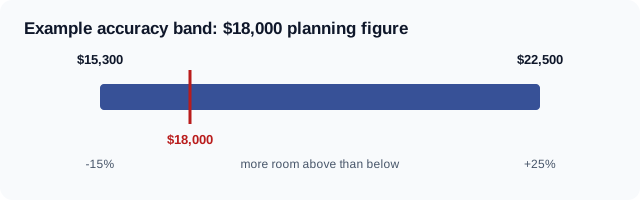
The band in that chart is an example set by the seller for one job. It is not an industry standard. There is no single legal or trade percentage for budgetary quotes, so each seller chooses a band that reflects how much is unknown, and states it.
What does the accuracy band look like?
An accuracy band is the range, written as a minus and a plus percentage around the planning figure, inside which the seller expects the final price to land. For example, a seller who plans on $18,000 and expects the job to land between 15 percent under and 25 percent over states a band of $15,300 to $22,500.
The band is usually lopsided, with more room above the figure than below it. That is because unknowns in a job tend to add work rather than remove it. A symmetrical band can mislead the buyer into thinking the risk is even.
Budgetary quote vs firm quote: what is the difference?
A firm quote is a priced offer for defined work that the buyer can accept, and a budgetary quote is a planning estimate that the buyer cannot accept. The difference shows in six places, set out in the table. For the wider comparison, see quote vs estimate: which is binding and which should you send.
| Point | Budgetary quote | Firm quote |
|---|---|---|
| Purpose | Plan a budget | Win the job |
| Price form | Range or planning figure | One fixed total |
| Scope | Loose, with assumptions | Defined in writing |
| Accuracy | Wide band, stated | Exact for the scope |
| Binding | No, it is not an offer | Yes, if accepted within its validity |
| Typical validity | 30 to 90 days, as a courtesy | A stated date |
The chart below puts the same comparison next to the job's life cycle.
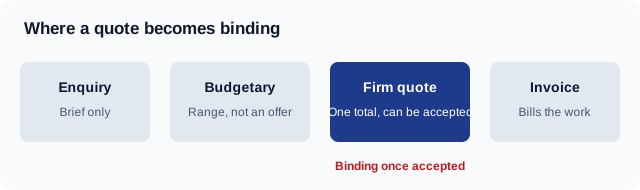
A rough estimate sits one step before a budgetary quote, and an invoice sits after the firm quote. If you need the firm step, the quote template gives the layout, and the estimate template covers the looser document.
Is a budgetary quote legally binding?
A budgetary quote is normally not binding, but only if it is written so that it is not an offer. Under United States contract law, an offer is a promise the other side can accept to form a contract. A figure labelled as a planning range, with no promise to do the work at that price, is not that.
The risk comes from the opposite case. Under UCC section 2-205, an offer by a merchant to buy or sell goods is irrevocable if it is in a signed writing that promises to stay open. The period is the stated time, or a reasonable time if none is stated, and it may not exceed three months. A budgetary quote that reads like a signed promise to hold a price can be caught by that rule if the sale is of goods. The cure is wording, not luck.
Government buyers draw the same line. The Federal Acquisition Regulation says in FAR 15.201 that responses to requests for information are not offers and cannot be accepted by the Government to form a binding contract. A budgetary price given in answer to such a notice is therefore a planning input, not a bid. This post covers goods and services sold by small suppliers, and it does not give advice on any single contract.
What wording keeps a budgetary quote non-binding?
Four things keep a budgetary quote non-binding: a label that says it is budgetary, a range, a list of assumptions and a sentence that it is not an offer. Add an expiry date so the figure does not live forever in someone's budget. Here is wording you can copy.
BUDGETARY QUOTE (not an offer)
Reference: BQ-2026-014        Date: 28 October 2026
Prepared for: Northfield Retail Ltd
Project: Online shop build, up to 40 products

Planning figure: $18,000
Expected range: $15,300 to $22,500

Basis: the brief dated 21 October 2026 and no site visit.
Assumptions: content supplied by the client; one payment
provider; no custom integrations.

This figure is an estimate for budget planning only. It is
not an offer and cannot be accepted. A firm quote will follow
once the scope is agreed in writing. This estimate expires on
27 November 2026.
Three habits make that block work. First, the word "budgetary" sits in the heading, so nobody can claim they thought it was a firm price. Second, the basis line names the information used, which explains the width of the range. Third, the last paragraph tells the buyer what comes next.
Words to avoid in a budgetary quote
Some words turn a planning figure into a promise. Avoid "guaranteed", "fixed price", "we will do the work for", "this price is held until" and "accepted by signing below". Avoid a signature block and an "accept" box too, since those are the signs of a firm quote.
Use "approximately", "expected range", "planning figure" and "subject to a firm quote". Those phrases tell the buyer the figure can move.
How do you build a budgetary quote step by step?
You build a budgetary quote by pricing the known parts, adding allowances for the unknown parts, and turning the total into a range. The steps below follow the order a freelancer or small contractor can work in an hour.
- Write down what you know. List the scope as the buyer described it, the quantities, the location and the date wanted.
- List what you do not know. For example, who supplies the content, what the site access is, and whether any existing work must be removed.
- Price the known parts at your normal rates. Use the same hourly or unit rates you would use in a firm quote.
- Add an allowance for each unknown. Give each unknown a cost and a likelihood, and add the expected amount.
- Set the planning figure. This is the known total plus the allowances.
- Set the band. Choose a minus and a plus percentage that match how much you still do not know.
- Write the assumptions and the expiry date. Then add the non-binding sentence.
Worked example: an online shop build
The example uses US dollars and a freelancer building a small online shop. The known work is 40 product pages, a checkout and one payment provider. The unknowns are content supply, product photography and a possible stock-system link.
| Line | Hours | Rate | Amount |
|---|---|---|---|
| Design and theme set-up | 40 | $100 | $4,000 |
| Product pages (40) | 60 | $100 | $6,000 |
| Checkout and payments | 30 | $100 | $3,000 |
| Testing and launch | 20 | $100 | $2,000 |
| Known work | 150 | $15,000 | |
| Allowance: content and photo edits | 20 | $100 | $2,000 |
| Allowance: possible stock link | 10 | $100 | $1,000 |
| Planning figure | 180 | $18,000 |
The planning figure is $18,000. The seller expects the job to land 15 percent under that figure if the content arrives clean, and 25 percent over it if the stock link and the photo edits both grow. The arithmetic is $18,000 times 0.85, which is $15,300, and $18,000 times 1.25, which is $22,500.
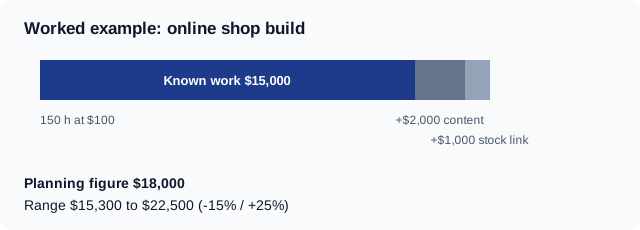
Two weeks later the client sends the product list, the photos and confirms there is no stock link. The seller now writes a firm quote for $16,800 and sets it to stay open for 30 days. The firm quote falls inside the budgetary range, which is the outcome a good band is meant to produce.
What happens if the final price lands outside the range?
If the final price lands outside the stated range, the usual cause is a changed scope, and the fix is to say so before the work, not after. A band is a statement of expected outcome given the assumptions. When an assumption fails, the band no longer applies.
Tell the buyer as soon as you see the failed assumption. Name it, price it and ask for approval in writing. For example, "The stock link you mentioned on 4 November adds about 25 hours, or $2,500. Please confirm you want it included." That one email turns a surprise on the invoice into a decision.
When should you turn a budgetary quote into a firm quote?
Turn a budgetary quote into a firm quote when the buyer has chosen you, the scope is in writing and the main unknowns are gone. Do it before you start work, not after the first week. A firm quote ends the guessing, and it gives the buyer a document they can accept. Once the buyer accepts, convert the quote to an invoice without retyping any line.
A short test helps. If you can list every deliverable and every exclusion, you can write a firm quote. If you cannot, stay budgetary and say what is missing. The quote generator turns the scope into a firm quote once you know it, and the estimate generator is the right tool while it is still rough.
Common mistakes with budgetary quotes
Most problems with budgetary quotes come from the buyer or seller treating a range as a price. The mistakes below cost the most.
- Giving a single number with no range. A lone figure reads as a price. A range reads as an estimate.
- Leaving out the assumptions. Without them, the band has no meaning and cannot be defended.
- Omitting the expiry date. A budgetary figure from last year ends up in this year's budget.
- Adding a signature box. A place to sign invites acceptance and turns the document into an offer.
- Quoting a band that is too narrow. A band of five percent on a vague brief is a promise you cannot keep.
- Skipping the follow-up. The budgetary quote is step one. Send the firm quote promptly once the scope is known.
Budgetary quote checklist
Check these before you send a budgetary quote.
- Does the heading say "budgetary quote"?
- Is there a range as well as a planning figure?
- Are the assumptions listed, with the date of the brief?
- Does one sentence say it is not an offer and cannot be accepted?
- Is there an expiry date?
- Are the signature and "accept" lines removed?
- Does the arithmetic add up when you check it by hand?
Invoqk can draft the firm version for you: describe the job and the quote generator produces a priced quote you can send.
Frequently asked questions
What does budgetary quote mean in business?
A budgetary quote is a non-binding price range given early so a buyer can plan a budget. It is based on limited information and is not an offer the buyer can accept. It usually carries a stated range, assumptions and an expiry date.
What is the difference between a budgetary quote and a firm quote?
A budgetary quote is a planning estimate with a wide range, while a firm quote is a priced offer for defined work with one total. The buyer can accept a firm quote. The buyer cannot accept a budgetary quote because it is not an offer.
Is a budgetary quotation binding?
Normally it is not, if it is labelled budgetary, shows a range and states that it is not an offer. In the United States, a signed merchant promise to hold a goods price can bind for up to three months under UCC section 2-205, so avoid promise wording.
How accurate should a budgetary quote be?
There is no fixed legal standard, so the seller chooses a band that matches the unknowns and states it. A common approach is a lopsided band, such as 15 percent under and 25 percent over a planning figure, because unknowns usually add cost.
How long is a budgetary quote valid?
Set your own expiry date, commonly 30 to 90 days, and write it on the document. A date stops an old planning figure being treated as a current price. After it passes, update the figure before anyone relies on it.
Should I charge for a budgetary quote?
Most sellers give a budgetary quote free, because it takes little time and helps win the job. If the buyer wants a detailed pre quotation that needs a survey or design work, say so first and offer to credit the fee against the final price.
Comments
0No comments yet
Be the first to share your thoughts on this article.
Leave a comment
Your email is never published. Comments appear after approval.