

- A quote is a fixed-price offer that binds you until it expires, while an estimate is an approximate price that can change with actual cost.
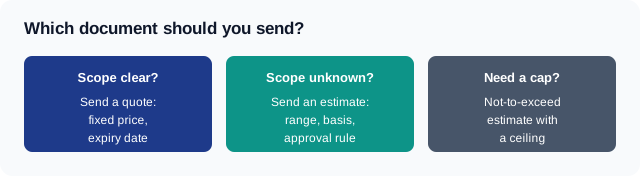
- Send a quote when the scope is clear and your costs are stable, an estimate when hidden work could change the price, and a not-to-exceed estimate when the client needs a ceiling.
- An estimate becomes safe to rely on only when it says it is approximate, names what the price is based on and promises to ask before going over.
Quote vs estimate: which is binding and which should you send?
A quote is a fixed-price offer for defined work, and it binds the sender until it expires. An estimate is an approximate price based on what is known today, and it can change as the real cost appears. The two documents look alike, and the difference between them is a legal and commercial one, not a design one.
The practical question is which one to send. Therefore, send a quote when you can stand behind the number. Send an estimate when you cannot. Send a third option, a not-to-exceed estimate, when the client needs a ceiling and you need room to move beneath it.
This guide gives a decision rule by job type, shows one fence job priced three ways and explains what the USA, the UK and Germany say about each document. It ends with wording that makes an estimate quote safe to send.
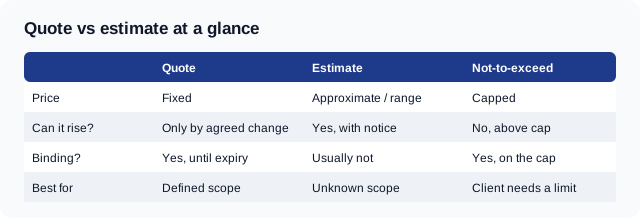
What is the difference between a quote and an estimate?
A quote promises a price. An estimate predicts one. If the final cost differs, the quote holds and the estimate moves.
| Feature | Quote | Estimate | Not-to-exceed estimate |
|---|---|---|---|
| Price | Fixed | Approximate or a range | Capped at a stated ceiling |
| Can it rise? | Only through an agreed change | Yes, with notice | No, not above the cap |
| Binding? | Yes, until it expires | Usually not | Yes, on the cap |
| Best for | Clear scope, stable costs | Unknown scope, hidden work | Unknown scope, client needs a limit |
| Risk sits with | The seller | The client | Shared |
Many people say "estimated quote" or "estimate quotation" as if they were one thing. They are not. For example, a document headed "Quote" with a total price is an offer. A document headed "Estimate" with a range is a forecast. The heading, the number and the caveats all carry weight, so they should agree.
Is an estimate or a quote legally binding?
A quote can bind you, and an estimate usually does not, but the wording and the country decide. Three sources show the pattern.
United States: firm offers and state rules
The US has no single rule for all quotes. For goods, UCC section 2-205 makes a merchant's signed written offer that promises to stay open irrevocable for the stated time, and never for longer than three months, according to the Uniform Commercial Code. A signed quote with a "valid until" date fits that rule.
For services, state contract law applies. Some trades face stricter rules. California's regulation on auto repair, 16 CCR section 3354, requires a revised estimate and the customer's authorization before charges exceed the original authorized price, according to the state's Bureau of Automotive Repair.
United Kingdom: what you write becomes the contract
In the UK, section 50 of the Consumer Rights Act 2015 treats things a trader said or wrote about a service as part of the contract with a consumer. Section 51 says that if the contract does not fix a price or say how to work it out, the consumer pays a reasonable price, according to legislation.gov.uk.
The effect is simple. A quote that fixes a price becomes the price. An estimate that clearly says "approximate" leaves the final figure to be reasonable. This covers consumer work only. Between two businesses, the signed terms apply.
Germany: Angebot and Kostenanschlag
German law has a word for each. An Angebot, or offer, binds the sender under section 145 of the German Civil Code (BGB) unless the sender has excluded being bound. The wording "freibleibend" is the usual way to do that.
A Kostenanschlag is the estimate. Under section 649 BGB, where the contractor did not guarantee ("Gewähr") the figure, an expected substantial overrun must be reported to the customer without delay. The statute text sets no percentage for "substantial".
Across all three systems the lesson is the same. Say clearly which document you are sending, and say it on the document.
How do you choose between a quote and an estimate?
You choose by asking two questions: how well is the scope known, and how stable are your costs? A clear scope with stable costs earns a quote. Anything else earns an estimate.
Use this decision rule:
- Can you list every task and quantity today? If yes, go to question 2. If no, send an estimate.
- Will your costs hold for the length of the quote? If yes, send a quote. If prices could move, send a quote with a short expiry, or an estimate.
- Does the client insist on a ceiling? If yes, and the scope is still uncertain, send a not-to-exceed estimate.
Which document suits which job?
| Job type | Send | Why |
|---|---|---|
| Logo design, fixed deliverables | Quote | Scope is a list |
| Printing a stated quantity | Quote | Materials and quantity are known |
| Bathroom or kitchen renovation | Estimate | Hidden work behind walls and floors |
| Auto body or engine repair | Estimate, then revised estimate | Damage shows up on teardown |
| Ongoing consulting by the hour | Estimate | Hours depend on the client |
| Fixed-scope website build | Quote | Pages and features are listed |
| Roof repair after a storm | Not-to-exceed estimate | Scope unknown, client needs a cap |
The same split runs through two Invoqk guides. Construction quote template: what to include, with an example covers the fixed-price side. Auto body repair estimate template: what to include, with an example covers the forecast side.
One job, three documents: a fence worked example
A fence contractor measures a yard. The fence is 120 feet at $42 per foot, which is $5,040. Two gates at $280 each add $560, and removing the old fence adds $600. The total is $6,200.
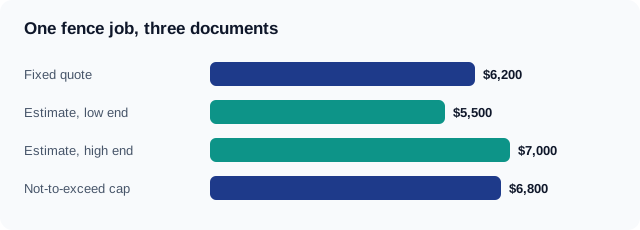
Here is the same job on three documents.
As a quote. Total: $6,200, valid until a stated date. If the old posts turn out to be set in concrete, the contractor absorbs the extra work unless the client signs a change.
As an estimate. Total: $5,500 to $7,000. The low end assumes the old fence comes out easily. The high end assumes some posts are set in concrete. The contractor bills actual hours and materials, and asks before going past $7,000.
As a not-to-exceed estimate. Expected total: $6,200. The invoice will not exceed $6,800 without the client's written approval. The client gets a ceiling. The contractor gets $600 of room.
For instance, the numbers matter less than the structure. Every version states what the price is based on, so the client can see why it could move.
What wording makes an estimate non-binding?
An estimate is non-binding when it says so plainly, ties the price to actual cost and promises to ask before exceeding it. A heading alone is not enough.
Use this block:
This is an estimate, not a fixed price. The final amount will be based on actual labor and materials. If we expect the total to exceed the high figure shown, we will tell you the new amount and ask for your approval before continuing. This estimate is valid until [date].
For a German-style offer that you do not want to be bound by, use:
This offer is subject to change (freibleibend) until it is confirmed in writing by [business name].
Three parts do the work: "not a fixed price", "actual labor and materials" and "ask for your approval". Remove any one and the document starts to read like a quote.
Wording that makes a quote binding on both sides
A quote needs the opposite treatment. Name the price, the scope and the date:
We offer to complete the work described above for [amount], valid until [date]. Changes to the scope will be priced and agreed in writing before work starts.
That clause protects you as well. A client who adds a gate halfway through has asked for a change, and the quote says changes cost money.
Can you turn an estimate into a quote later?
Yes, and it is often the best path. Send an estimate to win the conversation, then send a quote once the scope is confirmed. A budgetary quote fits in between when the client needs a rough number early. For example, a site visit, a measurement or a teardown usually turns an unknown into a number.
The sequence looks like this:
- Estimate with a range and the assumptions behind it.
- Inspection or measurement that removes the main unknown.
- Quote at a fixed price with an expiry date.
- Invoice that matches the quote, plus any signed changes (see how to convert an accepted quote into an invoice).
In practice, each step narrows the price. The client sees the range shrink, which builds trust. The guide Estimate maker: how to write a job estimate clients accept covers step one in detail, and Invoqk's free quote maker covers step three.
What happens when the real cost lands between the numbers?
The real cost rarely matches the document exactly, so decide in advance what each document does with the difference. The fence job shows it.
Suppose the contractor finds four posts set in concrete. Removal now costs $900 instead of $600, so the true total is $6,500.
| Document | What the contractor can bill | What the contractor must do |
|---|---|---|
| Quote at $6,200 | $6,200, unless the client signs a change | Absorb the $300, or ask for a written change first |
| Estimate of $5,500 to $7,000 | $6,500, which is inside the range | Show the extra removal on the invoice |
| Not-to-exceed at $6,800 | $6,500, which is under the cap | Nothing extra: the cap was never reached |
The estimate and the cap both absorb the surprise. However, the quote does not. That is the trade the contractor makes for giving the client a firm number, and it is why a quote on uncertain work should carry a margin or a change clause.
How do you ask the client to approve a change?
Ask in writing, give the new figure and make the answer a single word. The same message works for a quote with a change order and an estimate heading past its range:
We found four posts set in concrete. Removing them adds $300 to the job. The new total is $6,500, up from $6,200. Reply YES to approve and we will continue.
Save the reply. Its date goes on the invoice next to the added line: "Post removal, approved by email on April 14, 2026."
How do taxes show up on a quote and an estimate?
Taxes follow the same rule as the price: a quote states the tax it will charge, and an estimate states the tax it expects to charge. The amount of tax moves only when the price moves.
On the fence quote of $6,200, a state sales tax of 6% on the whole job would add $372, for a total of $6,572. Whether sales tax applies to the job at all depends on the state, so state your own rule on the document. In the UK and Germany, show the net price, the VAT rate and the gross total as separate lines. Tax authorities expect that split on the final invoice, and clients expect to see it earlier.
Never leave tax out silently. A quote of $6,200 that turns into $6,572 on the invoice has the same effect as an overrun, even though your price did not change. Write "plus applicable tax" next to the total if you cannot calculate it yet.
Common mistakes when you pick the document
These are the errors that lead to disputes:
- Calling a fixed price an estimate. The client reads it as a promise anyway.
- Calling a range a quote. A range is a forecast. The word "quote" makes it a price.
- No assumptions. "$5,500 to $7,000" with no reason looks like guesswork.
- No expiry date. Either document gets used months later at the old price.
- Silent overruns. An estimate that rises without notice breaks the trust it was built on.
- Mixing the two on one page. A total with the word "approximately" in the footer is neither one thing nor the other.
The fixes are cheap. Pick a heading, match the wording to it and put the expiry date next to the total.
A pre-send checklist for either document
Before you send:
- The heading says Quote, Estimate or Not-to-exceed Estimate, and the wording agrees.
- The scope is a list of tasks, not a paragraph.
- Quantities and unit prices are shown, so the client can follow the total.
- The assumptions behind the price are written down.
- The expiry date is spelled out, for example, "valid until April 2, 2026".
- The approval rule for overruns is stated.
- Taxes are shown or clearly excluded.
- The document has a unique number.
Invoqk's estimate template and quote template pages both follow this order.
Frequently asked questions
Is a quote the same as an estimate?
No. A quote is a fixed-price offer that binds the sender until it expires. An estimate is an approximate price that can change with actual cost. People use the words loosely, so state which one you mean on the document.
Can a contractor charge more than an estimate?
Yes, if the extra cost is real and the client was told first. An estimate is a forecast. Some places add rules: California requires a revised estimate and authorization for auto repair charges above the original price.
Is an estimate legally binding?
Usually not on the price. It can still shape the contract: in the UK, section 50 of the Consumer Rights Act 2015 treats written statements about a service as contract terms. In Germany, section 649 BGB requires prompt notice of a substantial overrun.
What is a not-to-exceed estimate?
A not-to-exceed estimate gives an expected price and a ceiling the final bill cannot pass without the client's written approval. It suits jobs where scope is uncertain but the client needs a limit. The ceiling binds the contractor.
Should I send a quote or an estimate first?
Send a quote if you can list every task and your costs are stable. Send an estimate if hidden work could change the price. When in doubt, send an estimate with assumptions, then a quote once the unknowns are resolved.
Comments
0No comments yet
Be the first to share your thoughts on this article.
Leave a comment
Your email is never published. Comments appear after approval.